About Ring the Changes
Ringers in a church tower never play a tune: they ring the bells in changing orders, and each change may only swap neighbouring bells. Here you conduct the band.
Every board shows a few music rows to reach. Plan an order that rings each of them once, never sounds any row twice, and comes back to rounds within the change limit. Par is the proved fewest changes, and a board's order of visits decides how close you get.
How to play
- Goal
- Ring every music row on the board's cards, then bring the bells back to rounds.
- How it ends
- The touch ends when you ring rounds again within the change limit. You cannot lose: Undo takes back a change.
- Record
- Each board has two records, the best time of a first finish and the fewest changes, each with its holder. Par is the proved fewest.
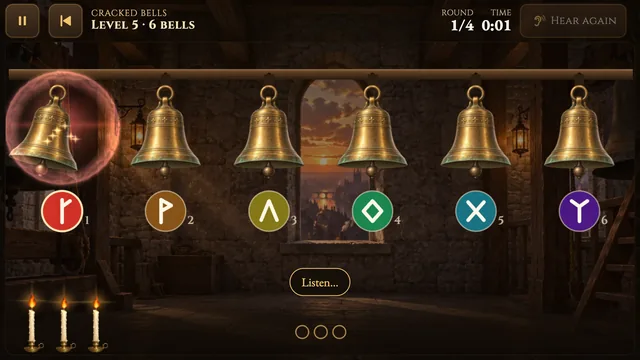
- The bells start in rounds: 1 2 3 4…, from the treble (1, the highest) to the tenor (the lowest).
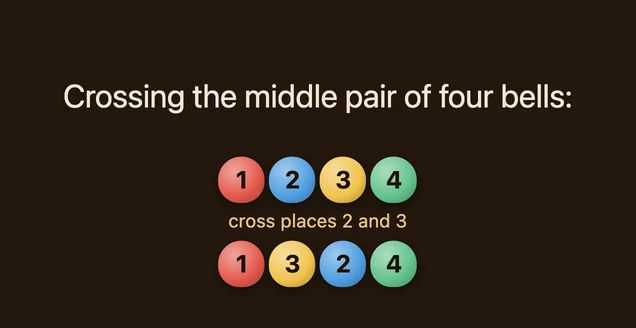
- A change crosses one or more pairs of neighbouring bells. Pairs may not share a bell, so each bell moves at most one place.
- Tap the gap between two bells to cross them. The row below shows what will sound; Ring sounds it and writes it on the sheet.
- The touch must be true: no row may be rung twice. Rounds may come again only as the last row.
- Ring each music row on the cards at least once, in any order. Each card says how many changes away it is; tap it to see it under the bells.
- Some towers add a rule shown above the bells: a learner treble that moves on its own, or tenors behind, where the two lowest bells never end a row swapped.
- Undo takes back a change. Start again returns the board to rounds and keeps the clock running.
Controls
| Input | Action |
|---|---|
| Tap / click a gap, then Ring | Cross that pair and ring the new row |
| Tap / click a music card | Show that row under the bells |
| ← / → | Choose a pair |
| Space | Cross or uncross the chosen pair |
| Enter | Ring |
| X | Cross every pair |
| U or Backspace | Undo |
| R | Start again |
| Escape | Board menu or close a panel |
| Gamepad D-pad / A | Choose a pair or button / cross or press it |
| Gamepad X | Ring |
| Gamepad B | Undo, or go back |
| Gamepad Y / Start | Rules / board menu |
Tips
- Plan the order of the cards Rows close to each other belong next to each other in the touch. The order of visits, not each single step, decides how near par you finish.
- Watch the distances Each card counts the changes from the current row. A card whose count drops as you ring is on your way; one that rises can wait.
- Mind the truth A short way back can be blocked by a row you already rang. Leave yourself a different route home before the last card.
Good to know
Progress saves in this browser when storage is available. Only the time of your first finish on a board is ranked, and only for an attempt begun on this visit; fewest changes can be improved on every replay. If this browser cannot save, finishes are not sent for the records. Settings turn the bells off, hide the clock or calm the screen. No account is needed.
Watch how to play
Questions
Why can a bell move only one place?
Real tower bells swing a full circle between strikes and can only shift one place in the order each time, so ringers change the order by crossing neighbours.
Does Undo cost anything?
No. Undo is free and is not a hint; only the rows on the sheet when you finish count.
What does par mean?
Par is the fewest changes any true touch needs for that board, proved by a solver. You can finish above par within the change limit.