How to play
- Goal
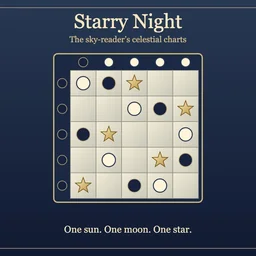
- Place one sun, moon and star in every row and column, with no identical symbols touching diagonally, and satisfy each edge distance clue.
- How it ends
- A chart finishes when every row, column, diagonal restriction and printed distance clue fits; Undo and optional empty notes allow corrections.
- Record
- Your first unassisted finish keeps your time for that chart; later plays are practice.
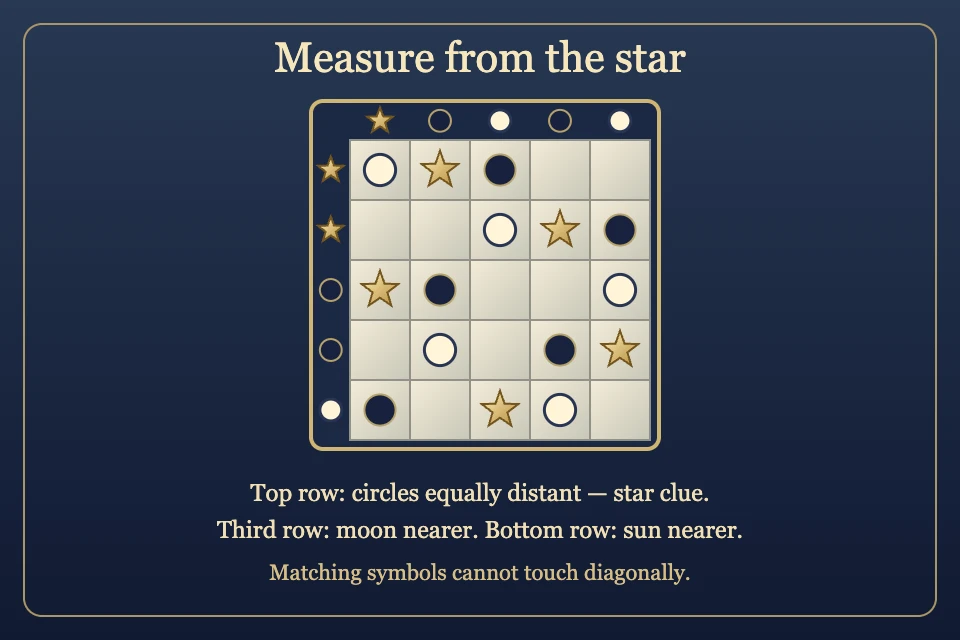
- Place exactly one Sun, Moon and Star in every row and every column. Sun is a white circle, Moon a black circle and Star a pointed star. Remaining cells stay empty.
- Identical symbols must not touch diagonally. Different symbols may touch; there is no general separation rule for all three kinds.
- Measure along a row or column from its Star. A Sun edge clue means the Sun is strictly nearer than the Moon; a Moon clue means the Moon is strictly nearer. Nearer does not mean adjacent.
- A Star edge clue means the Sun and Moon are equally distant from the Star. A missing clue adds no distance comparison.
- Choose Sun, Moon, Star, Empty or Erase, then tap cells or paint a stroke. Tap an edge clue to inspect its whole line while retaining the brush and selected cell. Empty notes are optional.
- Release commits a stroke as one Undo step. Escape, resize, pointer loss or a second finger cancels an unfinished stroke. Restart keeps the original clock; reload retains marks and Undo, and a resumed finish stays local.
Controls
| Mouse / touch | Choose a brush and tap or paint cells; tap an edge clue to inspect its line |
|---|---|
| Arrows + Enter / Space | Move the cursor and apply the brush |
| 1 / 2 / 3 / 4 / 5 | Choose Sun / Moon / Star / Empty / Erase |
| Delete / Backspace | Erase the selected cell |
| Z / Y | Undo / Redo |
| R / Restart | Confirm clearing marks while keeping the first clock running |
| Escape | Cancel a stroke, close a dialog or return to the atlas |
| Controller | D-pad moves; A marks; X changes brush; Y erases; shoulders Undo/Redo; B cancels/back; Start settings; Back rules |
Tips for Starry Night
- Start with equal distances A Star edge clue places the Star between the two circles, at equal step distances.
- Compare crossing lines A symbol must satisfy both its row and column, as well as matching-symbol diagonals.
- Use notes and Undo Empty notes can record exclusions, and Undo retracts an entire painted stroke.
Questions about this game
Are distances measured from the edge?
No. Compare each circle’s distance from the Star within that line.
Can different symbols touch?
Yes. Only identical symbols are forbidden from touching diagonally.
Must every cell have a symbol?
No. Each row and column has just one Sun, one Moon and one Star. Empty notes are optional.
What does a missing edge clue mean?
There is no distance comparison on that line; the row/column counts and diagonal rule still apply.
Can replay improve my first time?
No. The first saved finish stays unchanged; replay is practice.
All charts are open. Reload retains an unfinished first attempt, Undo and its original clock; resumed finishes stay local. Practice reopens fresh and preserves your first time.
Watch how to play
About Starry Night
Arrange three celestial symbols in the observatory’s charts. The printed edge symbol compares the circles’ distances from the star.
All 160 original charts are open across four shelves: five 5×5 and 155 6×6. Each has one answer and a complete bounded deduction proof. The sparse opening is a challenging logic puzzle.
Your first finish keeps its time for that chart. An uninterrupted verified first solve can claim the named fastest time; later plays are untimed practice.