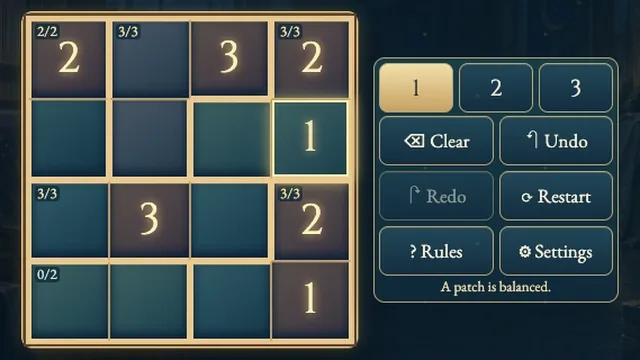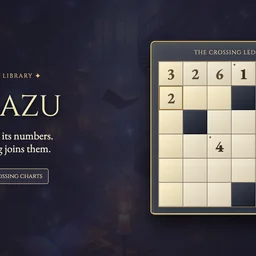
How to play
- Goal
- Fill every white cell so each horizontal and vertical run of two or more cells contains one through its length exactly once.
- How it ends
- The chart is won when every white cell is filled, all fixed numbers are retained, and every run satisfies its number set; one-cell runs impose no restriction, and Undo repairs entries.
- Record
- Your first unassisted solve of each chart is kept in this browser; verified solves under twenty-four hours compete for fastest-time records. Replays are practice.
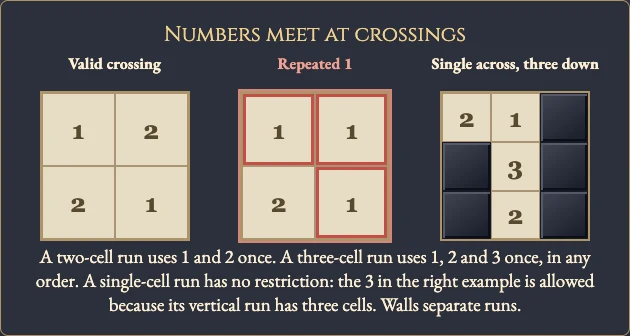
- Fill every white cell. Each uninterrupted horizontal or vertical run of two or more cells contains 1 through its length once, in any order. Walls and board edges end a run.
- For example, a two-cell run uses 1 and 2; a three-cell run uses 1, 2 and 3. At a crossing, the number must fit both runs. A single-cell run imposes no restriction of its own.
- Fixed numbers and walls stay fixed. Select a white cell, then choose a number. Notes adds optional pencil marks; every white cell still needs a final number to finish.
- Undo repairs entries. Restart clears your entries after confirmation and keeps the original first clock running.
Controls
| Tap a cell; number rail | Select a white cell, then enter a number |
|---|---|
| Arrows; 1–6 | Move through white cells; enter a number |
| Notes / N; Shift + digit | Toggle pencil mode; add or remove a pencil note |
| Delete / Backspace | Erase the selected editable cell |
| Z / Y; Undo / Redo | Withdraw or restore entries and notes |
| Enter / Space | Move from a selected cell to the number rail |
| Escape | Cancel a held tap, close a dialog or return to the atlas |
| Controller | D-pad moves; A opens the rail or confirms; B returns; X Notes; Y Erase; shoulders Undo/Redo; Start tools; Back rules |
Tips for Yakazu
- Count the run Stop at each wall or edge; the length determines the complete number set.
- Compare crossings A cell in a two-cell horizontal run cannot be 3, even if its vertical run is longer.
- Remember singles A one-cell run does not force 1. Its crossing run supplies any restriction.
Questions about this game
Does a single-cell run force 1?
No. Runs of one cell impose no restriction of their own.
Must numbers be in ascending order?
No. A run contains its complete set in any order.
Can a number repeat in a row across a wall?
Yes. Walls split a row or column into separate runs.
Do pencil notes count as final numbers?
No. Pencil notes are optional reminders; every white cell needs a final number.
Can replay improve my first time?
No. Your first completed time is retained; replay is untimed practice.
All charts are open. Progress saves in this browser; a reloaded attempt finishes locally on its original clock.
Watch how to play
About Yakazu
Restore crossing number charts in a lamplit library. Every horizontal and vertical run has its own complete set of numbers, and a crossing must satisfy both.
All 160 original charts are open, from four by four to six by six. Each chart has one independently verified solution and a deduction proof from its fixed numbers.
Your first completed time stays with each chart. An uninterrupted verified first solve under twenty-four hours on the game page can claim the named best; replay is untimed practice.