How to play
- Goal
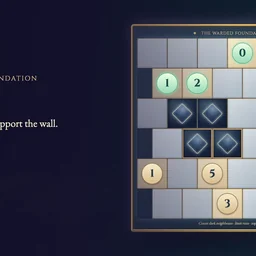
- Shade bricks so each number counts its dark neighbours, no row holds three consecutive dark bricks, and every dark brick above the base rests on dark support.
- How it ends
- A chart is solved when every clue and both wall rules hold; there is no loss state.
- Record
- The fastest first solve of each chart is kept as a public record, with its holder's name.
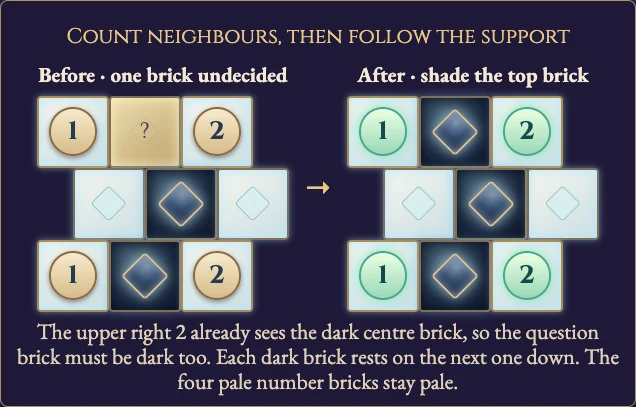
- Shade bricks until every printed number counts its touching dark bricks. Numbers stay pale. A brick touches its left and right neighbours and up to two bricks in each staggered row above and below.
- The worked picture shows a numbered 2 already seeing one dark brick. Shading the top middle brick makes the count exact, and the dark bricks underneath support one another. No row can hold three consecutive dark bricks; every dark brick above the base needs at least one dark brick below. Separate dark groups are allowed.
- Tap a free brick to cycle dark, pale note and clear. Pale notes are optional; only the dark pattern is needed. Undo reverses a mark; Restart clears marks without resetting the clock. Returning through the atlas keeps an unfinished first-solve clock, while reloading makes that finish local only. Public records accept times up to 24 hours.
Controls
| Tap / click a brick | Cycle dark, pale note and clear |
|---|---|
| Arrow keys | Move focus around the wall |
| Enter / Space | Cycle the focused brick |
| B / W / Backspace | Shade, mark pale or clear the focused brick |
| Undo / Z | Restore the previous mark |
| Restart | Clear marks without resetting the first clock |
| Escape | Close a panel or return to the atlas |
All 160 fixed charts have one independently verified answer and a separate bounded deduction trace. Removing the horizontal run rule makes 54 charts ambiguous; removing support makes 159 ambiguous. Private witnesses stay in build inputs and do not ship. Saves use morass.tawa.v1; sound follows the shared arcade setting. No ads or analytics run inside the game.
Watch how to play
About Tawa
Lay dark lapis bricks into the pale stone courses of a warded keep. Each row is offset, so a numbered brick touches up to six neighbours.
All 160 original charts have one independently proved pattern. A separate local deduction trace completes each without guessing.
Your first finish time stays in this browser. An uninterrupted first solve can take the named public best for its chart.