How to play
- Goal
- Fill each outlined region with 1 through its size, once each, while equal digits never touch, even diagonally.
- How it ends
- The chamber lights when every cell is filled and both rules hold; there is no loss.
- Record
- Your first solve time is kept for each chart, and the fastest verified first solve appears with its holder.
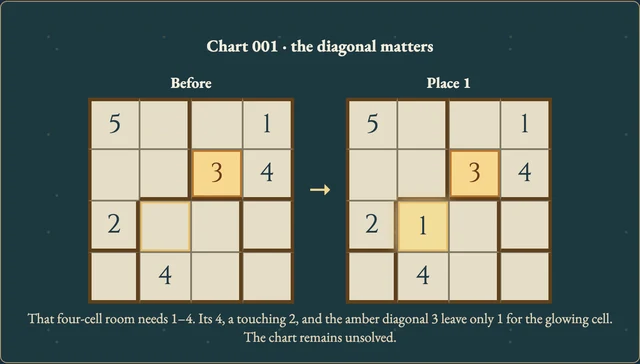
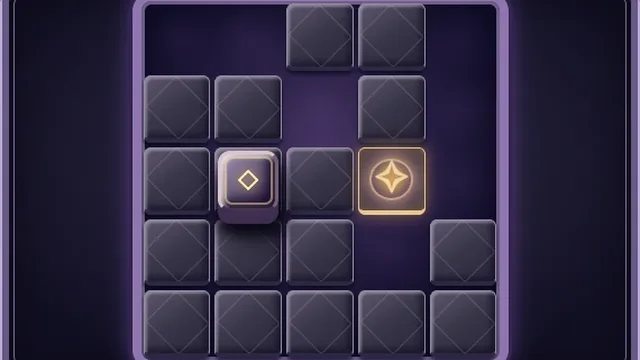
- A thick brass seam outlines a region. A region of N cells must hold 1 through N once each; a one-cell region must be 1. Equal digits cannot touch by an edge or a corner, including across a seam. Rows and columns have no extra rule. The worked picture shows Chart 001: its four-cell region needs 1–4. Its 4, a touching 2 and a diagonally touching 3 leave only 1 for the glowing square.
- Select a square, then choose 1–5 on the number rail or Erase. Erase removes a digit, or clears notes when the square is already empty. The rail disables numbers above the selected region’s size. Notes switches the rail and number keys to pencil entries; a note hidden by a placed digit returns if that digit is cleared. Red cells break a region or touching rule. A complete region glows.
- Fill every cell so both rules hold to light the chamber; there is no loss. Undo and Redo fix slips. Restart clears entries while the first-solve clock keeps running. A first clear can rank once; later clears are untimed practice.
Controls
| Tap / click a square | Select it; fixed clues can be inspected but cannot change |
|---|---|
| Number rail / Erase | Enter a digit; Erase removes it, then clears notes from an empty square |
| Notes / N | Toggle pencil entry for the number rail and number keys |
| Arrow keys | Move through the grid |
| 1–5 / Shift+1–5 | Enter a digit, or pencil when Notes is on; Shift always pencils |
| 0 / Backspace / Delete | Erase the selected square; on an empty square, clear its notes |
| Undo / Z; Redo / Y | Step backward or forward through edits |
| Restart / R | Clear entries without resetting the first-solve clock |
| Escape | Close a panel or return to the charts |
| Gamepad | D-pad moves; A/X cycle digits, Y erases, LB/RB undo/redo; Start opens the rail for pencil notes |
Tips for Suguru
- Check single-cell regions Their only possible number is 1.
- Read across seams Equal digits repel across region boundaries and diagonally too.
- Keep useful notes Pencil entries hide when ruled out by placed digits and return after an undo.
All 160 fixed charts have distinct region layouts, one exact answer and an independently checked no-guess deduction trace. Private witnesses never ship. Progress uses morass.suguru.v1. Only the first clear can rank; replays are practice. Sound follows the shared arcade settings. No ads or analytics run inside the game.
Watch how to play
About Suguru
In the Moonlit Observatory, brass seams divide an ivory grid into irregular rune chambers. Restore the numbers in every chamber while keeping matching runes apart, even at a corner.
All 160 charts are open from the start, from compact five-by-five seals to seven-by-seven observatory plans. Every chart has one independently proved answer and a direct deduction path that needs no guess.
Your first solve time stays with its chart. An uninterrupted first clear on the game page can claim the named best shown on the chart card and beside the clock.