How to play
- Goal
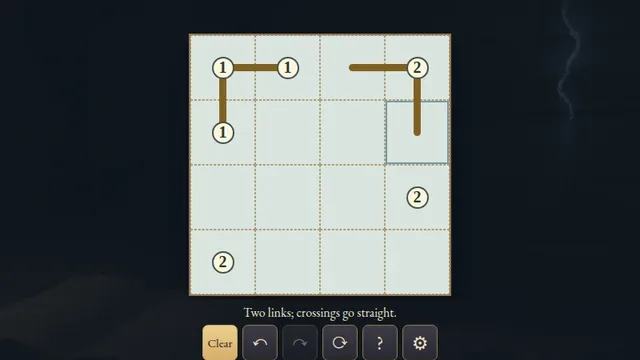
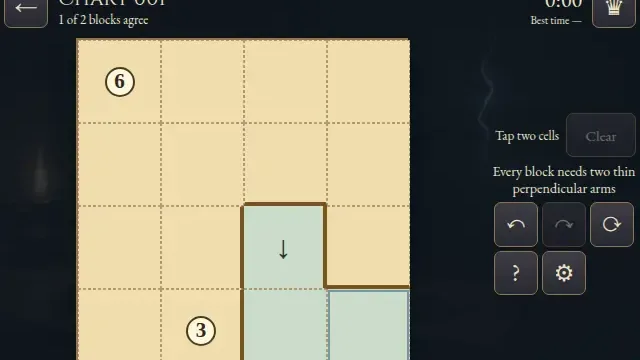
- Divide the whole grid into one-cell-wide L-shaped blocks, counting each number along its arm to the bend, including both cells. Each block has at most two numbered cells.
- How it ends
- The chart finishes when every block and clue obeys the rules; borders can be changed before completion, so there is no loss state.
- Record
- Your first unaided solve time is recorded for each chart; Replay is Practice.
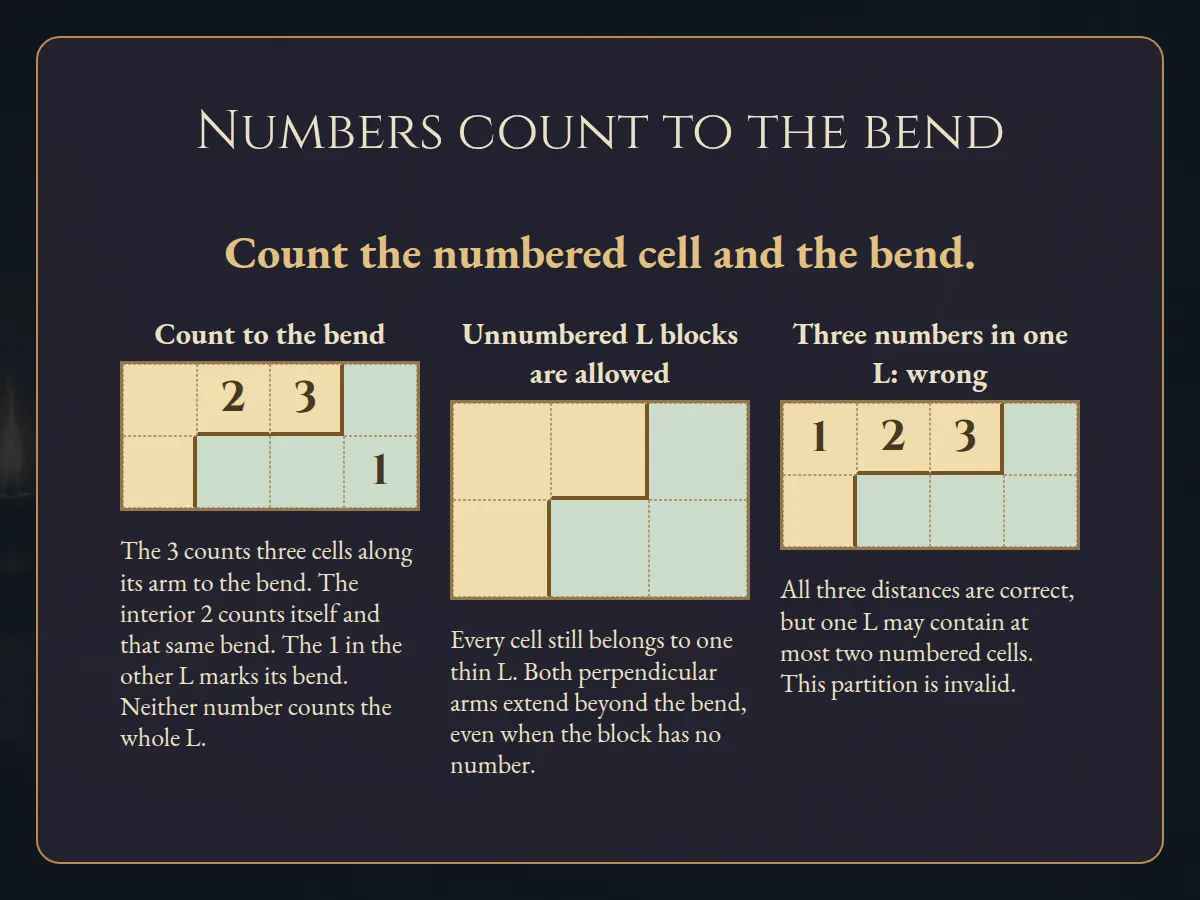
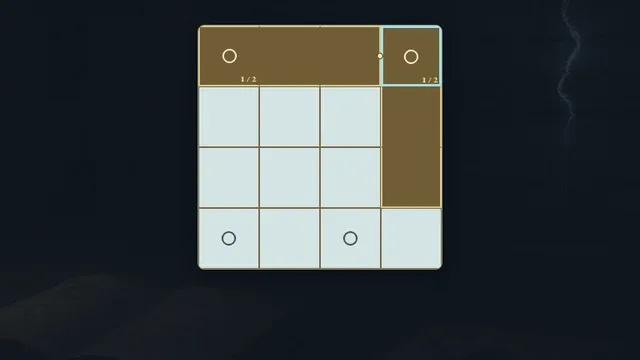
- Divide all squares into L-shaped blocks. Every L has two one-cell-wide perpendicular arms extending from a single bend; straight strips, thick corners, branches and gaps are forbidden.
- A number counts squares along its own arm from itself to the bend, including its own square and the bend. One is at the bend; two is one step away. A clue may lie inside an arm.
- Each L may contain zero, one or two numbers. Three numbers are forbidden even when their distances fit. Numbers do not give the total area.
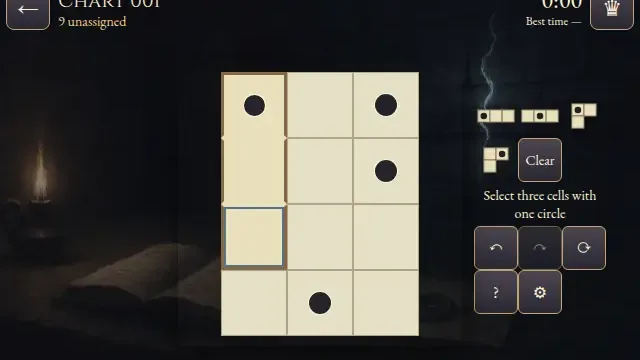
- Tap a cell and an orthogonal neighbour to toggle their shared wall. The outer frame is already a wall. Internal walls must separate different blocks.
- Use Undo or tap the same pair again to repair a wall. Rules inspect the selected block. Restart keeps the original first-solve clock.
Controls
| Mouse / touch | Tap two neighbouring cells to toggle their shared wall |
|---|---|
| Arrows / Space or Enter | Move the cursor / select or complete a neighbouring pair |
| Delete / Escape | Clear selection / clear or return |
| Z / Y / R | Undo / Redo / Restart confirmation |
| Controller | D-pad moves; A selects; X clears; Y undoes; shoulders undo/redo; B clears then returns; Start opens settings. |
Tips for Sashikazune
- Count inclusively A two is one step from the bend. Count the numbered square itself.
- Keep room for every square A possible elbow is impossible if it leaves another square without any disjoint legal L.
- Limit numbered cells Every L has at most two numbered squares.
- Allow blank elbows Some blocks have no number at all.
Questions about this game
Does a number give the block’s area?
No. It gives only the inclusive distance from its square to the bend.
Must a number be at an endpoint?
No. A numbered square can be inside an arm.
Can an L have no numbers?
Yes. Zero, one or two numbered squares are allowed.
Can a straight strip count as an L?
No. Both perpendicular arms must extend beyond the bend.
Can Replay replace my first time?
No. Replay is Practice and retains your first result.
This edition follows the corrected two-number limit and inclusive bend distances. All charts and examples were made for this edition; no published boards were copied. Reload keeps walls and Undo; resumed first solves stay local.
Watch how to play
About Sashikazune
Measure a floor of thin elbows. Every number describes its own distance to the bend, rather than the area of its block.
All 96 original charts are open: twelve 4×4, twenty-four 5×5 and sixty 6×6. Each has exactly one independently verified partition.