How a journey works, as the game counts it. The Start page has the menus into it.
Controls
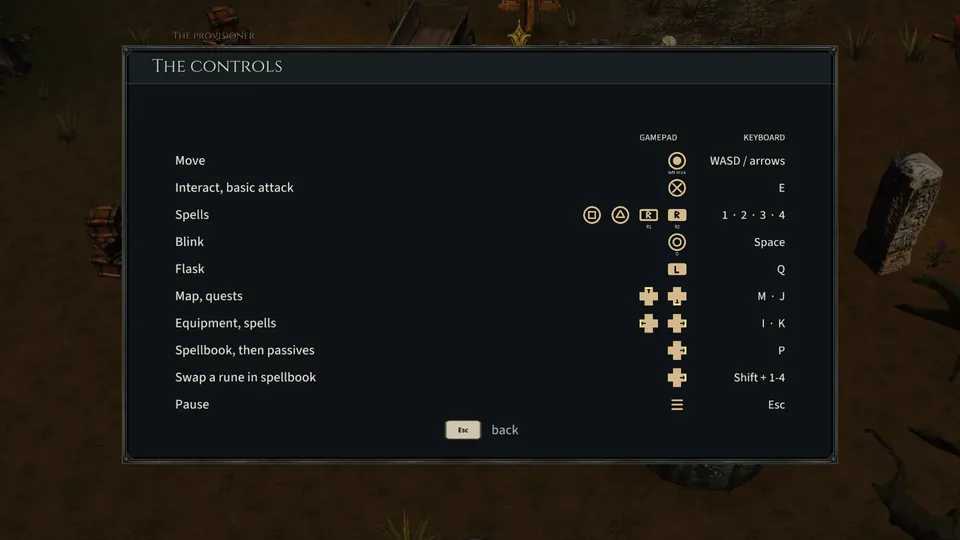
Morrowvane is built for a controller and plays fully on keyboard and mouse. The pad column names button positions with the PlayStation and Xbox labels; a Nintendo pad keeps the same positions under its own letters. Prompts follow the device you touched last.
| Action | Pad | Keyboard and mouse |
|---|---|---|
| Move | Left stick | WASD or the arrows; hold the left button on the ground to walk to the pointer |
| Interact, basic attack | South: Cross / A | E; click an enemy, board, letter or counter to walk to it and use it |
| Spell slot 1 | West: Square / X | 1 |
| Spell slot 2 | North: Triangle / Y | 2 |
| Spell slot 3 | Right shoulder: R1 / RB | 3 |
| Spell slot 4 | Right trigger: R2 / RT | 4 |
| Place a ground spell | Right stick, up to half the spell's reach | Lands at the pointer |
| Blink | East: Circle / B | Space |
| Flask | Left trigger: L2 / LT | Q |
| Map | D-pad up | M |
| Journal | D-pad down | J |
| Wardrobe (equipment) | D-pad left | I, C or Tab |
| Spellbook | D-pad right | K |
| Passives | Spellbook, then a shoulder to turn the tab | P |
| Cycle a slot's rune | In the spellbook | Shift + 1–4, also in play out of a fight |
| Pause | Options / Menu | Esc |
| Menus: confirm, back | South, East | Enter, Esc |
| Menus: page | Shoulders: L1 / R1, LB / RB | Q / E, PgUp / PgDn |
| Quick save, quick load | Pause menu | F5, F9 |
Spells aim along the way you face; ground spells are placed with the right stick or at the pointer. The left shoulder does nothing in play. Keys cannot be rebound; Calibrate Controller in Settings re-maps a pad whose buttons arrive in the wrong order. The pause menu's The controls shows the same list in the game.
Spells and slots
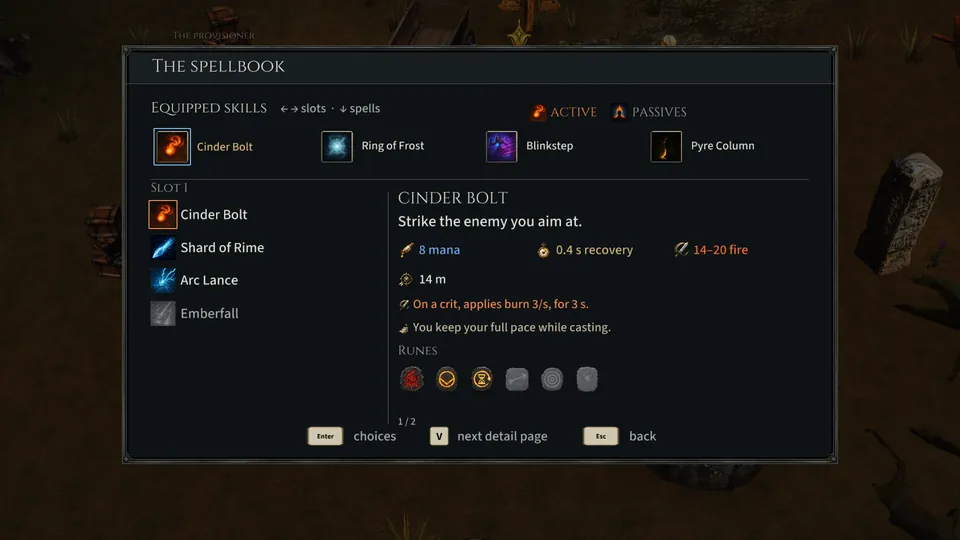
- Every class has sixteen spells, four for each of four slots. The first spell of each slot is equipped from the start. The other twelve open one at a time on every second level from 2 to 24, the slots taking turns: slot 1 at levels 2, 10 and 18, slot 2 at 4, 12 and 20, slot 3 at 6, 14 and 22, slot 4 at 8, 16 and 24.
- A slot holds only its own spells. Swapping is free, but only out of combat; in a fight the spellbook says Changes are locked during combat.
- Each spell costs the class's pool (or reserves part of it, for the spells that stay up), has a recovery after the cast and sometimes a cooldown. The spellbook prints all of it, and the Codex copies it for every spell.
- The pools differ: Mana, Essence, Faith and Spirit are deep and refill slowly, Focus, Guile and Breath are small and refill fast, and the Warden's Fury builds as you swing and drains out of a fight.
Runes
- Every spell has six runes, and one at a time can be socketed. A rune trades something: more reach for less damage, a burn that spreads, a free cast on a chilled target.
- Runes open by level, two or three a level from level 3 to 46, a spell's runes never before the level after the spell itself. The spellbook marks the new ones; reading a spell's page reads its runes too.
- Runes change only out of combat. On the keyboard, Shift + a slot's number steps that slot through its open runes (and back to none) without opening the book.
Passives and keystones
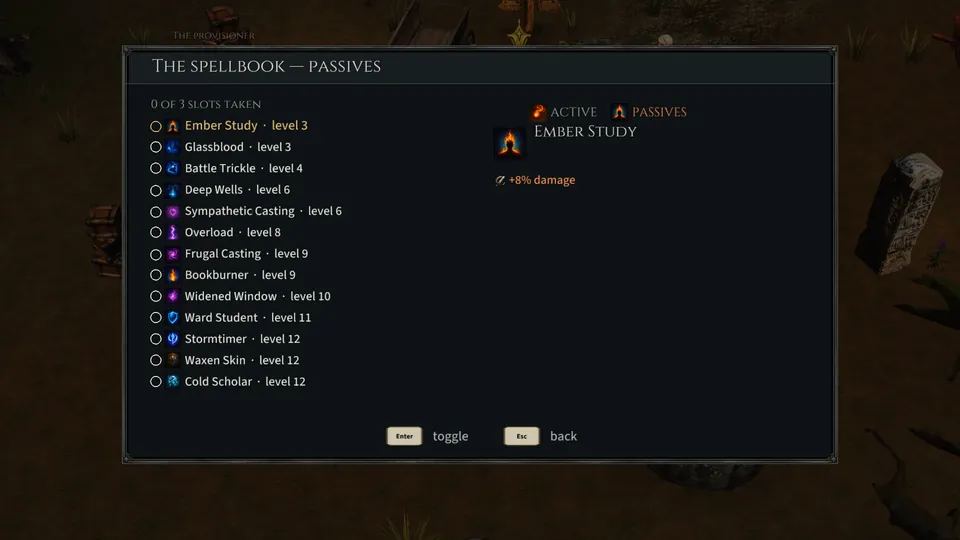
- Passive slots open with level: 1 at level 3, 3 at level 12, 5 at level 25 and 7 at level 40. Each passive has its own level; you choose from the known list on the spellbook's PASSIVES tab, and swapping is free out of combat.
- Each class has about forty passives, many grouped in lanes that name what they feed, and three keystones at level 50. You may hold one keystone at a time, in one of the seven slots.
Life, the flask and blink
- The flask has no charges. One drink, then it refills on its own. It starts at 35% of your life every 30 s. The apothecary at each hub strengthens it four times, one step at a time:
| Step | Price | Heals | Refills in |
|---|---|---|---|
| As found | — | 35% | 30 s |
| 1 | 350 gold | 40% | 27 s |
| 2 | 750 gold | 47% | 23 s |
| 3 | 1000 gold | 57% | 18 s |
| 4 | 1300 gold | 69%, and washes away one affliction | 12 s |
- Blink carries you 4 m the way you face, with 0.3 s in which nothing can hit you. It recovers in 3 s, and a blow it carries you through (the word dodge floats up) takes 1 s off that, once a blink. You cannot blink while frozen or stunned.
- Out of a fight, once nothing has hurt you for 4 s, life comes back at 1.5% a second. In a fight only the flask, health orbs, some spells and some passives heal.
Death and checkpoints
- Passing within 8 m of a checkpoint you have not touched saves the journey and marks it. Crossing into a region saves too, and so does Save the game in the pause menu.
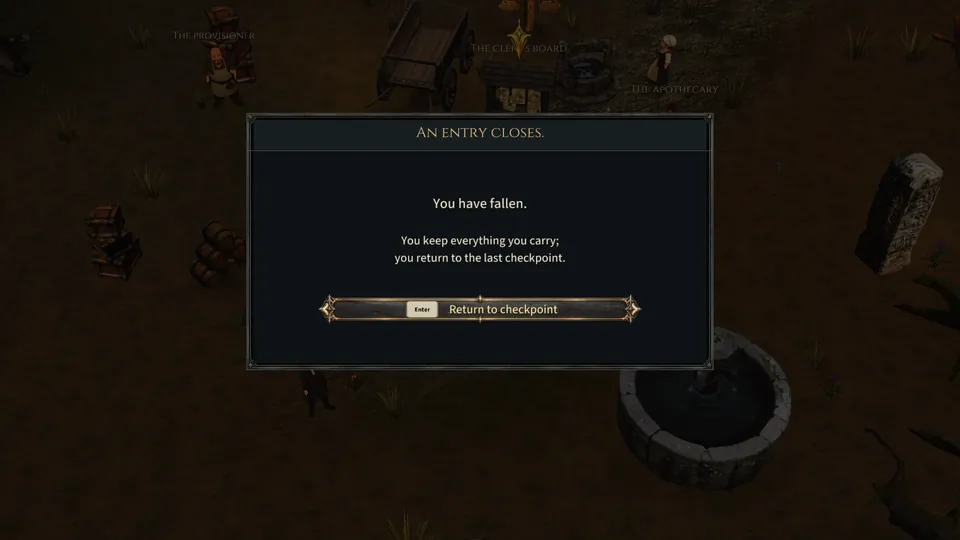
- When you fall, the card An entry closes. names what killed you, and Return to checkpoint stands you up at the last checkpoint at full life. You lose no gold, experience or items.
- The fight ends with you: common enemies you killed stay dead, everything else that was in it goes home and heals, and elites and bosses are full again.
Hubs: the board and three counters
Each region's first checkpoint is its hub, and every hub has the same four things.
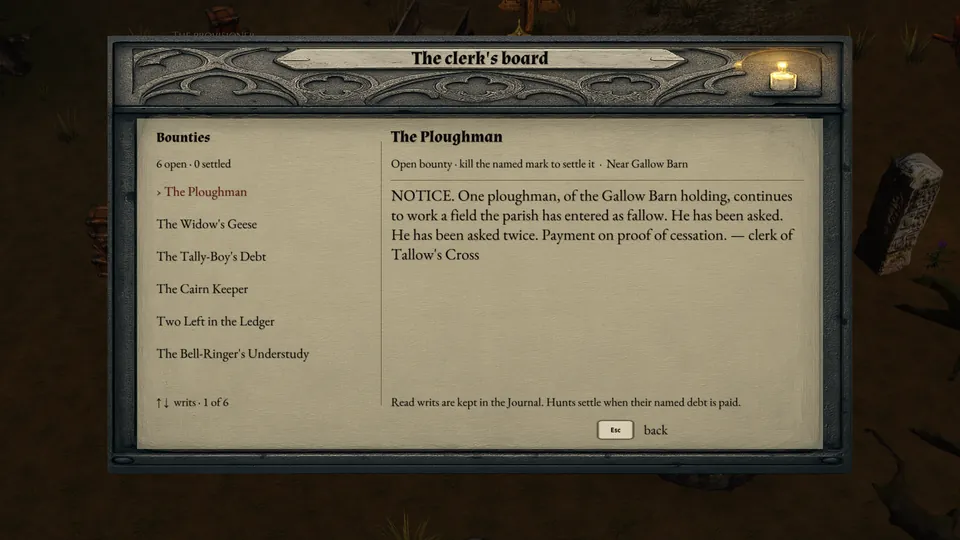
- The clerk's board
- Six bounties, called writs, 24 in the game. Most name a mark to kill; a pack writ settles when the pack's last member dies. A read writ is kept in the journal.
- The broker
- Buys what you mark in your bag; one button sells every marked piece. Plainly worse duplicates come marked already, uniques never.
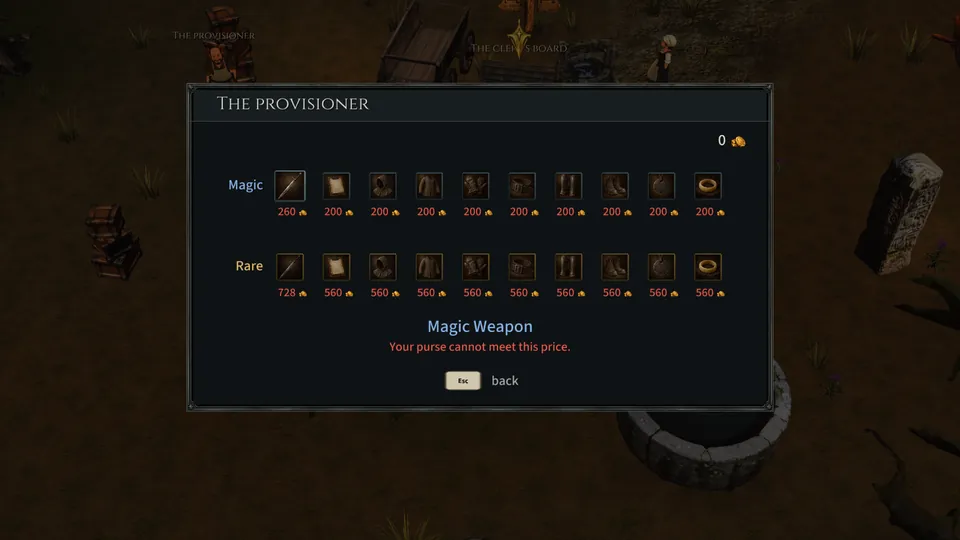
- The provisioner
- Sells a piece for any of the ten wearable slots, as magic or rare, rolled at the hub's tier; you see its properties only after buying. A magic piece costs 200, 230, 270 or 320 gold at the four hubs, a rare one 560, 650, 760 or 900, and a weapon costs 1.3 times as much.
- The apothecary
- Strengthens the flask, as above.
Loot and gear
- You wear eleven pieces: weapon, off-hand, head, chest, gloves, belt, legs, boots, an amulet and two rings. Items are common (your starting gear), magic, rare or unique; a magic piece carries one or two affixes, a rare one three to five.
- Elites and bosses always drop a piece; a roaming pack's leader always drops a rare. There are twelve uniques, three for each region.
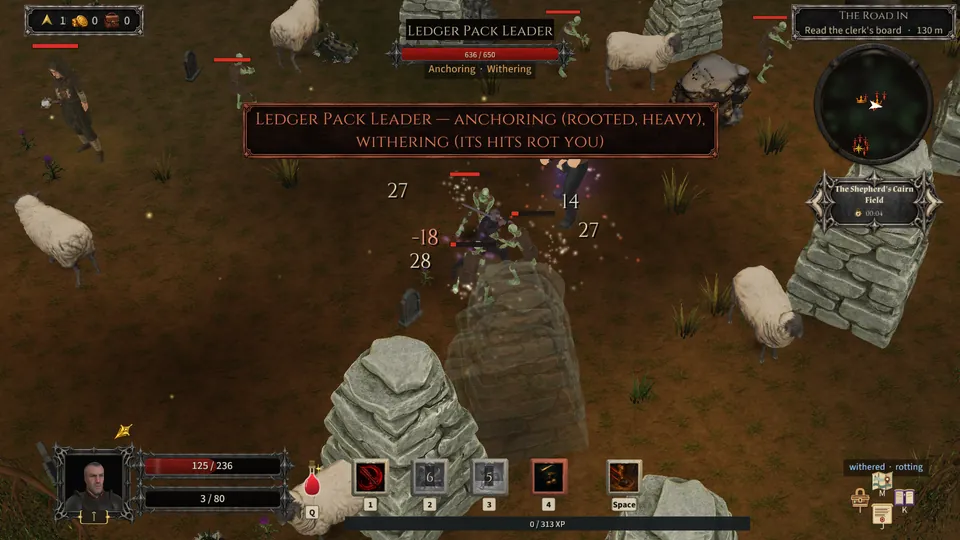
- Elites wear affixes, and the game names each with its tell as the elite arrives: hasted (fast), shielded (break its shield first), tolling (tolls, then bursts — walk out) and five more, listed in the Bestiary.
The journal, the map and the ledger
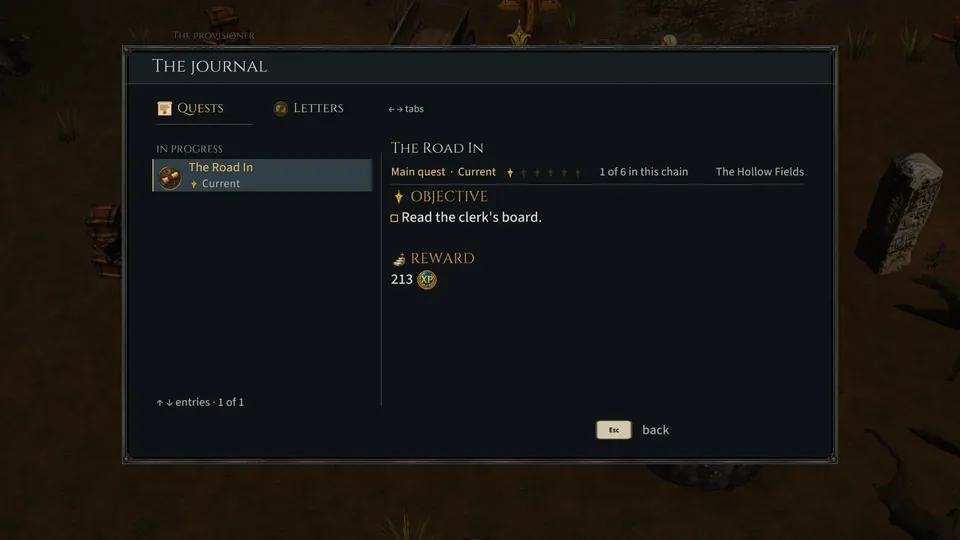
- The journal has two tabs. Quests lists the main quests, side accounts and local quests with their objective and reward; Letters keeps every letter you have read, word for word.
- The map fills in as you walk and lists the region's places, stops, letters and writs. There is no fast travel.
- Achievements on the title screen opens The deeds, read back: all 100 achievements, earned across every journey on this computer. Five stay sealed until earned. The Codex says how each one is counted.
Levels and the second journey
- The level cap is 50. Most experience comes from quests, the rest from kills. A player who clears everything gains about 15, 13, 11 and 8 levels across the four regions.
- After the last page, the pause menu at any hub offers Begin the next audit (NG+): a second, harder journey through a remixed province in a new save file, keeping your level, gear, gold, passives and runes. Enemies there have 1.8 times the life and deal 1.4 times the damage.