Morass GamesWiki
Spoilers ahead. The first-year guide walks one real first year. The goals list names every goal and its exact conditions. Guides contain solutions and may reveal encounters and progression.

Twenty Winters · Wiki

Irrigated land

Earn the Irrigated land goal by spring of year 2: ten channel cells, a road and three fields beside the river.

About the video. Played by an automated player through the game's own film mode; the narration is a synthetic voice, with English captions. Light spoilers. One real village in version 0.27.120 (seed 7). Council hands and the river's course differ between villages; the goal's conditions, the prices and the build arithmetic are the same in every village.

Irrigated land by the second spring

What the goal asks

Irrigated land needs both of these at the end of one season:

  • At least 10 channel cells, built (a channel still waiting for builders does not count).
  • At least 3 finished irrigated fields: fields whose centre is within 8 metres of water (the river, a built channel or a pond).

A new village has 2000 pennies. Ten channel cells cost 600, three fields 600, and the road that gives the fields a place to stand about 300, so the whole goal fits in the starting treasury if you spend nothing else in year 1. The same village also earns First channel on the way.

Steps
  1. Spring council: keep any plan, but do not place it. When the event panel opens, choose no event (Skip): every penny this year goes to land and water.
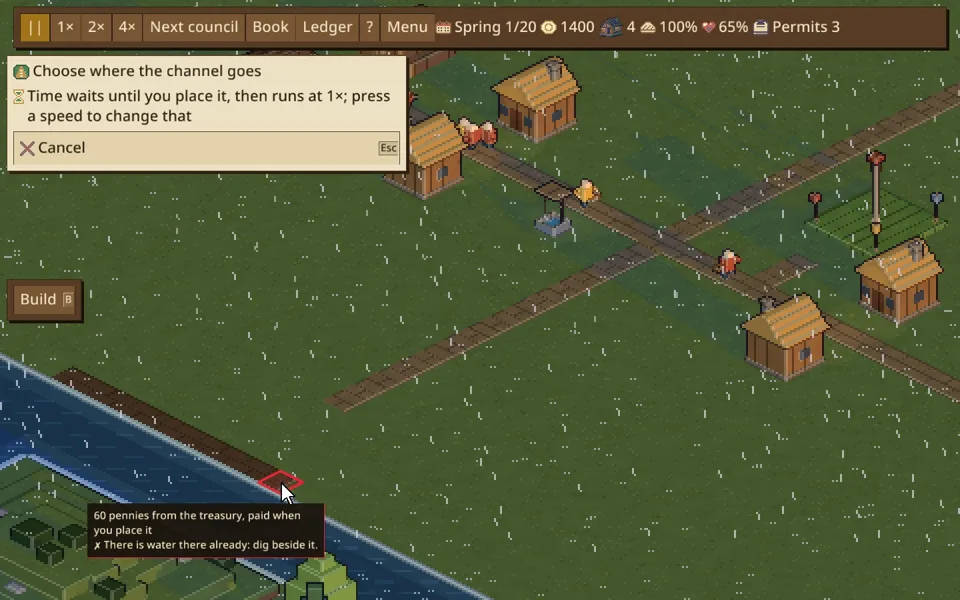
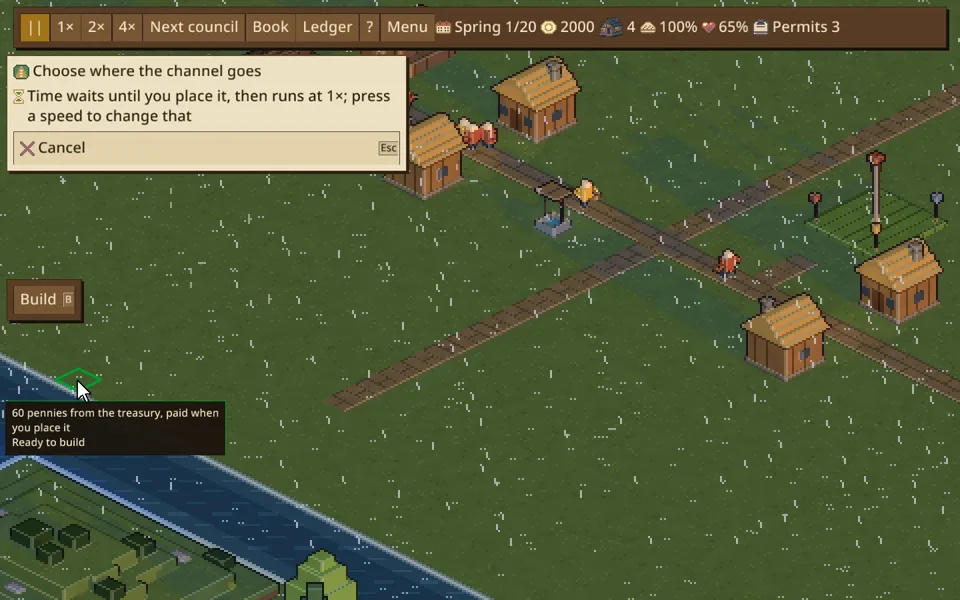
  2. Dig ten channel cells. Open Build › Water › Channel (60 pennies a cell, paid on the click). Click the grass cell right on the river bank, then nine more in a row along the bank, each one touching the river. The treasury drops from 2000 to 1400.
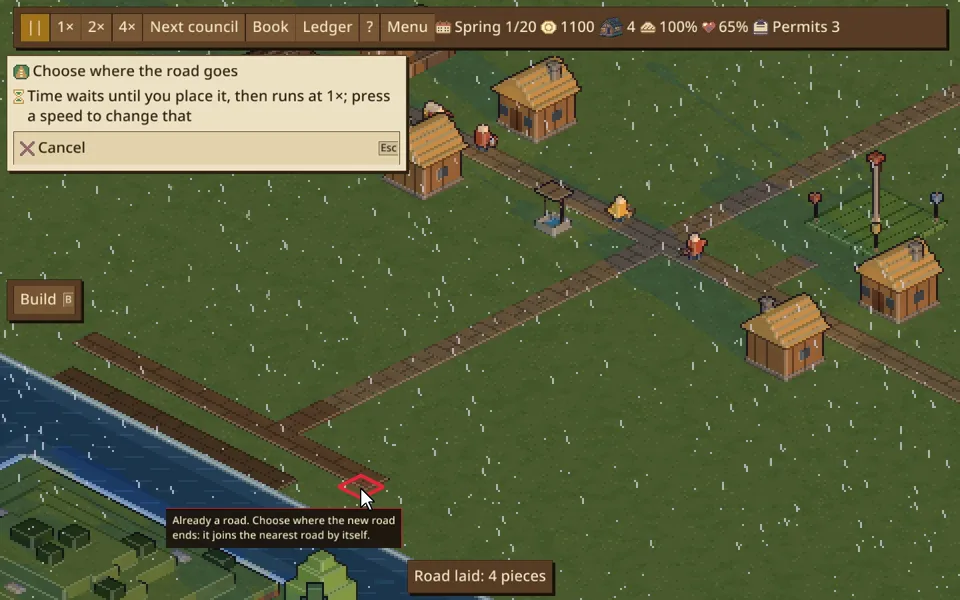
  3. Lay a bank road. Build › Homes › Road (20 pennies a piece). Click on the grass between the founding crossroads and the bank to lay a stem toward the river, then click the west and the east end of a road along the bank, a few cells above the channels. This village laid 15 pieces for 300 pennies; the toast after each click says how many pieces were laid. Treasury: 1100.
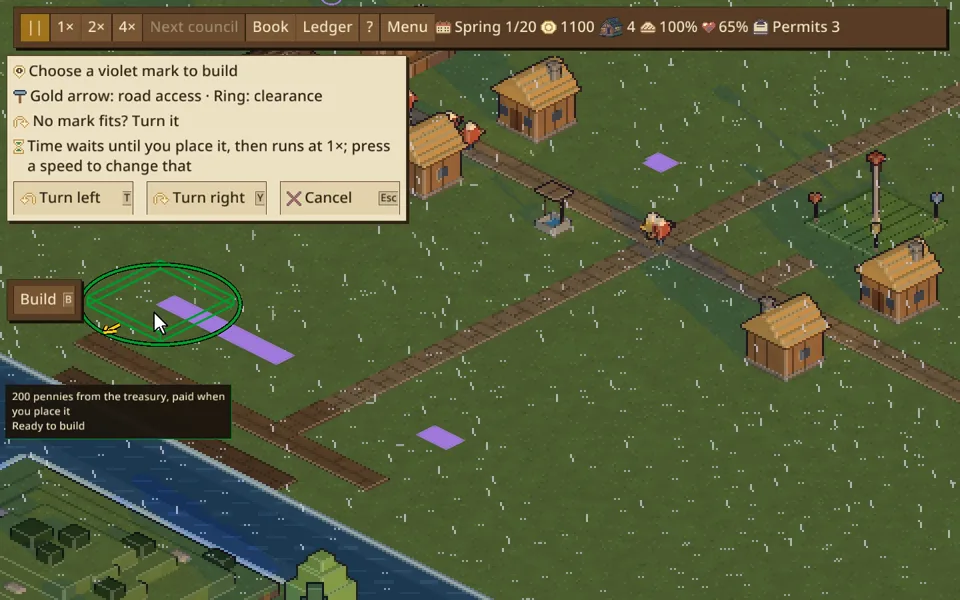
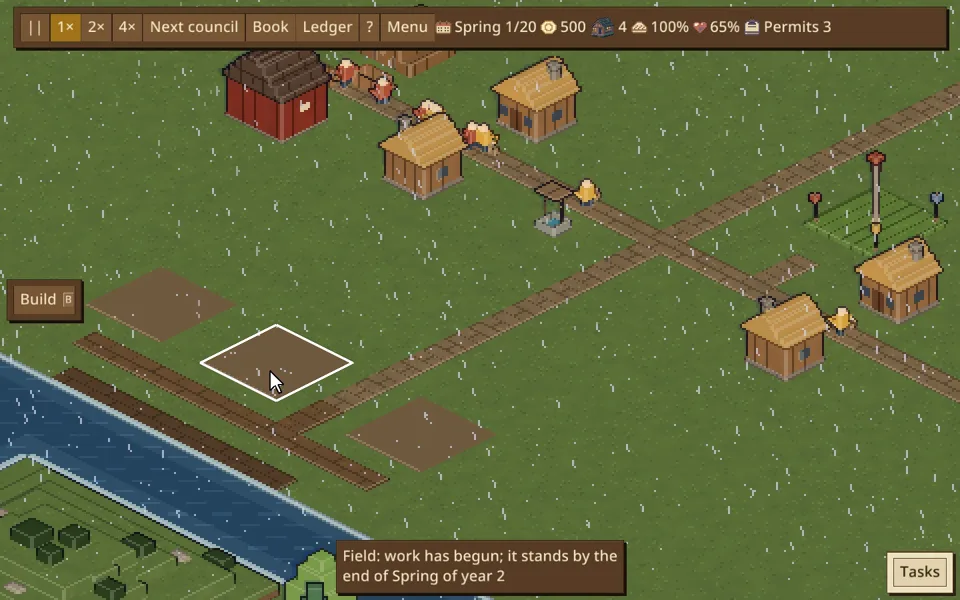
  4. Place three fields. Build › Village works › Field (200 pennies each). The bank road gives fields violet marks just above it, on the side away from the river, so the road runs between the fields and the channels. Put the first on the west mark, the second on the east one, the third between them. Treasury: 500. The tip of each field says when it will stand.
  5. Play at 4× and keep the treasury above zero. At each council keep a plan whose lines are all green (✓); you never have to build it. Place nothing else, and lay no more road, until the third field is finished.
  6. Spring council of year 2: keep a plan, choose no event again.
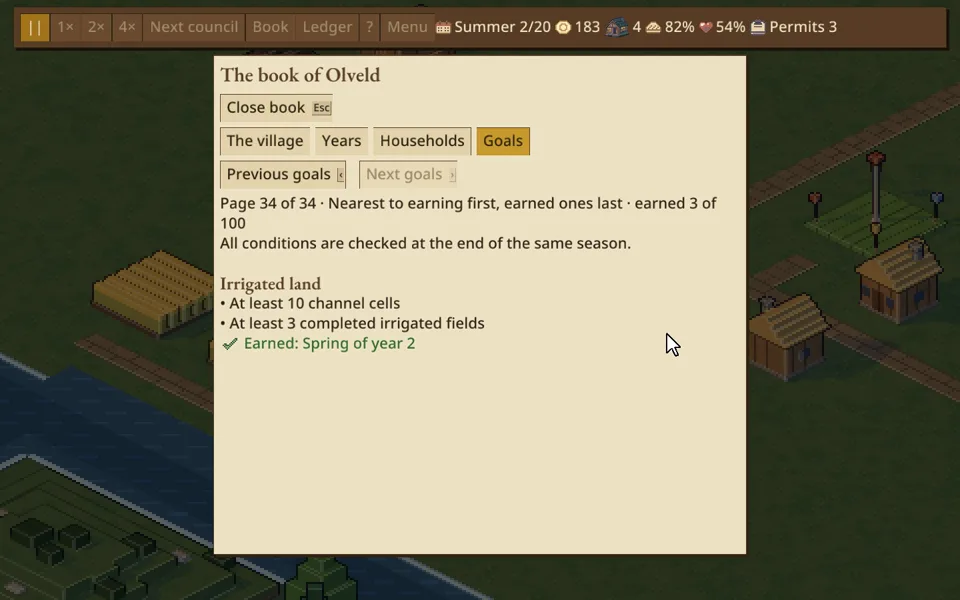
  7. End of Spring of year 2: the toast reads Field is finished. Open Book › Goals and go to the last page with Next goals: earned goals are listed last, and Irrigated land shows ✓ Earned: Spring of year 2.
Spring of year 1, 2000 pennies: the channel tool over the river bank, its tip 60 pennies from the treasury, ready to build
Step 2: the first channel cell, on the bank at the west end.
Ten channel cells along the river; the treasury reads 1400, and the tip over a channel says there is water there already: dig beside it
Ten cells dug for 600 pennies. A click on the river or on a channel is refused: There is water there already: dig beside it.
The road tool: a stem laid from the crossroads to the bank; the toast reads Road laid: 4 pieces
Step 3: the stem toward the bank, then the bank road itself.
The field tool with violet marks just above the bank road, which runs between them and the channels, the first field ghost on the west mark, 200 pennies, ready to build
Step 4: violet field marks above the channels.
Three fields placed above the channels, 500 pennies left; the tip says work has begun and the field stands by the end of Spring of year 2
All three placed. The third field's tip: it stands by the end of Spring of year 2.

Why it takes until the second spring

Builders work once, at the end of each season: 8 points plus 2 per family, so 16 with four families. Roads and channels are always built before buildings, whatever order you placed them in. Here that was 10 channel cells × 4 points = 40, then 15 road pieces × 1 = 15, then the fields at 4 points each:

End ofBuilder points so farDone
Spring, year 1164 channel cells
Summer328 channel cells
Autumn48all 10 channel cells, 8 road pieces
Winter64the road, 2 fields
Spring, year 280the third field: goal earned

A shorter road or fewer channel cells would not help: the goal needs the ten cells anyway, and the fields need a road to stand by. Any house, plan or extra road placed in year 1 takes points first and pushes the third field into summer or later.
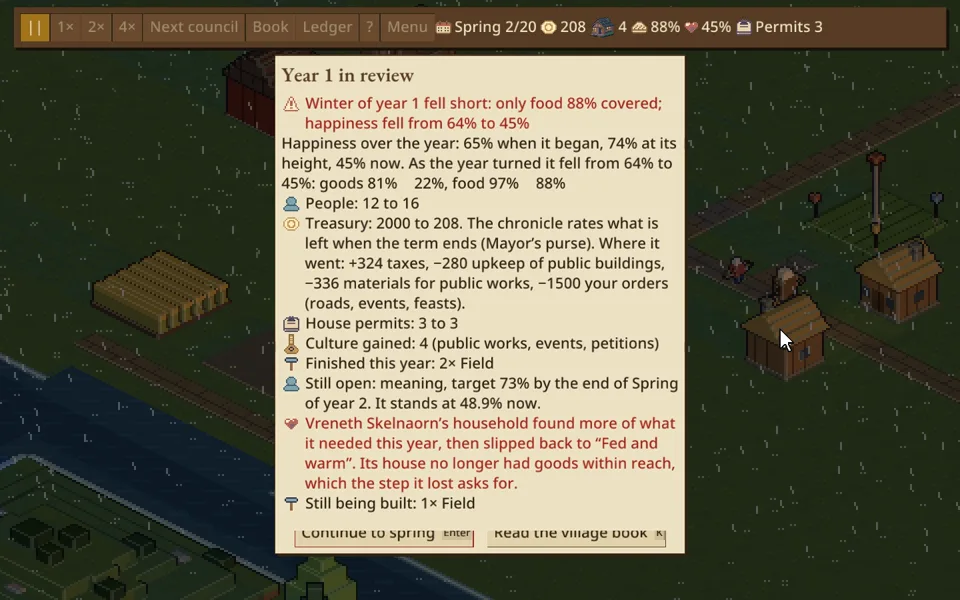
Year 1 in review: winter fell short, food 88% covered; still being built: 1 field; treasury from 2000 to 208
The year 1 review: one field still being built.
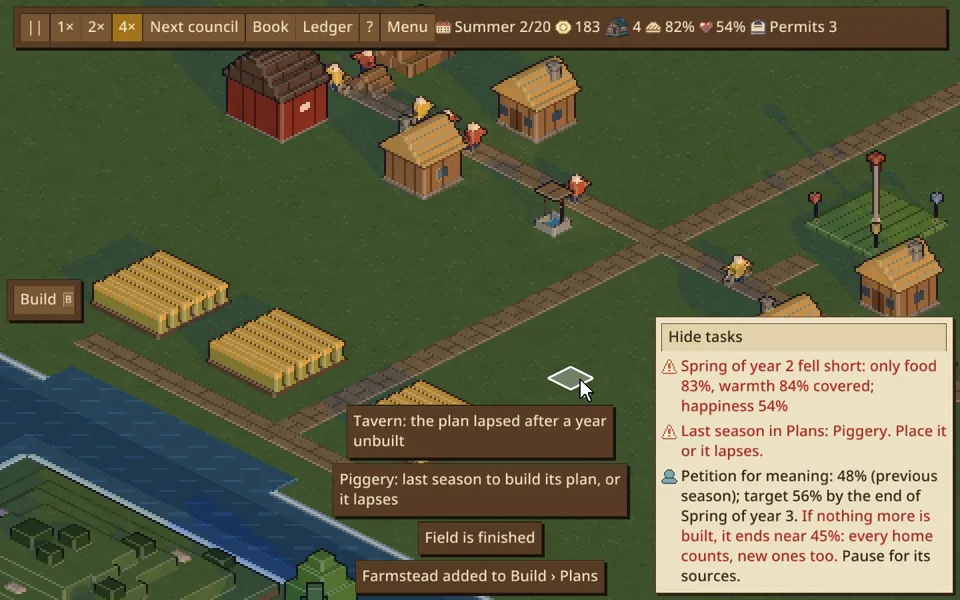
Summer of year 2: three ripe fields above the channels, and the toast Field is finished
The third field finished at the end of Spring of year 2.
The book, Goals, page 34 of 34: Irrigated land, at least 10 channel cells, at least 3 completed irrigated fields, Earned: Spring of year 2
Book › Goals, last page: earned in Spring of year 2.

What can go wrong

  • A channel cell not touching water. A channel must be dug next to the river or a built channel; one still waiting for builders does not count as water. Dig the first ten along the bank, each touching the river: the tip says Must be next to water otherwise.
  • A click on the river itself. Refused with There is water there already: dig beside it; nothing is paid.
  • No field marks. Fields stand only on violet marks, and marks appear by a road. If the founding roads end far from the bank, lay the bank road first.
  • A field too far from water. It is finished but not irrigated if its centre is more than 8 metres from water. The marks just above the channels are well inside.
  • Something else placed in year 1. It takes the builders' points (see the table) and the goal moves to Summer of year 2 or later.
  • An empty treasury. Building materials are paid as work goes on; this village was down to 208 pennies at the review. If the treasury cannot pay, building stops for the season.
  • A cold first winter. Nothing went to food or warmth: winter fell short (food 88% covered) and happiness fell from 64% to 45%. Once the third field stands, place a food plan; the fields raise the yield of every farm building whose reach they lie in, and an irrigated field counts twice.