The coast
The Iron-Fog Coast is a shore the Crown says is not there. The game keeps returning to the fact. A scholar-surveyor is sent to study a coast the Crown says is not there
; a Crown agent is sent, quietly, to find what the Crown buried here and told no one about
; and the loading screens put it more bluntly still: The Hush Trade lands what the Crown forbids, and calls it salvage.
It is a land outside the Concord's writ, and that, for some who cross, is the whole attraction.
Its name comes from its weather. The iron-fog lingers in hollows after the strand has cleared, and a stand of stunted coast cedar near the port is the first place the fog reads as more than weather
. By the end of the story the fog has a source that can be sealed, though the port's authoriser is plain that the fog itself will thin. It will not lift.
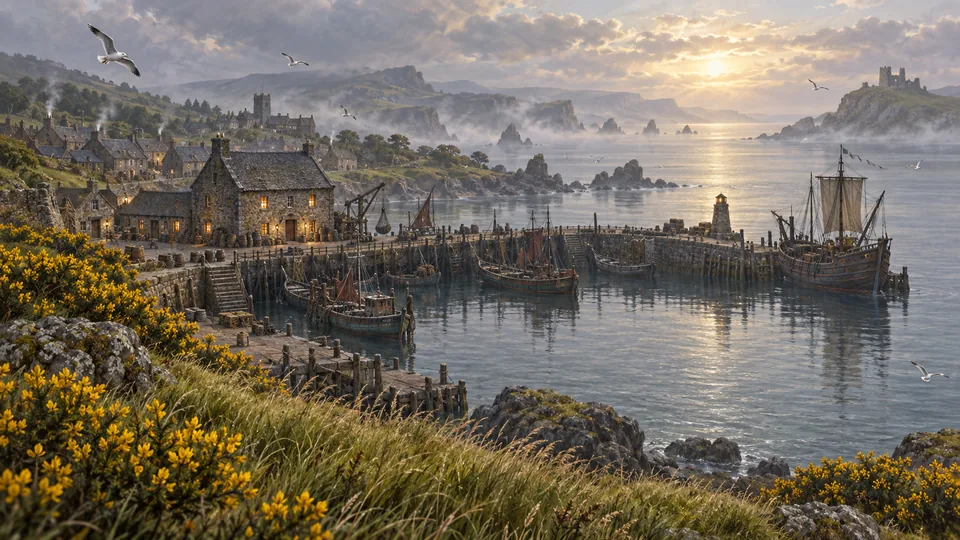
Everything starts at Threnvast, the Hush Trade's one sanctioned landing, a coast it does not hold
. It is a beachhead turning into a village. Its stalls reopen one at a time, as the work behind each one gets done: a bench for Vendrelm, a corner forge for Threkmir Skrenward, the first green meal that port has grown rather than landed. The first thing anyone sees on arrival is the Tideline Wreck, a hulk on the sand. Its ribs carry a painted draught-line laid on higher than any Iron-Fog boat would ever ride, and whatever it was built to carry, it was not carrying it when it came ashore.
Beyond the port the coast reads as a chain of places where somebody once built something and then stopped. There are a timber ramp laid before anyone at the cove needed one, a toll-post older than the Trade's causeway, a palisade longer than a survey crew can chart in a day, a settlement whose doors stand open and whose hearths are cold. The Trade does not so much conquer this country as walk it with chalk, stone and a ledger, one cairn at a time, and the story is largely about what that walking finds.
The regions
The game divides the coast into three regions, and the story moves through them in order. The Threnvast Landing is the shore, the marsh, the fens and the scarp: the part of the coast that is charted, however thinly. The Dreskneld Reach begins at the fallen palisade and carries on through the abandoned settlement of Tornkeld to the high promontory of Vrelskarr, where, in a phrase the crews repeat, the coast behind you is charted and what is in front of you is on nothing anybody has drawn. The Drethold Heart is the ash country and the crater beyond it.
The crossing
Nobody arrives on the Iron-Fog Coast by accident. The crossing is the first act of every story here, and it is paid for in different currencies. The game's loading text calls it crossing into new country
, and every origin begins the same way: off the boat at the Hush Trade's landing.
The crossings within the coast work the same way. Brenvast Cove is where the Hush Trade puts in when the port cannot know
. Halvreth Olvmark works its crossings, while Dresva Ferrywright keeps what passes for the ferry camp's books. The cove's namesake, the Low Crossing, is a shelf of tide-washed rock that anyone can walk dry-shod if they time the water. As Halvreth admits, his boat is not selling the crossing, it is selling you the hour.
a shelter on the coast path is a place where whatever they are carrying changes hands as often as not
, and nobody at the cove asks where the path goes after. The same quiet arrangement keeps every coast port fed without ever quite being on the books.
Even the old crossings have a past. The tollhouse on the Saltmarsh road took a toll generations before the Trade cut a road to it
, so, as Vosrenn Scarpward puts it, the Trade did not open that crossing but bought one already running. The ford at Vronveld was a crossing before the farm
. The coast was being crossed long before the Hush Trade began to count who went over.
The blight and the forge
The blight is the coast's wound, and it is measured, not described. Thin blight-taint hangs in the air in the middle country; in the deeper ground it lies heavy, and without ward it will wear you down
. The loading screens are blunter: Breathe shallow. The blight is patient and it has all the time there is.
At the last camp before the crater, nobody crosses the line without buying ward or an anti-blight draught first. Ward-charms that crews left behind on the road have all cracked the same way, from the middle outward. Moths cluster in the warmth of the vents, more symptom than animal
, and the warm ground has crept twenty paces further out than last season.
For most of the story the blight is something found at the end of a trail of evidence. The fallen line at Dreskneld has timber scorched on the inside faces, heat with no fire anyone lit recently, and no bodies on a wall that long. Tornkeld's people shut up their settlement, capped their own well to keep its water out of the hollow, and walked downhill about four years ago. Downstream the water goes under, not stopped
, and in the Sunken Cut are forge-revenants, scorched and fused with iron, still keeping a shift among Tornkeld's own tools. On the high promontory of Vrelskarr a man was sent down the Hollow Stair to hold a relief-point and the relief never went. He held it anyway, for a season, and the hero finds him as The Unrelieved.
The game's answer to what is doing this is a forge. At the Emberline in Throdath, where the ash-fall begins, a fallen way-marker is cut with old work-runes reading dreth-keld
. Vosrenn Wardhand reads a second mark cut deep into a cleared stone face, and says what nobody at the hold has said aloud: it is a forge-guild rune, and not from the Skrovenn people but Krevorn, older than any chart of this coast.
A forge made the things in the Sunken Cut, and one is still burning.
Down in the crater at Drethold, that forge is real and enormous: a hall scaled to a keep rather than a smithy
, its coal-beds still glowing under a thousand-plus years of ash, its flues still clear of ash because someone is clearing them. The revenants on the ramp are drawn up in ranks, like a garrison that never got the order to stand down
, and a route from the flues keeps them fed: Held, not haunted,
says Vosrin Farwarden. A haunting does not have a supply line.
The crews call what keeps the hall the Emberfather. The forge has burned a thousand years, making revenants of the dead.
The answer the game gives is not a victory. The hero carries stone and salt from the port to the Forgemouth, kills the Emberfather, and packs the seam with stone, salt, and the names of the coast's lost. The heat draws inward, the archway cools, and what stood open for a thousand years is shut.
The keeper of the waymark, Kaldrenn Threshward, enters it in his roster as a post to be kept
: Sealed, not dead. That is the honest word.
Back at the port the seam goes on the watch rotation, so that if the marks change we will know the week it happened rather than the season.
The factions
Six names appear in the game's standing screens. Five are communities with something they want from the coast, and one is a distance.
The Hush Trade
The Hush Trade is the coast's only organised power and the reason anybody is here. It runs the port, the Tally House, the survey road and the Relay-Chain of cairns, and it authorises sweep crews to go out and come back with a count. It wants a chart and a ledger. It prefers to tax those who work the wreck than to chase them, buys old crossings rather than building new ones, and settles its disputes on paper, one finished sweep, one closed cairn, and no sheet
becoming a fact the port has heard.
It is also a trade that keeps quiet hand-offs and unlogged shelters for whatever the port would rather not sign for, and its own loading text calls what it lands salvage.
Its face is the port's authoriser, Brendorn Vrenveld, and the standing tiers you earn with it open up in the course of the main story.
The Adapted
The Adapted keep to the Held Hearth at the centre of a channel-hollow in the Gullbone Fens. They keep a single fire, which is never allowed to go out and which burns only what comes in on someone's back, because a hold with two fires is two holds.
They want not to be arrived at unannounced, and their watch, the Outwatch, exists not to stop anything, only to be the reason nothing arrives unannounced.
Of a gift sent to the Survey Station, Kelnora says: We do not pay for a kindness, we answer it.
To the Trade they are Drethmark; at their own hearth they are Drethkin. Their warden Gremnir Skorsen and the hold's Kelnora Reedmend fear the channel that hides them narrowing, which, as Kelnora says, would make the hold a place you carry things into, not one you pole into.
The Frontier Folk
The Frontier Folk are independent scavengers and hunters who work the Gullbone Roost and the margin between the charted edge and open thross-water. They want to stay small, quiet and unrecorded. In their own words the whole margin they live on is the gap between what the water leaves and what anybody writes down
, and they teach newcomers to read the reeds and the birds so that, as Kessin Fenwarden says, as long as what they count looks like weather, we are weather.
They deal with the Trade carefully: when the Roost sends a lot down to the port, the papers and the goods carry the same number on both, and the port's buyer calls it First honest lot to come down off the Roost
to come off the Roost.
The Strand-Scavvers
The Strand-Scavvers are what is left when no one is in charge. They have a beach a walk away from the port, a slinger's stand with a clear line onto the path, and stolen crates stacked below it. They have no leader, no banner, just opportunists who found an empty settlement first
and mean to pick it clean before the Trade gets organised. They turn up all over the early coast: the Wreck, the causeway, the Salvage Hollow at Tornkeld, the cart road at Vronveld. One of their camps, out past the charted road, was not a drift: as Vosrenn Scarpward says, somebody walked them out and told them where to build, and that somebody has seen our charts.
The Forge-Remnant
The Forge-Remnant are not a people but a left-over. They are the revenants of the Sunken Cut, the ranked line on the Emberline and the sentry-form in the Underwatch, all scorched and fused with iron. They want nothing that anyone can name: they hold ground, and something below is still feeding the line.
The Crown / Concord
The Crown / Concord is the power that says the Iron-Fog Coast is not there, and the loading screens say the Hush Trade lands what it forbids. The origins touch it from both sides: the Scholar-surveyor and the Crown agent are sent on its account, and the Exile crossed to a land the Concord's writ does not reach. In the story itself it surfaces in a corroded iron fitting that Threkmir examines at his forge: This is not the coast's iron and it is not the Crown's.
The origins
The game opens by asking who crossed and why. There are four answers.
Recovery-crew hand
The Recovery-crew hand was hired by the Hush Trade to bring back what the coast still holds.
This is the plainest reason to cross: a wage and a coast with something left on it. The origin's perk is described as a salvage utility: you can read a wreck faster than the crew that hired you. It starts with the spell Cleave.
Scholar-surveyor
The Scholar-surveyor was sent by Iremnar to study a coast the Crown says is not there.
The scholar's perk is a survey insight: the charts fill in faster under your hand. It starts with the spell Hunter's Mark.
Exile
The Exile crossed because Threnvast is the one land the Concord's writ does not reach.
The exile's perk is a survival one: nobody who ran that far arrived soft.
It starts with the spell Stone Ward.
Crown agent
The Crown agent was sent, quietly, to find what the Crown buried here and told no one about.
The perk is an information one: you were briefed on things the landing has not been told. It starts with the spell Ember Shot.
The people
Every named person is a ledger entry somewhere, and most of them are tending a post. The ones below carry the story across the three acts.
At the port
Brekva Tollwright keeps the Tally House ledger and the first voice of the main story. She is stubborn about writing things down exactly as they are (a careful nothing is worth logging same as a find
) and she keeps a private line, apart from the Trade's manifests, for facts she would rather not turn into claims. Her story starts with a sweep that was marked complete by a hand not on it, and her line, paperwork is hers; being lied to in writing is mine
, sets the tone for a story that is mostly about what gets written down and what does not.
Brendorn Vrenveld is the Hush Trade's authoriser at the port: nothing goes out on the coast without his word, and the word is often a permission rather than a promise. He asks which cairn you reached first and how long you waited at the second, he sends the stone and salt for the seal, and he is the one person who has to hear the whole account in person. A forged Trade ward-mark traces back to the Old Beachhead; Brendorn admits he has seen the mark twice and let it go, because chasing it costs more than the goods it moved, and Trelsava Skevnorn reads that as someone who has known where it comes from for years. After the seal, he puts the Forgemouth's cairn on the watch rotation, and the line The fog will thin. It will not lift
is his.
Aluvi Threlveld is the survey lead and the engine of the main story's first act. She wants a coast that is where the chart says it is, she writes down answers as given, and she is careful to separate a favour from a payment. Her missing report starts the chain, her relay route finds the second cairn.
On the scarp
Fenkathr Voskresketh is the scarp guide who marked the first two chalk-marks on his own line and finds a third that is not his. The fourth, cut past the end of any contract, leads to a scout who never came back down, and Fenkathr hears about it without surprise, which is worse than surprise.
His story ends when the bearing is entered in the Farwatch ledger.
Kaldrin Farwarden keeps that ledger at the scarp picket, and his creed is that a line in a ledger is the only permission this coast respects. He logs the bearing, logs the kill of The Cleftwing, and reads the account of the Fallen Line at Dreskneld, which turns the main story out of the charted country. He is where the first act ends and the second begins.
In the Reach
Skennor Gatewarden and Vetra Ironmend do the arithmetic that Tornkeld demands. The settlement's doors stand open and nothing is broken: It looks like a decision, taken by everybody, in about a day.
Skennor wants the place to be a settlement again and not a site, so she has the hero read its name off its lintel. Vetra follows the capped well, and the water, down into the Sunken Cut, where Tornkeld's own tools are carried by things that still keep a shift.
Fenneth Farwarden keeps the Watch on Vrelskarr, the first high ground since the scarp. Her story is about the unrelieved: a man sent down the Stair whose relief never went, whom the hero ends by relieving. Threnna Stockhand keeps the relief camp's book and finds the open line without looking it up: a name, a posting, a date sent, and nothing in the returned column.
In the ash
Kaldrenn Threshward teaches the border, boot on that side, boot on this
, and sends the hero into the crater with the port's stone and salt. Vosrenn Wardhand reads the forge-guild rune, keeps the ward stock and the roster at the last safe camp, and wants to know what position a garrison of the dead thinks it is holding. When the ranks are broken she says what the whole third act has been about: A garrison that was never told to stand down is still a garrison,
and Somebody had to be the order.
Vosrin Farwarden counts what is still standing under the smoke, and finds most of it, and finds the flues clear.
Along the coast
Halvreth Olvmark runs the Brenvast crossings and is proud of a rate that holds steady. His arc is about owing and being owed: a coin wedged so deep a stone has closed on it, and a parcel that comes back to him the line has never run this way before.
Vrenna Delnmark keeps the Roost fed and her crews home. Gremnir Skorsen holds the hearth at Drelthdren and has his people walk Brekva in when she visits, which, she says, they have never done. Kreskava Fenmend is the fen-side medic who mends people rather than nets, and whom Brekva writes in as a trade, which in that port is the same as a welcome. Dreneth Thralkorn runs the independent Stolkeld mine and lets a stranger, Selkorn, take a surface shift: Today he has earned a place by the scale. Tomorrow is still his to answer for.
Marekka is the odd one out: she came to Vensvael for the birds and stayed for a patch of green from the valley she left, growing in a bowl a quarter-mile wide. It is the only living ground on that side of the ridge, and it has moved four paces in since she came. Trelsava Skevnorn is the one who keeps asking where the false ward-mark came from, and has already decided that someone is keeping a ledger of their own.