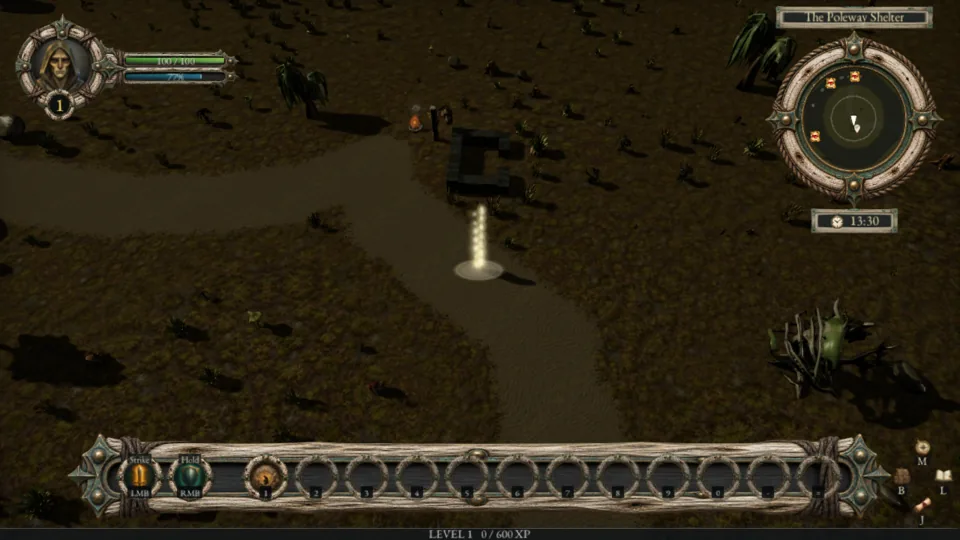
Every place on the coast, grouped by zone. A place is found when you walk near it, and it is then marked on the map (M). Most places have spots to look at up close: walk to one and press E. Those lines are listed under Up close.
The Landing Shore
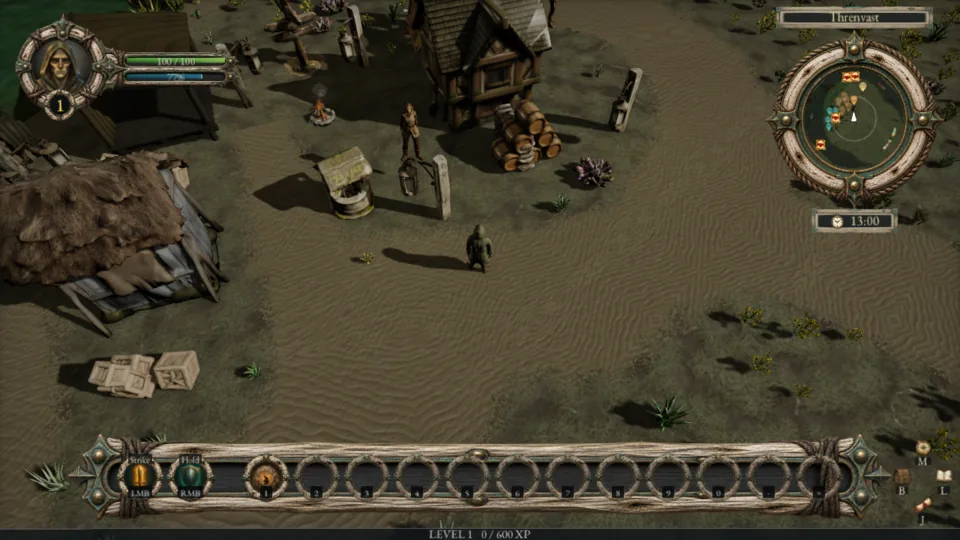
 ThrenvastThe Hush Trade's one sanctioned landing on the Iron-Fog Coast; every expedition starts here, and the traffic is turning what was a beachhead into a village.
Up close
3 things to look at closer
- You go along the quay-front the way the clerks do it — a hand on each crate, a look at each seal. Half the marks are the Hush Trade's own; the rest are nobody's, and nobody standing here minds that.
- The manifest nailed to the end post is two days old and three crates short of what is stacked under it. A porter shifts to let you past and does not ask what you are counting.
- There is nothing on this quay you have not already turned over. The tide-boards say the next boat is not due until the ebb.
People here
| Name | Does |
|---|---|
 Brekva Tollwright | quest giver, vendor |
 Brendorn Vrenveld | quest giver |
 Halvreth Olvmark | quest giver |
 Thalva Packwright | quest giver, vendor |
 Threkmir Skrenward | quest giver, vendor |
 Vendrelm | quest giver, vendor |
 Trelsava Skevnorn | quest giver |
 Mira Saltveld | ambient |
 Osk Fennmark | ambient |


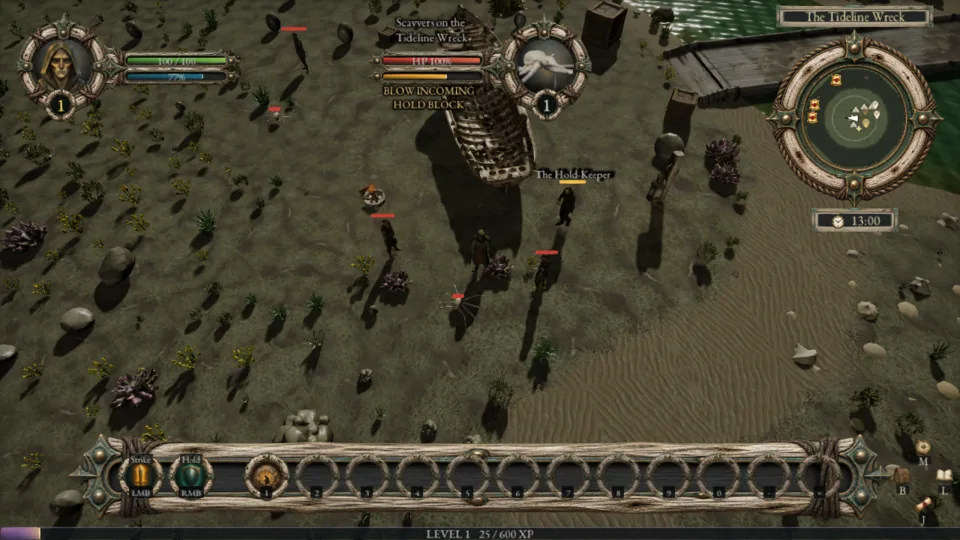
 The Tideline WreckA prior expedition's grounded hull, half-buried in the tidal flat south of the port and picked over by scavengers.
Up close
5 things to look at closer
- You go in through the split in the hull. The sand inside is dry, packed hard, and someone has been sleeping on it recently enough that the hollow still holds a shape.
- Under the foredeck the ribs still carry a painted draught-line, laid on higher than any Iron-Fog boat would ever ride. Whatever this hull was built to carry, it was not carrying it when it came ashore here.
- Everything loose in the wreck has been lifted twice over. What is left is the ship itself, and the tide is taking that on its own schedule.
- You go along the keel with a hand on the ribs, counting frames. Two are cut, not broken — sawn through cleanly, from inside, by somebody stripping the hull for the timber while she still floated.
- Right down under the sand at the stern there is a bilge-pocket the sea has not reached: dry rope, a scrap of oiled cloth, and a smell of tar that has not aged a day.
Foes here
| Who | Levels |
|---|---|
| Scavvers on the Tideline Wreck | 1–2 |
 The Hold-Keeper | 2–3 |
Gathered here
- Hull Tar
- Pale Amber
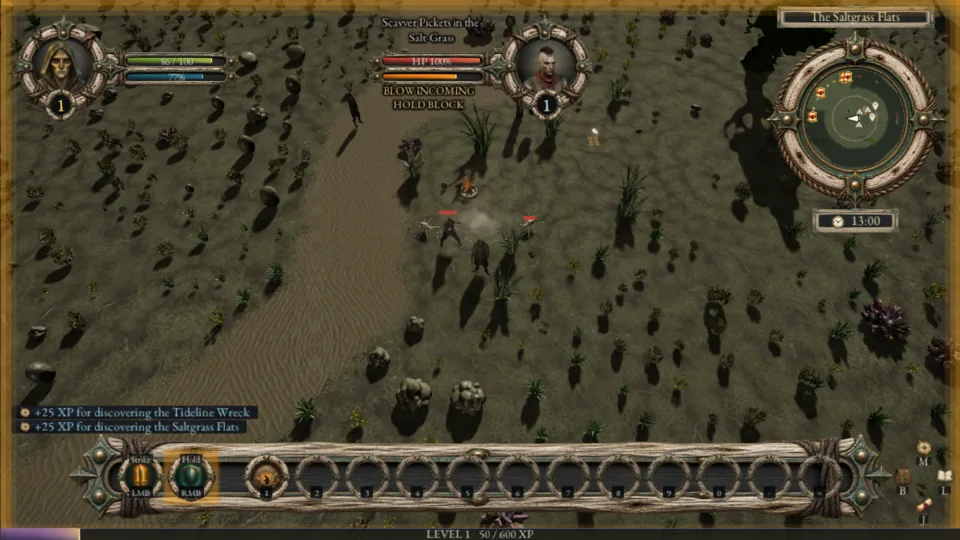
 The Saltgrass FlatsThe dune line between the port and the Wreck: salt-grass and gorse over wet sand, dune-hare warrens and the tide-worn amber the first ledger sends you to comb.
The dune line between the port and the Wreck: salt-grass and gorse over wet sand, dune-hare warrens and the tide-worn amber the first ledger sends you to comb. The port's safe ground — the first place a new arrival is sent.
Up close
7 things to look at closer
- You work the dune line the way the first ledger says to: wind at your back, eyes down, following the darker sand. The amber comes up in the gorse roots far more often than out in the open.
- A dune-hare breaks from a warren three paces off and is gone before you straighten up. The burrow mouth is lined with combed-out fur and one bead of amber nobody ever came back for.
- The flats are picked bare along your own bootprints. Finding more means walking a line somebody else has not already walked.
- You cut across the grain of the dunes instead of along them. The far side of every ridge is where the tide leaves what it is done with, and nobody works the far sides.
- You go along the wet sand at the tide's turn, which is the only hour the amber sits proud of the surface.
- The gorse roots hold what the sea gives up and let go of it a season later; every good handful comes out of a root-ball rather than out of the open.
- The warrens on the high side have been dug out and re-dug, and the digging is a person's rather than a hare's.
Foes here
| Who | Levels |
|---|---|
| Scavver Pickets in the Salt-Grass | 1–2 |
Gathered here
- Dune-Hare Hide
- Pale Amber
 Hollen's RacksFisher huts and net-drying racks along the strand west of the quays, where the tidal channel keeps the crab pots full.
Fisher huts and net-drying racks along the strand west of the quays, where the tidal channel keeps the crab pots full. Hollen Netmend mends and sells here and feeds the port; the racks are the Landing's second doorstep.
Up close
3 things to look at closer
- You go down the rack line turning the drying nets over. The mend in every third one is the same hand's work — fast, ugly, and holding better than the netting around it.
- The pots come up heavy off the channel bottom. Hollen counts them out loud from the hut door without looking up, and the count matches yours.
- The racks are all turned and the pots are all set. Everything here works because somebody does this twice a day, every day.
People here
| Name | Does |
|---|---|
 Hollen Netmend | quest giver, vendor |
Gathered here
- Quay-End Catch
- Tide-Crab
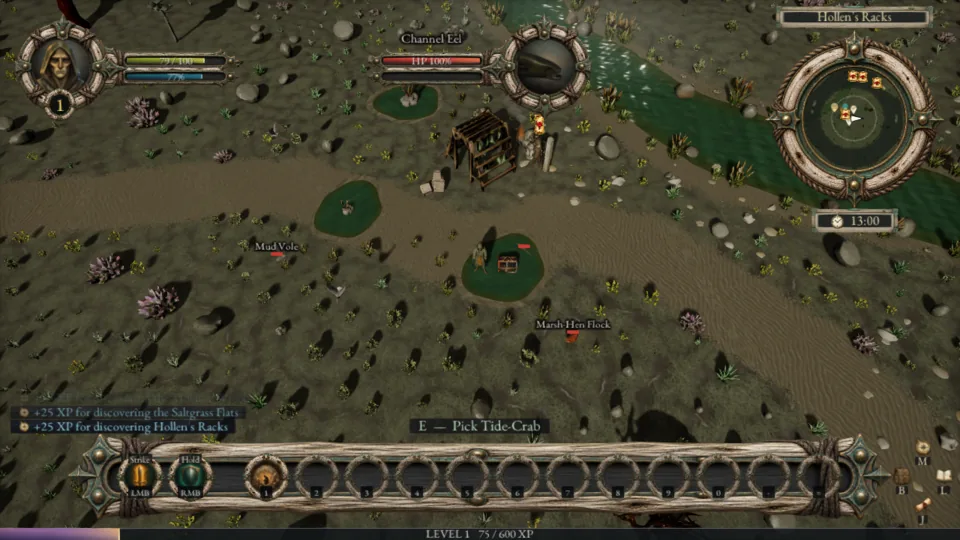
 The Old BeachheadThe first expedition's landing, three generations back: rotted stakes, a foredeck locker sunk in the sand, a stone hearth-ring nobody has lit since.
The first expedition's landing, three generations back: rotted stakes, a foredeck locker sunk in the sand, a stone hearth-ring nobody has lit since. The port moved west to the quays and left it; the Tally-Thief hides in what is left.
Up close
3 things to look at closer
- You dig the foredeck locker out with your hands. The wood gives like wet bread, and what is inside went three generations ago to people who needed it more.
- The hearth-ring is a clean circle of stone under the sand, laid by people who fully expected to come back and light it again.
- The stakes still standing are set in a line that does not point at the quays. This landing was aimed at something further up the coast.
Foes here
| Who | Levels |
|---|---|
| Slingers on the Gorse Bank | 1–2 |
 The Tally-Thief | 2–3 |
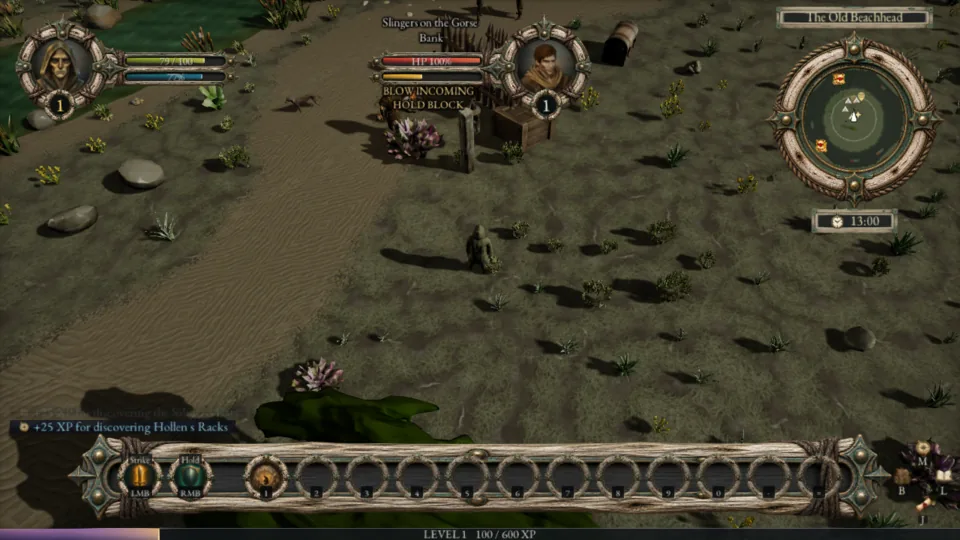
 The Survey StationThe surveyors' field station on the road inland toward the Saltmarsh Cairn — a lean-to, a rod-rack and a plane-table under canvas.
The surveyors' field station on the road inland toward the Saltmarsh Cairn — a lean-to, a rod-rack and a plane-table under canvas. Aluvi Threlveld works from here now rather than the loft; every survey the port commissions leaves from this table.
Up close
3 things to look at closer
- You lift the canvas off the plane-table. The sheet pinned to it is the coast from the port to the Cairn, drawn twice — the second pass in a lighter hand, correcting the first inland of the road.
- The rod-rack holds nine rods and space for twelve. The three empty slots have been empty long enough to lose their dust line.
- The table is squared, the rods are counted, and every mark on the sheet agrees with the one beside it. Nothing here is out of place yet.
People here
| Name | Does |
|---|---|
 Aluvi Threlveld | quest giver |
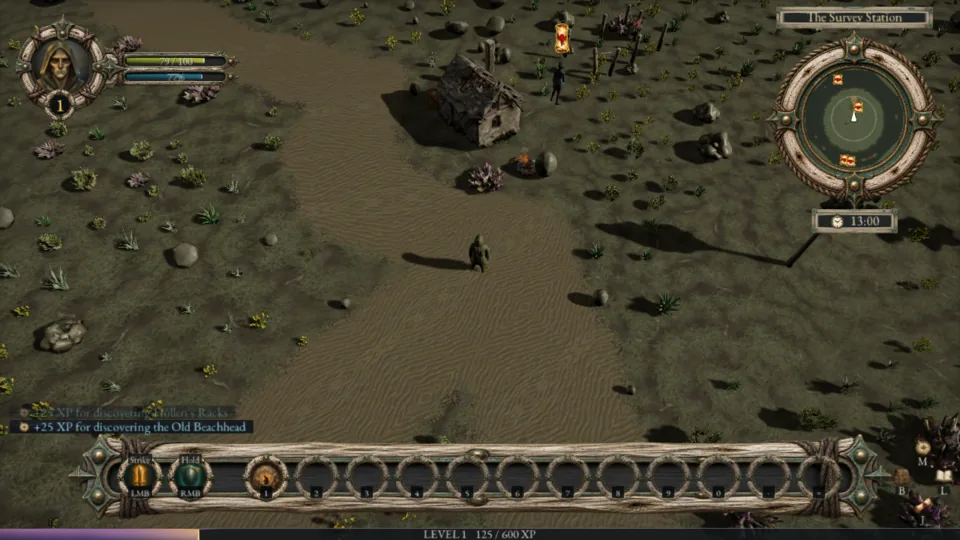
 The Fogbank GroveA stand of stunted coast cedar in a hollow that holds the iron-fog after the strand has cleared: gorse banks, tinder, herb ground, and the first place the fog reads as more than weather.
A stand of stunted coast cedar in a hollow that holds the iron-fog after the strand has cleared: gorse banks, tinder, herb ground, and the first place the fog reads as more than weather. Scavver pickets use its edge; the port calls it 'the grove' and nothing more.
Up close
3 things to look at closer
- You go in under the cedars. The fog does not thin the way it does on the strand — it stands between the trunks like something waiting to be walked around.
- The tinder here is bone-dry an arm's length off the ground and soaked below it. Whatever the fog is, it does not fall as water.
- The gorse banks have been cut back along one edge, recently, by somebody working fast and leaving the stems where they dropped.
Foes here
| Who | Levels |
|---|---|
| Wreck-Pickers on the Flat | 1–2 |
Gathered here
- Dry Tinder
- Shore Gorse Bloom
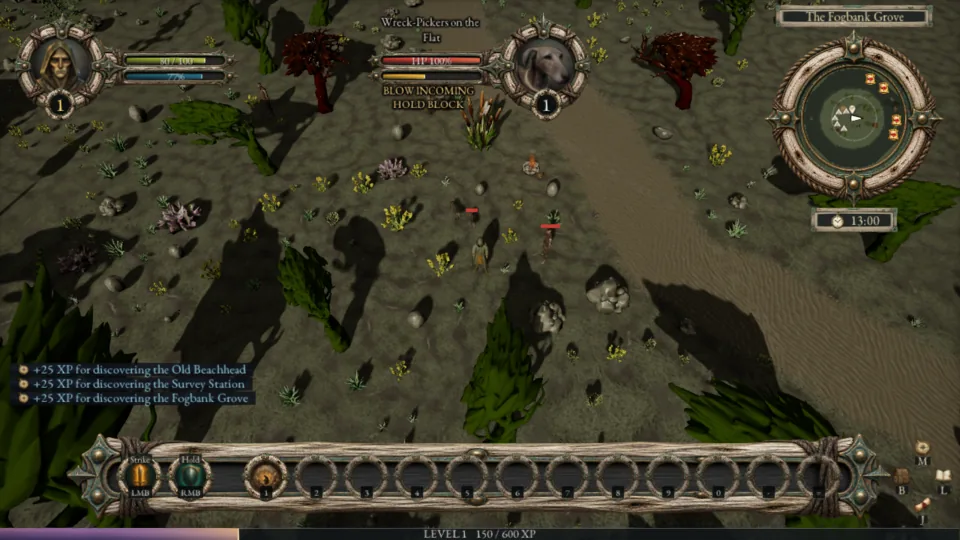
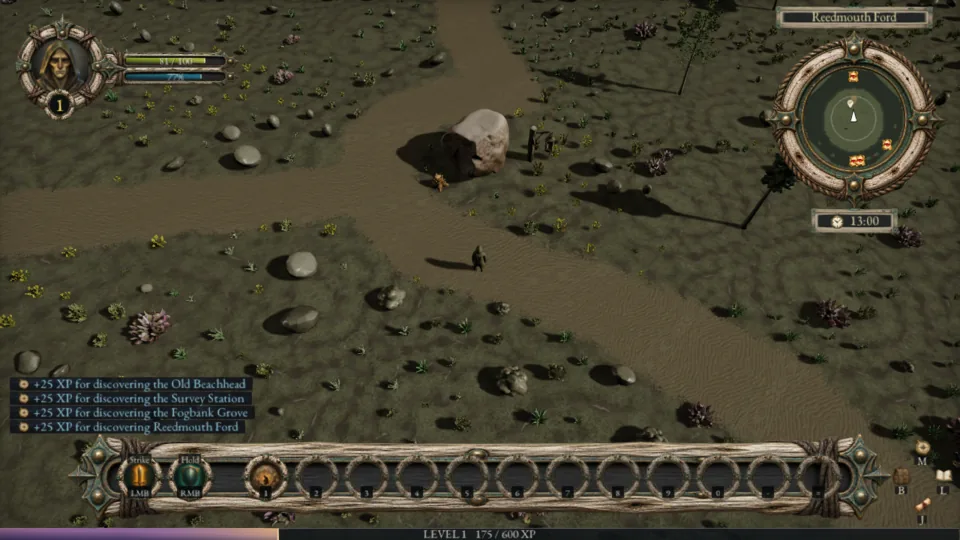
 Reedmouth FordWhere the survey road crosses the stream that comes down off the moor to the sea: reed beds, driftwood caught in the shallows, herons and toads.
Where the survey road crosses the stream that comes down off the moor to the sea: reed beds, driftwood caught in the shallows, herons and toads. Fresh water, which the port has to carry; the ford is why the road runs where it does.
Up close
3 things to look at closer
- You wade the ford at the crossing stones. The water off the moor runs cold and clean and tastes of nothing at all, which is why the road bends to it.
- Driftwood has jammed the shallows into a half-dam and the reeds have already grown through it. A heron works the pool it made and does not move for you.
- The reed beds are trodden flat in a line that leaves the ford and does not rejoin the road on the other side.
Gathered here
- Dry Tinder
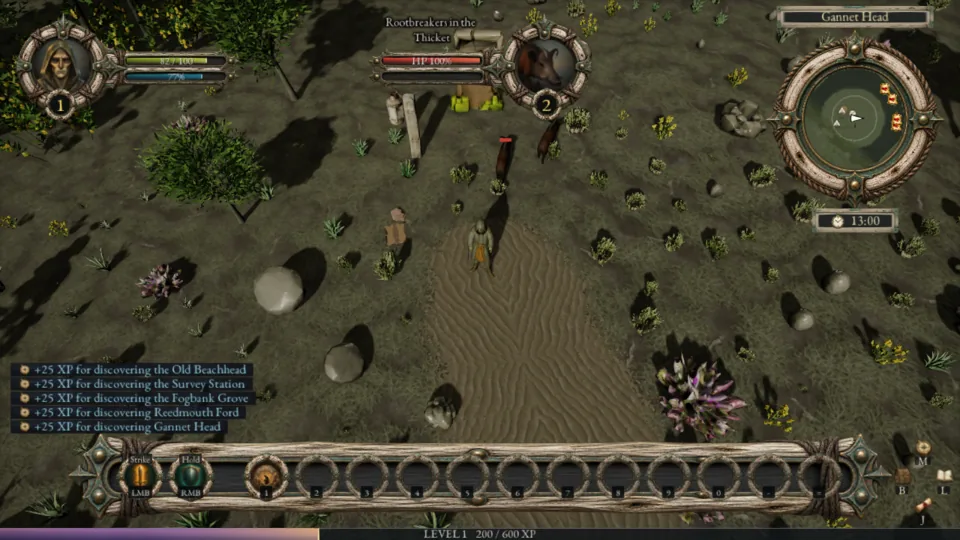
 Gannet HeadThe headland north-west of the Landing, a Relay-Chain look-out cairn on its crown and gannets on its face.
The headland north-west of the Landing, a Relay-Chain look-out cairn on its crown and gannets on its face. The whole shore is visible from the top — the port, the Wreck, the grove, the road running inland — and a rootbreaker boar holds the thicket on the way up.
Up close
3 things to look at closer
- You climb to the cairn on the crown. From here the whole shore lies out at once — the port, the Wreck, the grove, the road running inland until the fog takes it.
- The look-out cairn is Relay-Chain work: flat stones laid tight, a slot on the seaward face at eye height, and old wax in the slot from a shielded lamp.
- The gannets go off the face in a sheet when you come over the lip, and settle again before you have counted them. Nothing else up here has moved in years.
Foes here
| Who | Levels |
|---|---|
| Rootbreakers in the Thicket | 2–3 |
Gathered here
- Dune-Hare Hide
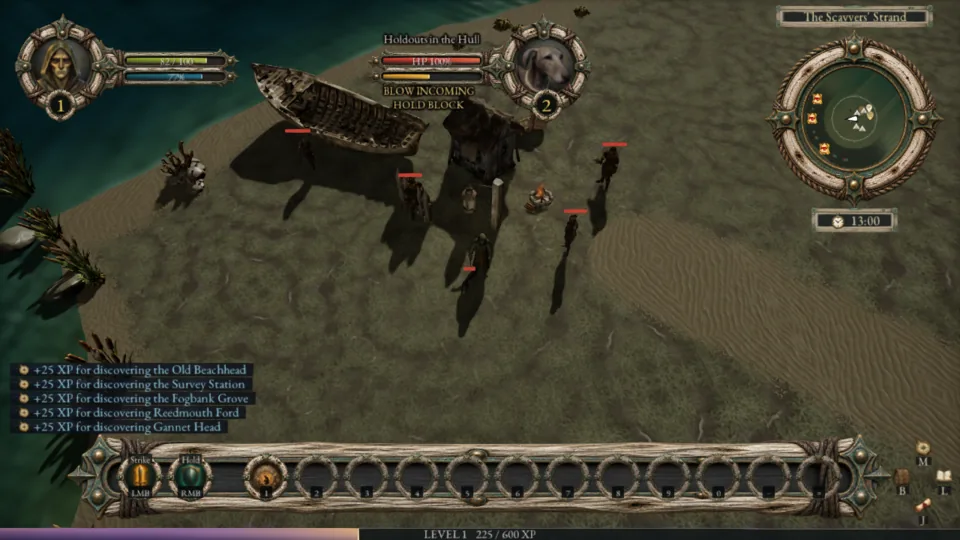
 The Scavvers' StrandThe strand-scavvers' own beach east of the old beachhead: lean-tos of hull timber, a slinger's stand on the dune, the port's stolen crates stacked in the open.
The strand-scavvers' own beach east of the old beachhead: lean-tos of hull timber, a slinger's stand on the dune, the port's stolen crates stacked in the open. Where the Landing's fights are, kept a walk away from where its work is.
Up close
4 things to look at closer
- You go through the lean-to row. Every timber in it came off a hull, and two of them still carry the port's own crate-marks, burned in and half planed away.
- The slinger's stand on the dune has a clear sight down the whole beach and a pile of picked-round stones ready at its foot.
- The stacked crates are open to the weather and nobody has bothered to cover them. Whatever these people are afraid of, it is not the rain.
- You count lean-tos and read the beach the way a warden would: fourteen sleeping places, one fire, and boot-prints that all come up from the water rather than down from the road.
Foes here
| Who | Levels |
|---|---|
| Holdouts in the Hull | 2–3 |
Gathered here
- Hull Tar
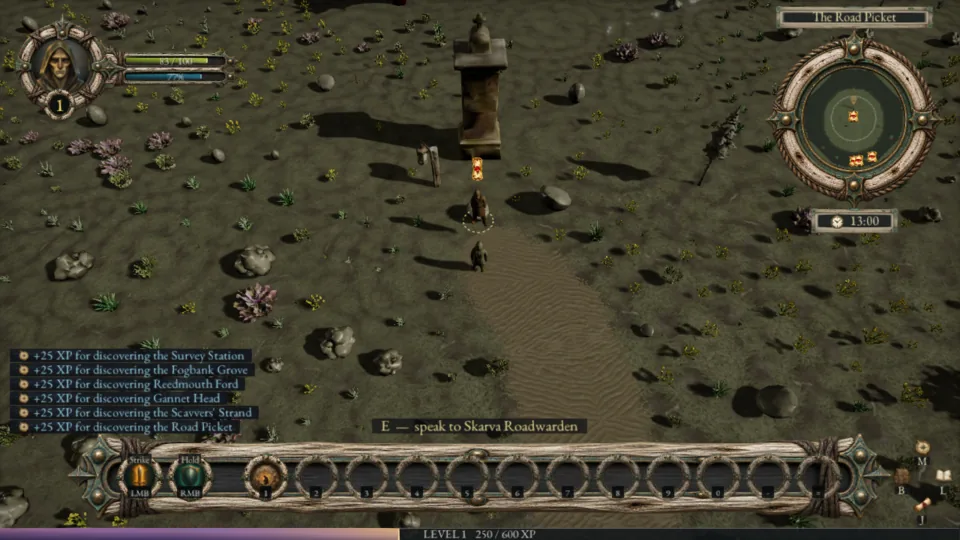
 The Road PicketThe Hush cell's picket on the survey road where the Landing ends and the Saltmarsh begins: a road-marker stone, a hearth, a warden with a roster.
The Hush cell's picket on the survey road where the Landing ends and the Saltmarsh begins: a road-marker stone, a hearth, a warden with a roster. Everything the port sends inland is handed over here, and it is the last safe place before the reach.
Up close
3 things to look at closer
- You check the roster hung at the picket. Everything the port sends inland is written down twice — once by the porter, once by the warden — and the two columns do not always agree.
- The road-marker stone is older than the picket built around it, and the mark cut into it is not one the Hush Trade uses.
- The hearth is banked, the roster is current, and the warden's eyes follow you all the way to the reach-side of the stone.
People here
| Name | Does |
|---|---|
 Skarva Roadwarden | quest giver, guard |

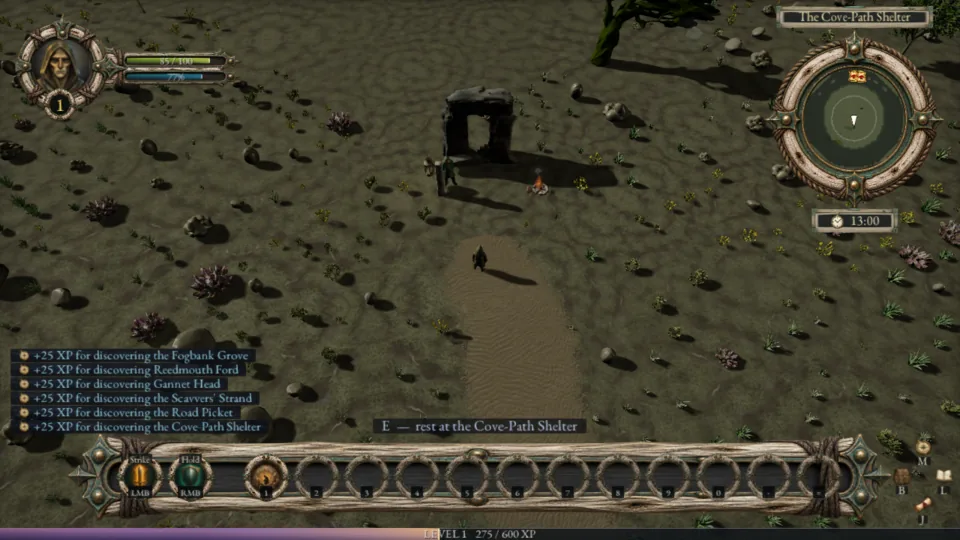
 The Cove-Path ShelterA runners' shelter on the path south along the cliffs toward Brenvast Cove — a dry cave-mouth, a marked stone, a fire that is never quite out.
A runners' shelter on the path south along the cliffs toward Brenvast Cove — a dry cave-mouth, a marked stone, a fire that is never quite out. The Hush Trade's skiff-runs to the cove start and end here, and so does anything the port would rather not sign for.
Up close
3 things to look at closer
- You duck into the cave-mouth. The fire is down to embers and warm through, the way a fire is when it is never quite let out.
- The marked stone by the entrance carries a dozen scratches in three different hands — a tally of runs, or of runners, kept by people who could not sign for them.
- There is dry kindling stacked to the roof at the back, more than any one crossing would ever need. Somebody expects this path to be busy.
People here
| Name | Does |
|---|---|
 Tesk Covehand | quest giver |

Brenvast
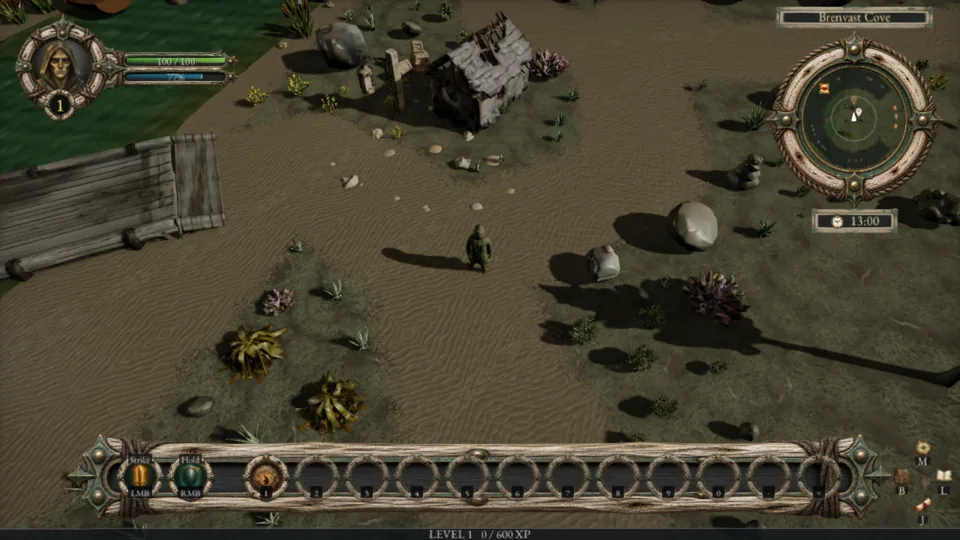
 Brenvast CoveA screened inlet a short walk south of the port where two or three flat-bottomed skiffs can run up unseen.
Up close
3 things to look at closer
- You go along the shingle where the skiffs run up. Four keel-marks, all the same width, all dragged to exactly the same line above the tide — somebody measures this beach.
- The screening rocks stand where they stand by luck, but the gorse behind them has been cut back and trained. Somebody spent a season making this inlet invisible from the water.
- Nothing is left on the shingle between runs. That is the discipline the place is really built on.
Gathered here
- Bitter Salt

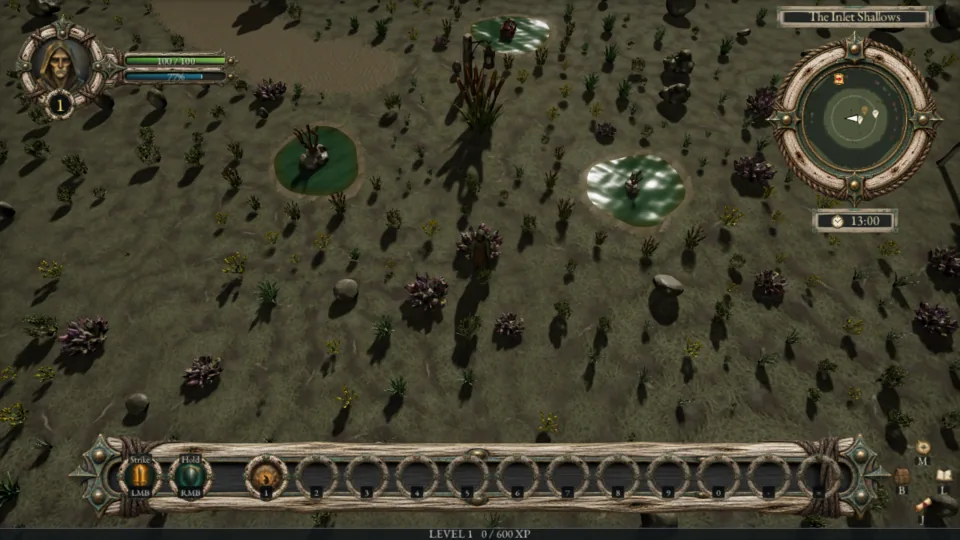
 The Inlet ShallowsThe cove's own tide-rocks break the swell here, so the water inside runs calm and warm over sand — a line needs no boat, and young tide-crabs work the shallow mud at the ebb for anyone's first hunt.
The cove's own tide-rocks break the swell here, so the water inside runs calm and warm over sand — a line needs no boat, and young tide-crabs work the shallow mud at the ebb for anyone's first hunt. A handful of cove seals haul out on the outer rocks, undisturbed since no official traffic ever comes far enough to scare them off. Nothing here fights back; it is the ground a crossing-party is shown first, before they are trusted with anything that does.
Up close
3 things to look at closer
- You wade the warm water at the ebb. The young crabs work the mud in plain sight, and none of them run from you — nothing here has ever been hunted seriously.
- The seals on the outer rocks lift their heads, decide you are not worth moving for, and put them down again.
- The shallows are exactly as safe as they look. That is why crossing-parties are shown them first.
Gathered here
- Inlet Fish
- Tide-Crab
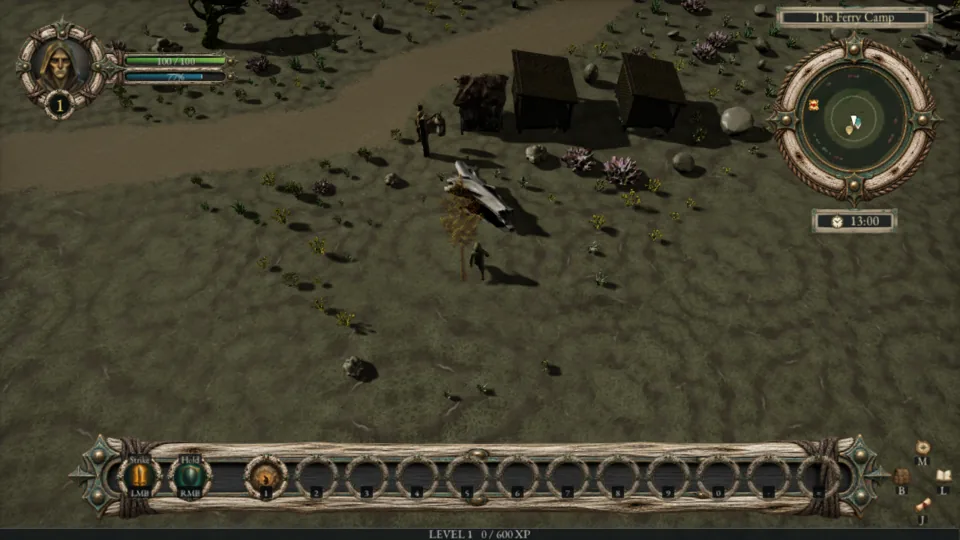
 The Ferry CampA driftwood lean-to row west of the cove where the people who actually run the crossings wait out the tide between jobs — a board nailed to the end post for the odd jobs and word from up the coast.
A driftwood lean-to row west of the cove where the people who actually run the crossings wait out the tide between jobs — a board nailed to the end post for the odd jobs and word from up the coast. Nobody here answers for the cove itself; a boat, a bunk and a going rate is all the camp offers, and that has been enough to keep three or four hands through every season since the first skiff ran. Dresva Ferrywright keeps what passes for its books.
Up close
3 things to look at closer
- You read the board nailed to the end post. Four jobs, three hands, and a going rate written in chalk that has been rubbed out and rewritten twice this season.
- The lean-tos are driftwood over a bunk each, and every bunk has a bag under it packed to leave. Nobody here is settling.
- There is nothing behind the camp but the tide-times chalked on the post — which is all the camp has ever claimed to be.
People here
| Name | Does |
|---|---|
 Dresva Ferrywright | quest giver, vendor |
Gathered here
- Unlogged Parcel
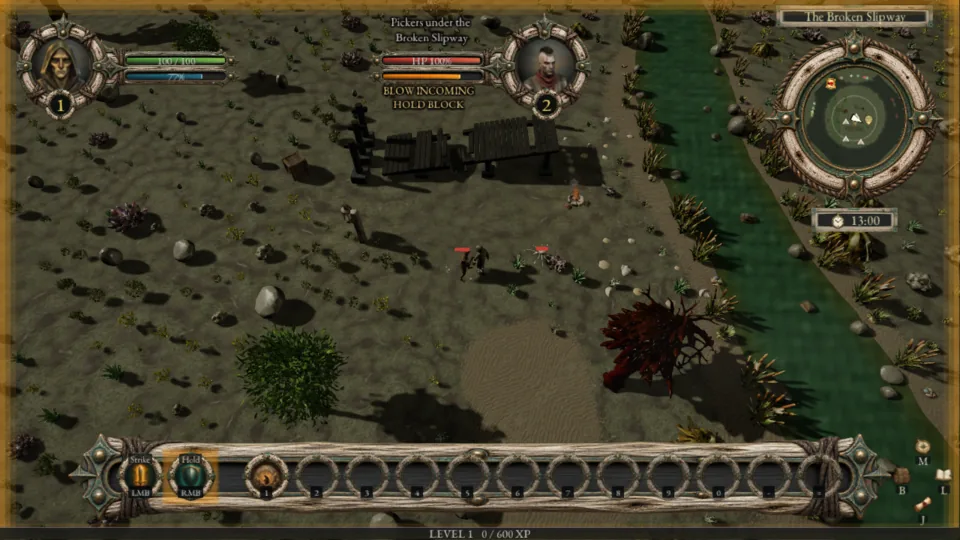
 The Broken SlipwaySun-bleached pilings and a collapsed timber ramp east of the cove, laid down by some earlier hand long before Halvreth's crossings ever needed a cove at all — nobody now living remembers who built it or why they left.
Sun-bleached pilings and a collapsed timber ramp east of the cove, laid down by some earlier hand long before Halvreth's crossings ever needed a cove at all — nobody now living remembers who built it or why they left. The fallen decking has a dry space under it, exactly the kind of place a hurried crossing would tuck something rather than carry it further. The tide has taken most of the rest.
Up close
7 things to look at closer
- You get under the fallen decking. The pilings are jointed, not lashed — proper yard work, from a yard nobody on this coast remembers.
- The ramp went down in one piece and stayed where it fell. Whatever ended here ended fast enough that nobody came back for the timber.
- The tide has taken everything but the shape of it, and the shape says this was built for something bigger than a skiff.
- You get under the fallen decking again and follow a piling down. It is set in cut stone below the waterline.
- The ramp's timbers are jointed with pegs rather than iron, which is older work than anything the cove uses.
- There is a name-cut on the inside face of one piling, worn to three letters, and none of them are letters the Trade uses.
- The tide has taken everything above the stone. What is below it is not going anywhere.
Foes here
| Who | Levels |
|---|---|
| Pickers under the Broken Slipway | 2–3 |
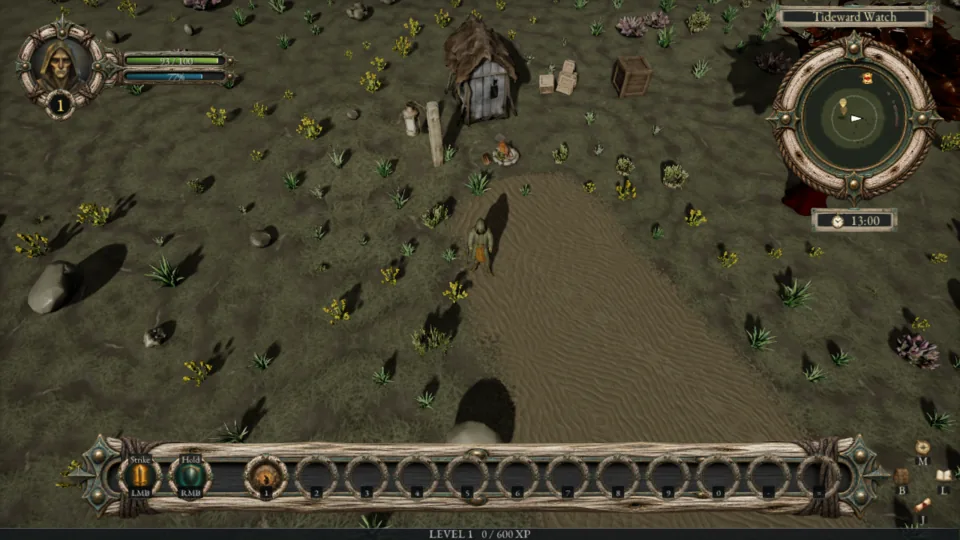
 Tideward WatchA lean-to and a fire-scarred flat stone northeast along the inland track, where whoever is minding the road that day keeps an eye on the tide-times and the coming traffic both.
A lean-to and a fire-scarred flat stone northeast along the inland track, where whoever is minding the road that day keeps an eye on the tide-times and the coming traffic both. It is the only place in the zone with a fixed lookout, though the face behind the fire changes with the season and the job. Word of a crossing gone wrong, or one worth watching for, starts here before it ever reaches the cove.
Up close
3 things to look at closer
- You sit at the fire-scarred stone where whoever is minding the road sits. From here you see the track, the inlet mouth, and nothing else — which is the whole point of where it is.
- The tide-times are cut into the stone itself, one notch a season, going back further than anyone at the cove has been alive.
- The watch is a stone, a fire and a view. There is nothing else to find and there never was.
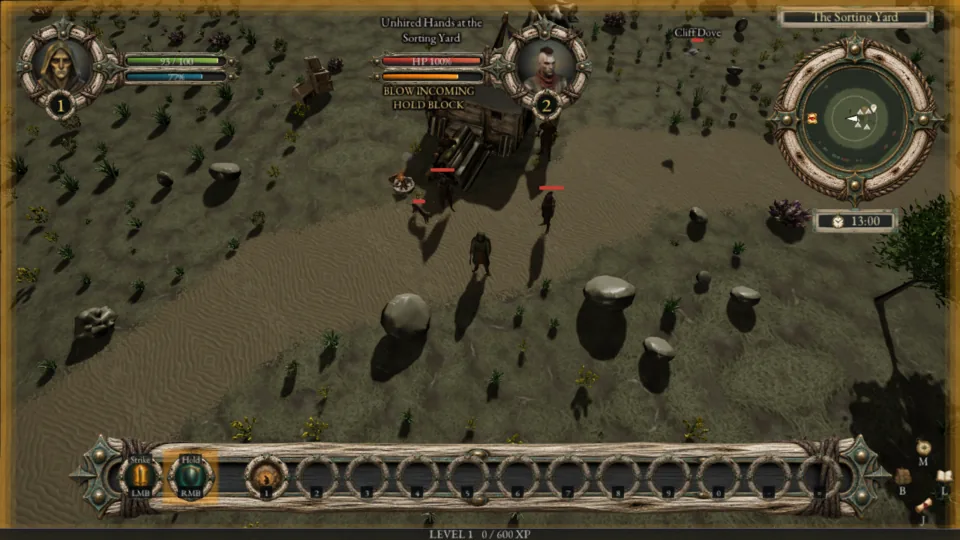
 The Sorting YardThe scrubby flat northwest of the cove where Tideward Watch's own hands sort what a crossing actually carried — driftwood cut to size, netting mended, the odd salvaged crate broken down before anyone asks whose manifest it left off of.
The scrubby flat northwest of the cove where Tideward Watch's own hands sort what a crossing actually carried — driftwood cut to size, netting mended, the odd salvaged crate broken down before anyone asks whose manifest it left off of. Timber and gorse both grow thick enough here to work, and the ground shows more boot-wear than anywhere else in the zone that isn't the cove itself.
Up close
3 things to look at closer
- You go through what has been sorted. Driftwood cut to length, netting mended, and one crate broken down so thoroughly that not one burn-mark survives on any face of it.
- The boot-wear here runs in a loop — yard to cove, cove to yard — and one path that leaves the loop northwest and does not come back.
- Everything worth sorting has been sorted. The yard is tidy in the way a place is tidy when the people who use it expect to be asked about it.
Foes here
| Who | Levels |
|---|---|
| Unhired Hands at the Sorting Yard | 2–3 |
Gathered here
- Shore Gorse Bloom
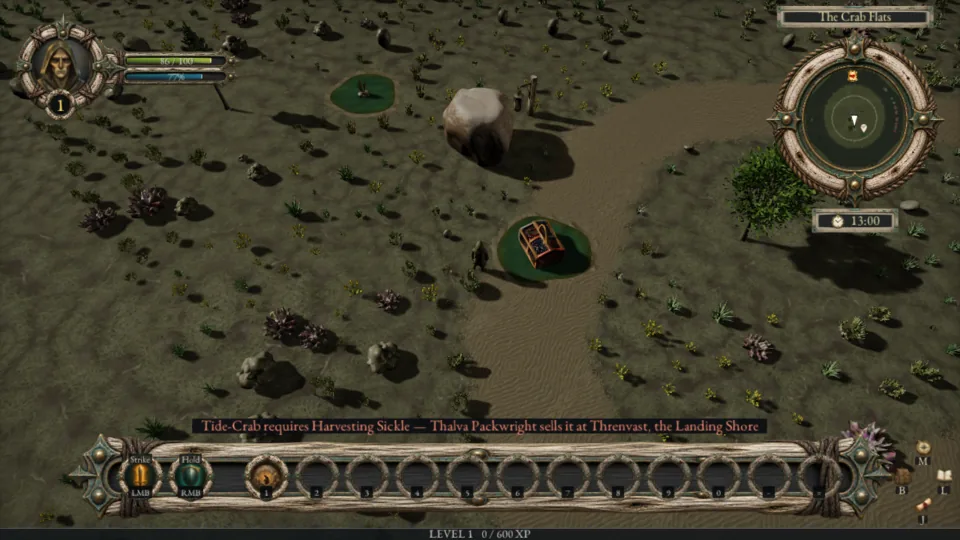
 The Crab FlatsThe inlet's mudflat north of Tideward Watch, worked at low tide by whoever wants shell and meat enough to earn it — the same crabs the cove's own shallows raise smaller and easier, grown proper out here where the mud runs deeper.
The inlet's mudflat north of Tideward Watch, worked at low tide by whoever wants shell and meat enough to earn it — the same crabs the cove's own shallows raise smaller and easier, grown proper out here where the mud runs deeper. Past the worked ground the mud stops firming up at all, which is exactly why nobody works past where the pickers already have.
Up close
4 things to look at closer
- You work the mud at the low tide. The crabs out here are twice the size of the cove's and take twice the digging, which is exactly the trade the pickers made.
- Past the worked ground the mud stops firming up. You go three paces further than you meant to and come out slower than you went in.
- The flats are worked to the edge of where working them is sensible, and not one pace past it.
- You go out one more time on the turning tide and take what the last dig loosened. The mud closes behind your hand as you pull it back.
Gathered here
- Inlet Fish
- Tide-Crab
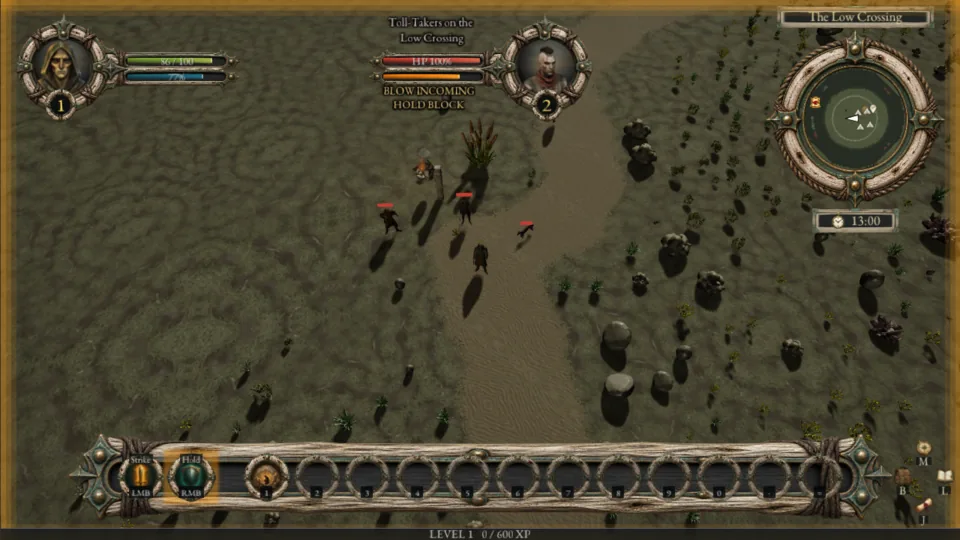
 The Low CrossingA shelf of tide-washed rock southeast of the cove that bridges the two headlands at anything short of full tide — the actual crossing Brenvast takes its name from, older and plainer than anything Halvreth's own trade runs on it.
A shelf of tide-washed rock southeast of the cove that bridges the two headlands at anything short of full tide — the actual crossing Brenvast takes its name from, older and plainer than anything Halvreth's own trade runs on it. Anyone willing to time the water can walk it dry-shod; anyone who isn't waits for a boat instead. No one has ever bothered marking it, because the tide already does.
Up close
4 things to look at closer
- You walk the shelf dry-shod with the tide out. It is a road — flat, wide enough for two, and nobody has ever put a mark on it because the water marks it twice a day.
- Halfway across, the rock underfoot changes: dressed stone, worn smooth, laid by somebody who thought this crossing was worth improving.
- The far headland is close enough here that the crossing barely deserves the name. That is why the cove's whole trade exists to sell you a boat instead.
- You wait out a whole turn of the water at the shelf's edge, and watch the road disappear under it in about the time it takes to eat.
Foes here
| Who | Levels |
|---|---|
| Toll-Takers on the Low Crossing | 2–3 |
Gathered here
- Pale Amber
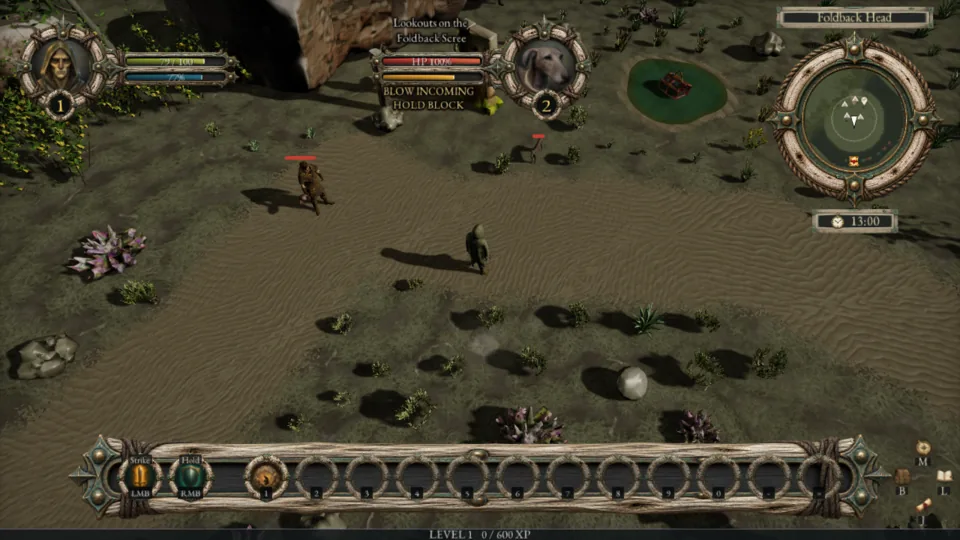
 Foldback HeadThe headland northwest of the Sorting Yard, high enough that the port's own rooftops would be visible on a clear day if the angle didn't fold the whole view away just short of the quays.
The headland northwest of the Sorting Yard, high enough that the port's own rooftops would be visible on a clear day if the angle didn't fold the whole view away just short of the quays. The climb up is loose scree and switchback goat-track, harder than anything else in the zone — but nothing waits at the top to make it worse, only the view and the wind.
Up close
3 things to look at closer
- You come up the scree the way the goats do, and the wind takes the last of your breath at the lip.
- From the top the coast folds away exactly short of the port's rooftops, the way it always does. Whatever you came up here to see, the land has already decided you cannot.
- There is nothing up here but the view and the wind, and the view is of somewhere else.
Foes here
| Who | Levels |
|---|---|
| Lookouts on the Foldback Scree | 2–3 |
Gathered here
- Tide-Crab
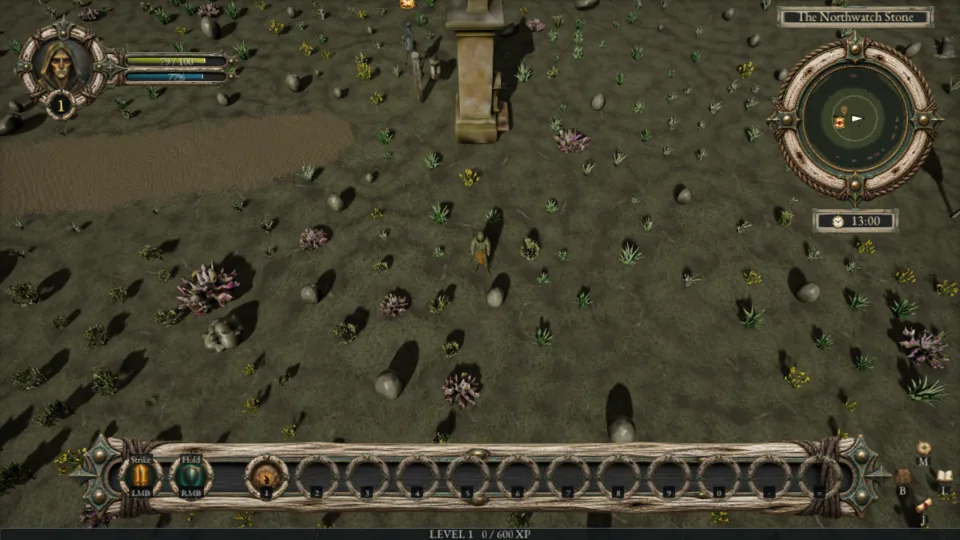
 The Northwatch StoneA standing marker stone just north of the Crab Flats, where the cliff path climbs back up toward the Landing — the last waystone before the crossing stops being Brenvast's business and starts being the port's.
A standing marker stone just north of the Crab Flats, where the cliff path climbs back up toward the Landing — the last waystone before the crossing stops being Brenvast's business and starts being the port's. Fenvara Cliffwarden holds it, checking every face that passes either way against whatever the day's roster says to watch for.
Up close
3 things to look at closer
- You read the marker. Names, times, and a column of small marks against the ones the day's roster says to watch for.
- Fenvara checks your face against the roster without pretending she is doing anything else, and lets you past.
- The stone is the last thing that belongs to the cove. Past it, everything is the port's business again.
People here
| Name | Does |
|---|---|
 Fenvara Cliffwarden | quest giver, guard |
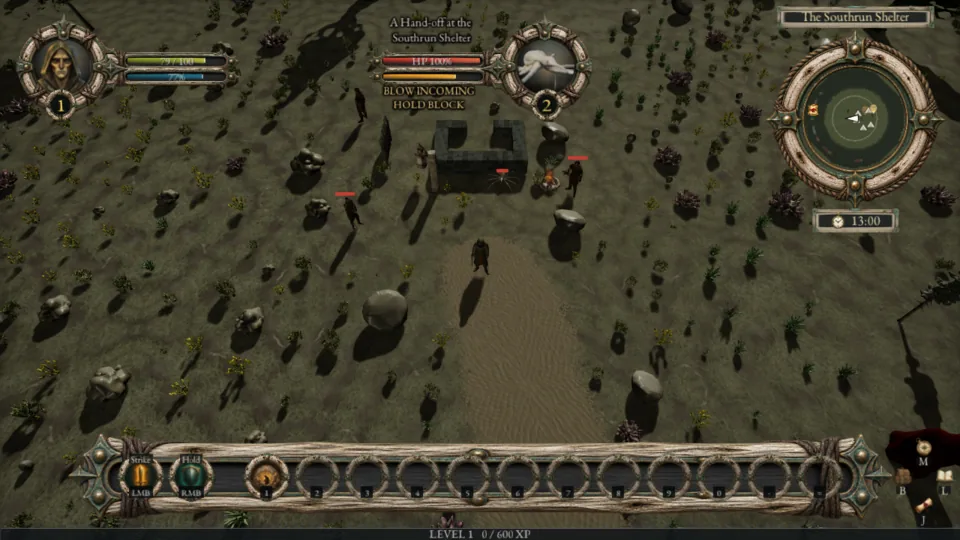
 The Southrun ShelterA low stone shelter southwest of the Ferry Camp, built into the lee of the cliff where the coast path keeps running south past anywhere Brenvast's own business reaches.
A low stone shelter southwest of the Ferry Camp, built into the lee of the cliff where the coast path keeps running south past anywhere Brenvast's own business reaches. Runners heading further down the coast wait out weather here rather than risk the open cliff-top, and whatever they are carrying changes hands as often as not before they move on. Nobody at the cove asks where the path goes after this; that is the whole point of it.
Up close
3 things to look at closer
- You duck into the lee. Somebody has been here within the hour: a warm stone by the fire, and a place where a pack sat in the dust.
- Whatever changes hands here changes hands fast — no stores, no stock, nothing kept. The shelter is a place to not be seen for twenty minutes.
- Nobody at the cove asks where the path goes after this, and standing in it you understand that is a courtesy, not ignorance.
Foes here
| Who | Levels |
|---|---|
| A Hand-off at the Southrun Shelter | 2–3 |
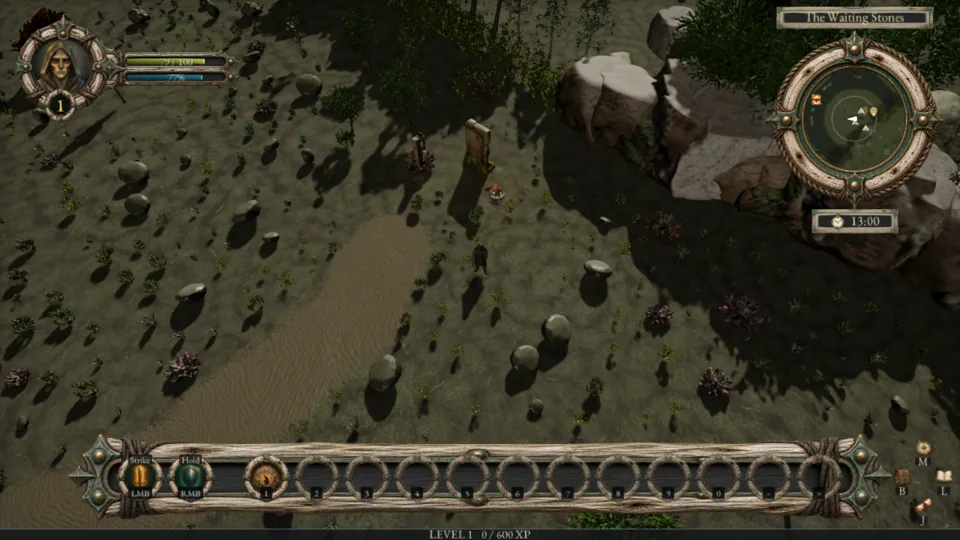
 The Waiting StonesA scatter of flat stones south of the Low Crossing, each one carrying a scratched mark or a worn coin wedged into the cracks — left, by habit more than custom, by people who waited here for a boat that was late or never came.
A scatter of flat stones south of the Low Crossing, each one carrying a scratched mark or a worn coin wedged into the cracks — left, by habit more than custom, by people who waited here for a boat that was late or never came. The stones are set closer than a marker needs, and one of them sits proud of the line it should keep. Nobody at the cove claims to know whose habit started it.
Up close
7 things to look at closer
- You read the marks on the flat stones. Names, initials, one whole date — and a coin wedged into a crack, so worn its face is a suggestion.
- You look for a coin thin enough to spare and wedge it into a crack of your own choosing. Nobody is watching, which is most of what the custom is.
- There are more marks than there are stones, cut over one another. People waited here for a very long time, and some of them more than once.
- You count the marks properly this time. There are more marks than stones, cut over one another, going back further than the cove's own trade.
- One stone has been turned over at some point and re-set with its marked face down.
- The coins wedged in the cracks are all small denominations, and all of them are port coin rather than cove coin.
- You have read every stone that carries anything. The rest are just flat rocks, which is what makes the marked ones worth reading.
Foes here
| Who | Levels |
|---|---|
| Diggers among the Waiting Stones | 2–3 |
Saltmarsh Reach
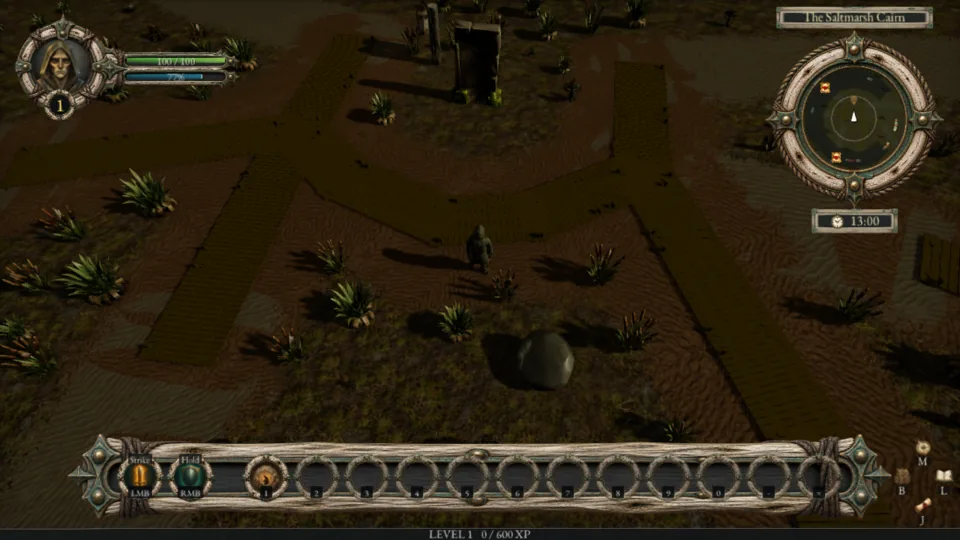
 The Saltmarsh CairnA Relay-Chain cairn marking a completed survey sweep whose crew never filed their report; the ground around it has gone sound-dead.
Up close
3 things to look at closer
- You read the cairn's own marks. Survey shorthand, cut clean: the date, four hands, and the closing stroke a crew cuts when the work is finished and the stones are re-set. They finished. They just never filed it.
- Thirty paces out the sound comes back — reeds, water, your own boots. Thirty paces in, it goes again. The dead-silence has an edge you can stand on, and it is a circle.
- There is nothing under the stones. You lift two of the smaller ones to be sure and set them back the way the crew left them, which is the only respect a cairn takes.

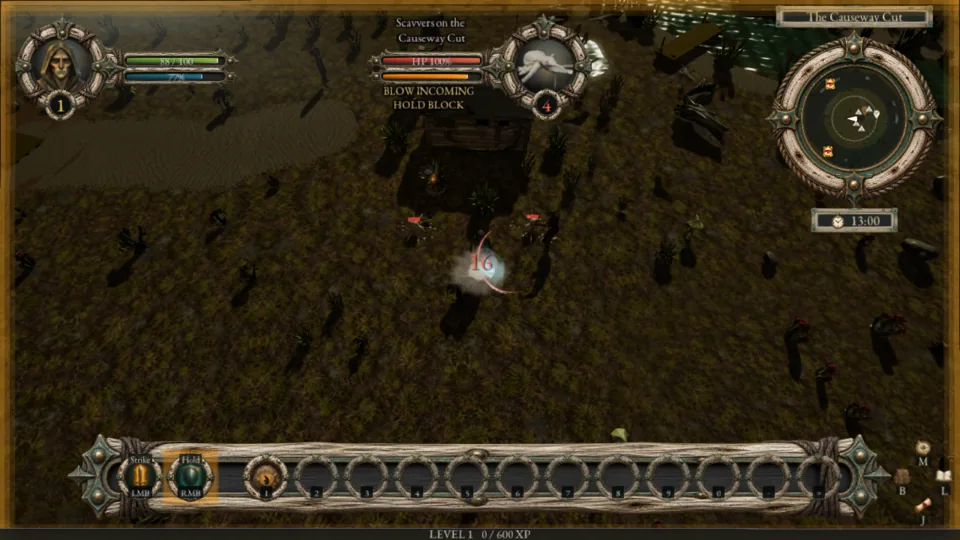
 The Causeway CutWhere the survey road crosses a tidal channel well short of the Cairn — a fishing spot, a rest hearth, and the reach's own ordinary huntable ground, kept deliberately clear of the Cairn's thirty-pace dead-silence radius.
Up close
3 things to look at closer
- You walk the cut at the low water. The stonework under the road is older than the road — dressed blocks, laid dry, by somebody who expected the tide to argue with them.
- The rest hearth has been used within the week: ash still dry in the middle, and a fish spine picked clean and dropped where somebody sat.
- You work the channel edge over and turn up nothing but weed and the cold. Whatever crosses here does it in daylight and does not linger.
Foes here
| Who | Levels |
|---|---|
| Scavvers on the Causeway Cut | 4–5 |
Gathered here
- Causeway Catch
- Marsh Herbs
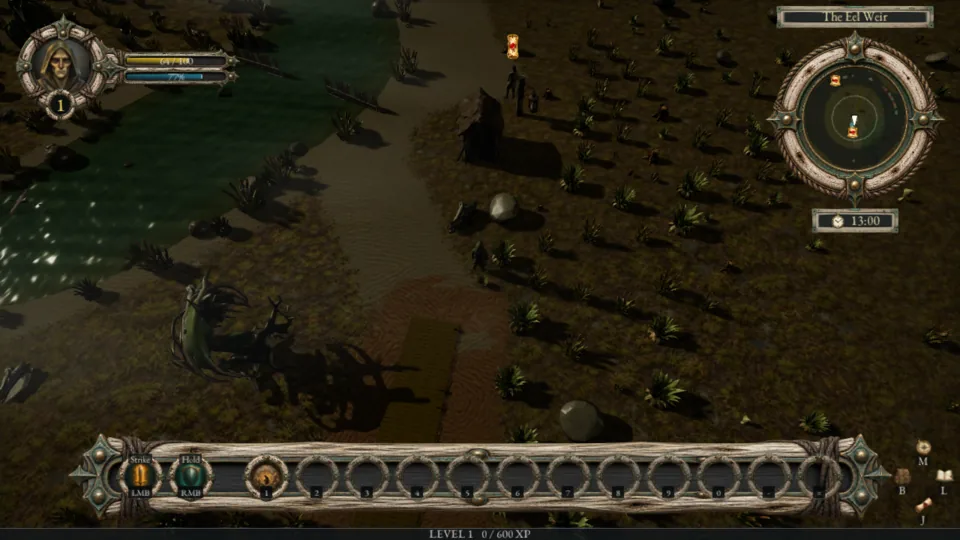
 The Eel WeirA Hush Trade weir-stake fence strung across a slow channel where eels run thick with the autumn tide, tended by a handful of trade hands who smoke the catch and split it against the port's ledger.
A Hush Trade weir-stake fence strung across a slow channel where eels run thick with the autumn tide, tended by a handful of trade hands who smoke the catch and split it against the port's ledger. A contract board nailed to the drying rack takes on work the Tally House can't reach this far out. Reed thatch keeps the smokehouse dry through the wet months, and the channel beyond the stakes is calm enough to work without a second thought.
Up close
3 things to look at closer
- You lift a weir-stake and look down the run. The eels come with the tide in a rope of their own bodies, and the fence turns them into a queue.
- The smoke-house rack is full and the ledger nailed beside it is not: three days of catch, no entries. Somebody has been too busy to write, or too careful.
- You go along the whole fence and find one stake pulled and re-set at the far end, out of line with the rest. Something came through and somebody tidied up after it.
People here
| Name | Does |
|---|---|
 Fenna Reedwright | quest giver, vendor |
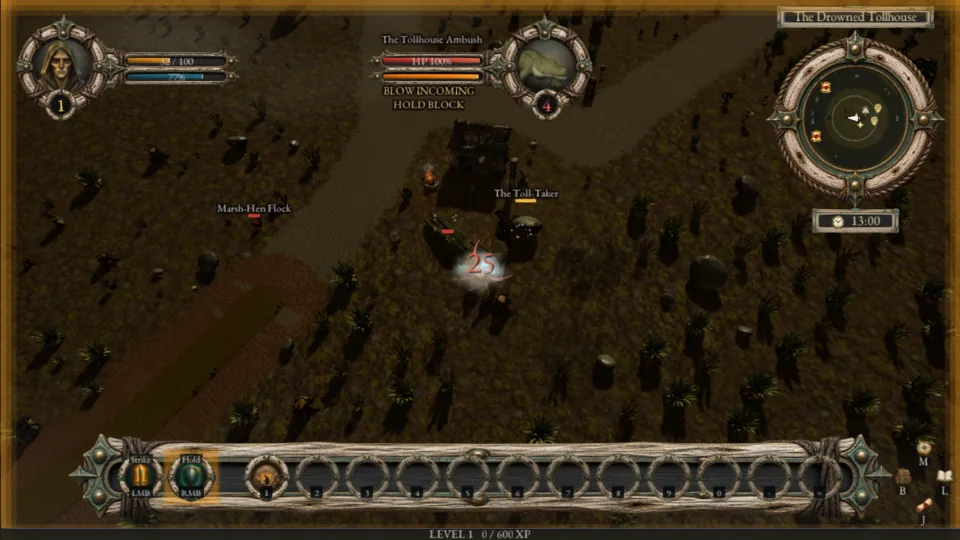
 The Drowned TollhouseA collecting-post from before the Hush Trade ever ran a road out here — older charters name a toll taken on this crossing generations before the causeway was cut, and one standing doorway and a stone footing are all that outlasted the tide.
A collecting-post from before the Hush Trade ever ran a road out here — older charters name a toll taken on this crossing generations before the causeway was cut, and one standing doorway and a stone footing are all that outlasted the tide. Its cellar sits half-flooded and half-hidden, packed with whatever the crossing's later takers didn't carry off. The reeds around the doorway grow thick enough to hide a watcher, and travelers who cross here alone sometimes don't report what took the toll this time.
Up close
9 things to look at closer
- You go through the standing doorway because it is the only thing left to go through. The threshold stone is worn in a curve — a great many feet, over a great many years, on a crossing nobody now charges for.
- The stone footing carries a cut mark under the waterline: a toll-scale, notched for weights the Hush Trade does not use and has never used.
- Under the fallen half of the floor there is a cellar with a foot of standing water in it and a ledger-shelf above the line, empty, with the dust disturbed.
- You clear the reeds by the door back far enough to see the sill. There are three sets of prints in the mud under them, all coming out, none going in.
- In the flooded half, something is wedged under the fallen floor at arm's depth: a strongbox hasp, snapped, with the box gone.
- You go over the standing doorway one more time. On the inner face, at knee height where a sitting man's hand would rest, the stone is worn smooth in a patch the size of a palm.
- You get the last of the reeds off the sill. Under them the threshold stone carries a second, shallower wear-line — a different width of foot, a different century.
- The cellar water is warmer than the channel outside it, which it has no business being.
- You go over the standing doorway a final time. Every cut on it is weathered except one, low down, that is not.
Foes here
| Who | Levels |
|---|---|
| The Tollhouse Ambush | 4–5 |
 The Toll-Taker | 4–5 |
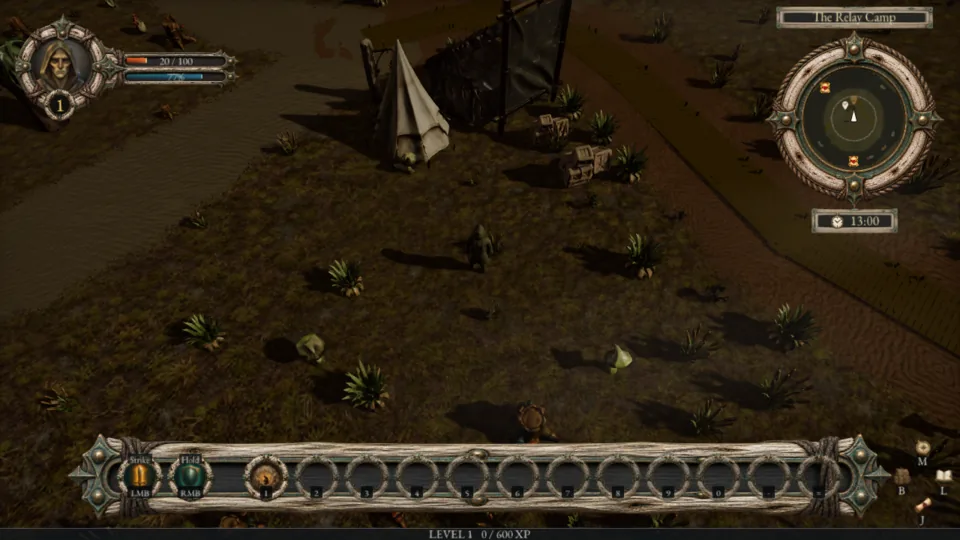
 The Relay CampA standing Relay-Chain camp on the survey road past the weir, canvas and a plank table where crews update the cairn charts before pushing on toward the scarp and the fens beyond.
A standing Relay-Chain camp on the survey road past the weir, canvas and a plank table where crews update the cairn charts before pushing on toward the scarp and the fens beyond. Runners rotate through on short postings, restocking from the port and carrying word back of what the marsh has swallowed this season. The camp keeps its own contract board for work too far out for the Tally House to track directly.
Up close
3 things to look at closer
- You read the plank table. The chart on it is the reach as it was surveyed, and the corrections pinned over it are all in one hand, and all of them move marks eastward.
- The contract board has four postings and a fifth torn off, leaving two corners of paper under the nail. Nobody here mentions a fifth.
- The camp is exactly what it looks like: canvas, a table, a kettle, and people who will be somewhere else in a week. There is nothing in it that is not carried.
Gathered here
- Snare Cord
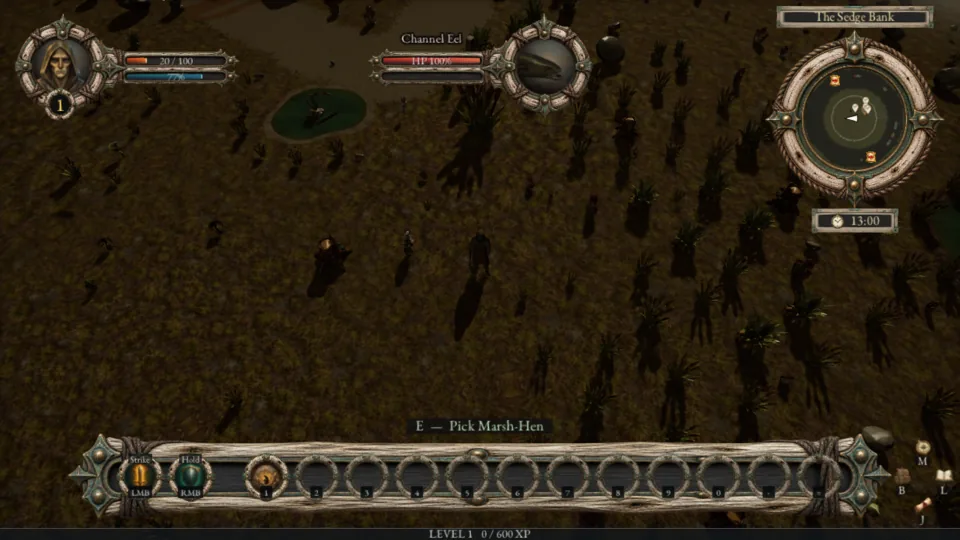
 The Sedge BankA raised bank of dry sedge and stunted willow at the edge of the relay camp's ground, cut for thatch, cordage, and the reed-fiber the port's ropewalks want more of than the coast can supply.
A raised bank of dry sedge and stunted willow at the edge of the relay camp's ground, cut for thatch, cordage, and the reed-fiber the port's ropewalks want more of than the coast can supply. Marsh herb clumps grow thick along its drier shoulder, worked by crews from the camp between postings rather than left to go wild.
Up close
3 things to look at closer
- You cut a handful of sedge to see how it takes the knife. Dry to the root, tough along the grain — rope fibre, and the ropewalks are right to want it.
- The herb clumps along the bank have been worked already, and worked badly: whole plants pulled instead of cut, which kills the stand for a season.
- There is a flattened place in the willow scrub the size of a sleeping man, and no fire anywhere near it.
Gathered here
- Causeway Catch
- Marsh Herbs
- Marsh-Hen
- Reed Cordage
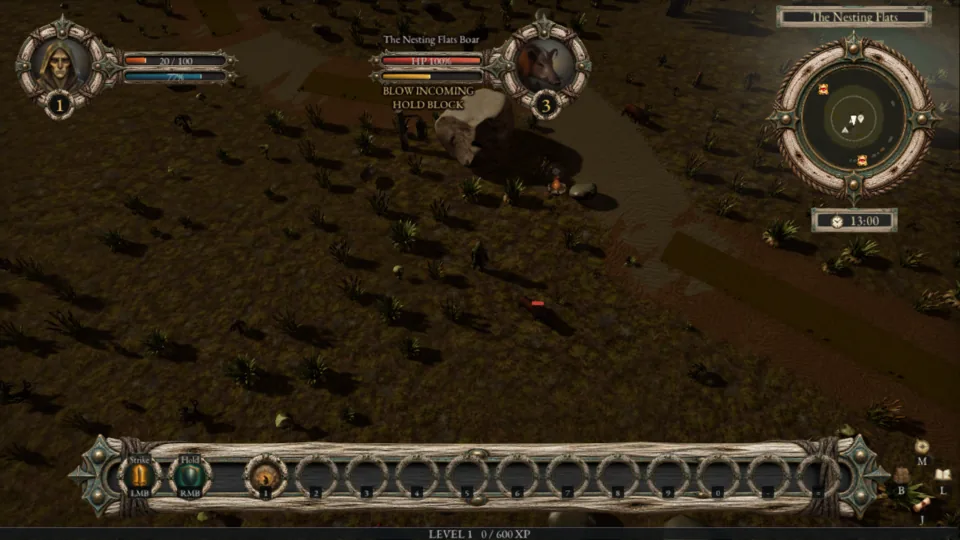
 The Nesting FlatsWide, waterlogged flats north of the relay camp where marsh-hens nest thick among the reed clumps, loud enough to hear before you see them — the reach's own game ground, worked under a Trade permit that caps what any one hand can take in a season.
Wide, waterlogged flats north of the relay camp where marsh-hens nest thick among the reed clumps, loud enough to hear before you see them — the reach's own game ground, worked under a Trade permit that caps what any one hand can take in a season. Feather and meat go back to camp for Cooking's pot and Harvest's tally alike.
Up close
3 things to look at closer
- You go in low along the reed line. The hens go up in a wall of noise fifty paces ahead of you, every time, which is exactly how a permit-capped bird stays a permit-capped bird.
- The nests you pass are thinned in a pattern — every second or third clutch taken, evenly, by somebody who wants this ground to still be here next season.
- Further out the pattern stops. Whole reed clumps are stripped bare, and the birds have abandoned the ground around them.
Foes here
| Who | Levels |
|---|---|
| The Nesting Flats Boar | 3–4 |
Gathered here
- Marsh-Hen
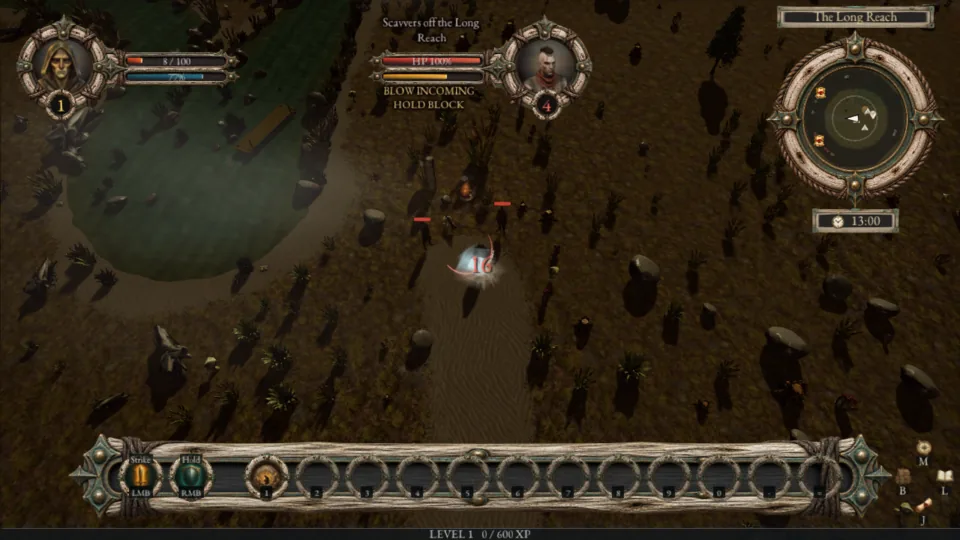
 The Long ReachThe wide, slow stretch of tidal reed-water the whole zone takes its name from — reed-water and standing channel as far as the eye follows, the salt-grass behind you and the fens ahead lost in the same grey haze.
The wide, slow stretch of tidal reed-water the whole zone takes its name from — reed-water and standing channel as far as the eye follows, the salt-grass behind you and the fens ahead lost in the same grey haze. No path crosses it directly; the survey road bends around its edge, and every charted route through the reach measures itself against how far out this water runs.
Up close
3 things to look at closer
- You wade out until the reeds close over the way you came. The water is warm on top and cold underneath, and it goes on doing that further than you are willing to walk.
- Something has been through the reeds ahead of you, pushing a channel wide enough for a body and letting it close again. It does not come back toward the road.
- The Long Reach is water and reed and grey light, and that is the whole of it. You have been out far enough to know nobody crosses it.
Foes here
| Who | Levels |
|---|---|
| Scavvers off the Long Reach | 4–5 |
Gathered here
- Poached Hide
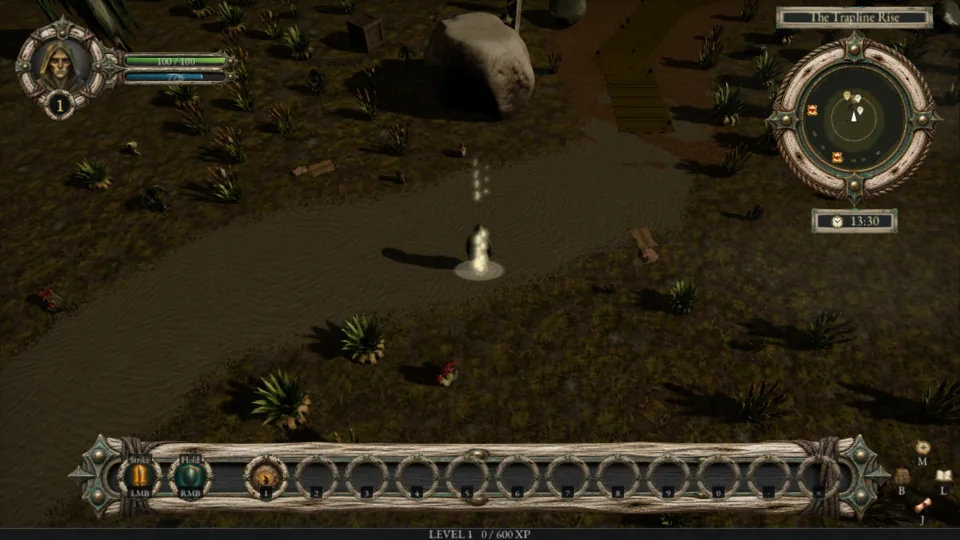
 The Trapline RiseA hummock of firmer ground rising just high enough over the reeds to see the whole reach at once — the causeway, the relay camp, the long grey water beyond.
A hummock of firmer ground rising just high enough over the reeds to see the whole reach at once — the causeway, the relay camp, the long grey water beyond. Snares and weighted nets run off it through the game trails below, strung by someone working the marsh-hens harder than any Trade permit allows, and the ground gets meaner the further you follow the lines off the rise.
Up close
10 things to look at closer
- You go up the hummock and see the whole reach at once — causeway, camp, the long grey water. This is where you would stand if you wanted to know when the crews move.
- You work the trapline down through the game trails. Every third snare is sprung and empty, and the ones that hold a kill hold it stiff: somebody is running this line ahead of the people who set it.
- Where the nets run into the reeds there is a cut cord end, weighted and dropped, tied in a knot the Trade's own hands do not use.
- You lie flat on the hummock and watch the reach the way somebody working this line would. From here every crew on the causeway is visible and nobody on the causeway can see you.
- The far end of the line runs into ground the permit does not cover, and the snares there are newer than the ones nearer the camp.
- You pull the last of the sprung snares and coil them. Whoever set these will know within a day that somebody has been up here.
- You lie flat again and wait out a full turn of the tide. Nobody comes up, which tells you the watcher works this rise on the crews' hours rather than the water's.
- The near snares are stiff with disuse and the far ones are oiled. Somebody maintains half of this line and lets the other half rot.
- From up here the reach reads as one system: causeway, camp, water, trails. Anyone who learned it from this hummock learned it whole.
- You have walked every trail off the rise. What is left is the water, and the water is not walkable.
Foes here
| Who | Levels |
|---|---|
 The Snarekeeper | 4–5 |
Gathered here
- Poached Hide
- Snare Cord
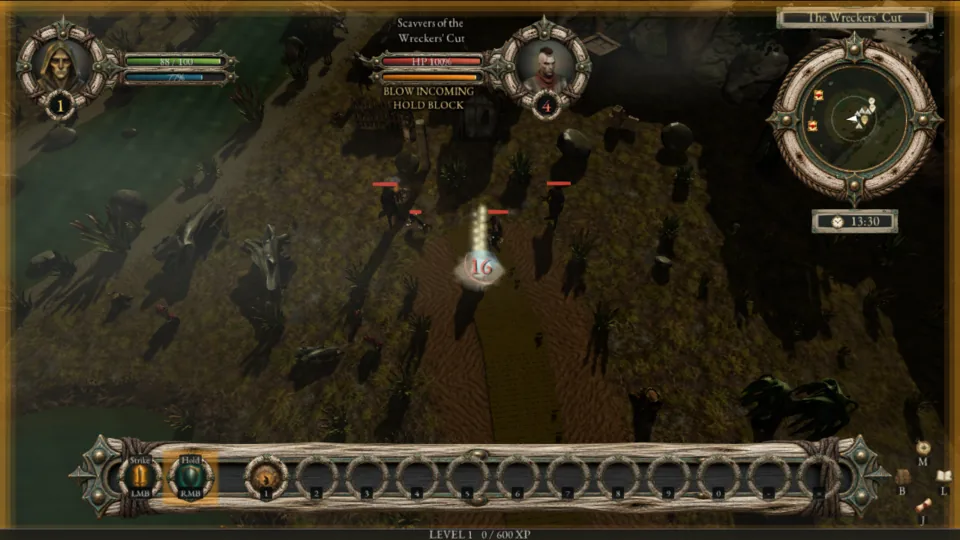
 The Wreckers' CutA tidal cut where a band of strand-scavvers has dragged hull-timber and stolen crates up from the coast to build a second camp, well off the charted road and past the old tollhouse.
A tidal cut where a band of strand-scavvers has dragged hull-timber and stolen crates up from the coast to build a second camp, well off the charted road and past the old tollhouse. They work the reach's game trails the same way they worked the Wreck, and anyone following the trapline this far is fair game to them.
Up close
3 things to look at closer
- You go up the cut from the water. The timber they have dragged up here is hull-planking, and the crates behind it still carry the port's own burn-marks under a coat of tar.
- Their fire-pit is dug deep and screened on the seaward side, so it cannot be seen from the coast — only from the reach, where nobody looks.
- You go over what they have not hidden and find nothing worth the walk. Whatever they take that matters, they do not keep it here.
Foes here
| Who | Levels |
|---|---|
| Scavvers of the Wreckers' Cut | 4–5 |
Gathered here
- Scavenger Cordage
- Scavenger Scrap
- Scavenger Sinew
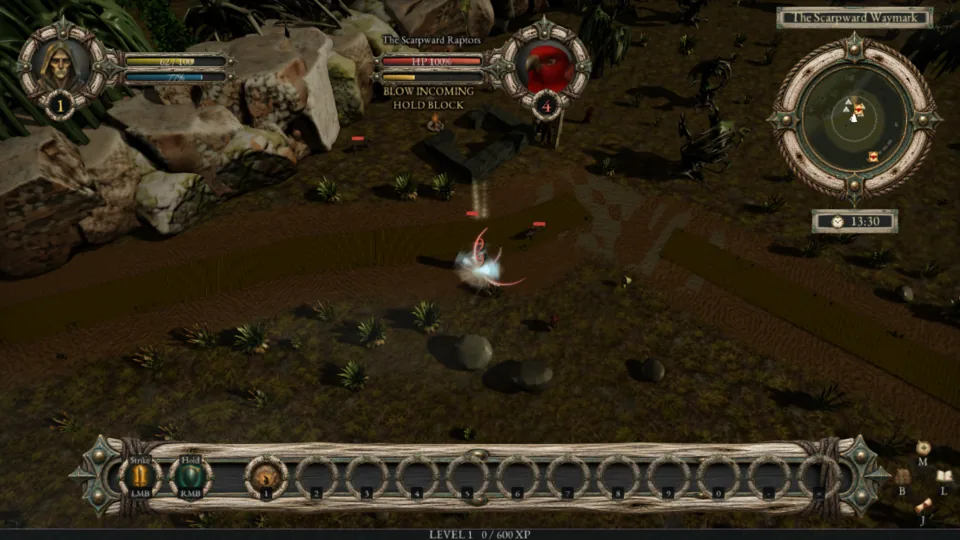
 The Scarpward WaymarkA waystone at the edge of the nesting flats where the survey road climbs out of the reeds toward the scarp country — the last charted ground before the marsh gives way to bare rock.
A waystone at the edge of the nesting flats where the survey road climbs out of the reeds toward the scarp country — the last charted ground before the marsh gives way to bare rock. A warden keeps the roster here and sees off anyone the port sends onward, and the stone itself marks the reach's own border the way the cairn marks its entrance.
Up close
3 things to look at closer
- You look up the road and see where the reeds stop. The marsh gives way to bare rock in the space of about thirty paces, as if it were ruled there.
- The roster on the stone has more names crossed out than standing, and the crossings are all in the same week.
- The waystone itself is Relay-Chain work, cut and set true, with the slot for a shielded lamp on the landward face. Nothing out here is meant to be seen from the sea.
People here
| Name | Does |
|---|---|
 Vosrenn Scarpward | quest giver, guard |
Foes here
| Who | Levels |
|---|---|
| The Scarpward Raptors | 4–5 |
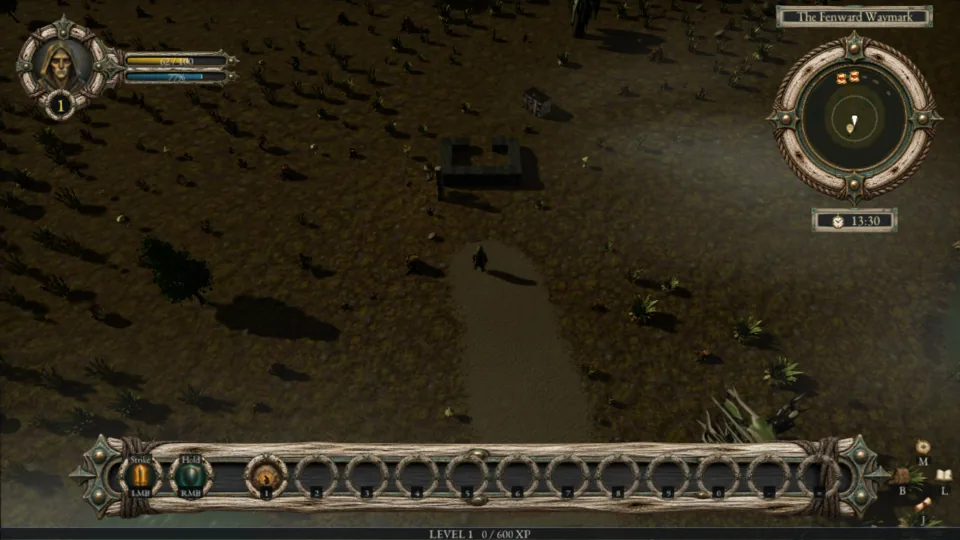
 The Fenward WaymarkA runners' shelter southwest of the weir where the road forks off toward the deeper fens, a lean-to and a fire kept low against the wet.
A runners' shelter southwest of the weir where the road forks off toward the deeper fens, a lean-to and a fire kept low against the wet. Whatever the port won't carry itself goes out from here by hand, and whatever comes back from the fens is counted here before it ever reaches the Tally House.
Up close
3 things to look at closer
- You duck into the lean-to. The fire is kept deliberately low — smokeless wood, banked tight — and there is dry kindling for four more nights stacked against the wall.
- Whatever goes out from here goes out by hand, and the ground shows it: a hard-packed path a boot wide, and no cart-rut anywhere.
- There is a mark scratched inside the lintel where only somebody lying down would see it. It is not a Trade mark, and it is recent.
The Gullbone Fens
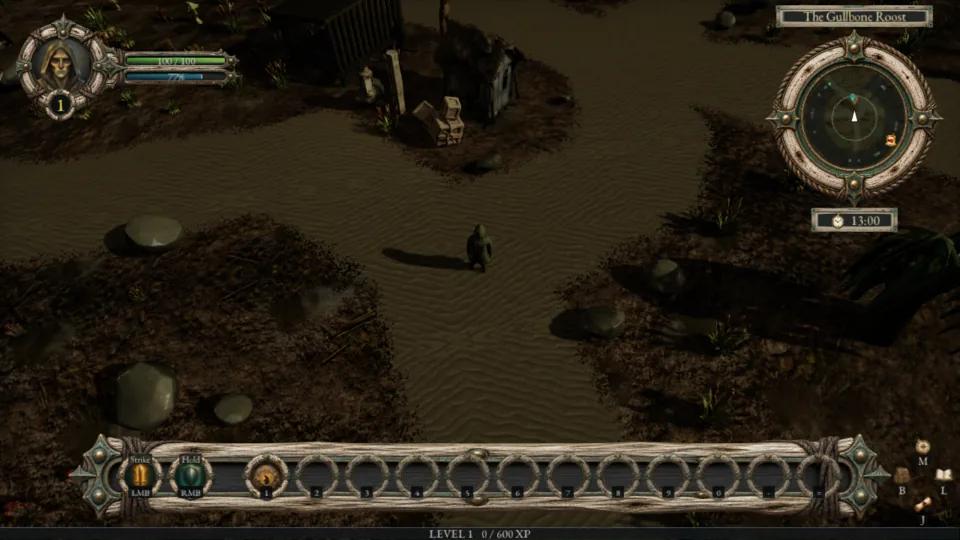
 The Gullbone RoostA scavenger camp where independent frontier folk work the margin between the charted edges and open thross-water.
Up close
7 things to look at closer
- You go through the Roost. Everything is lashed rather than nailed, and everything can be poled away inside an hour — a camp built by people who have moved it before.
- The margin they work is visible from the platform: charted water one way, open thross-water the other, and the Roost sitting on the line by choice.
- Nothing here belongs to the Trade and nothing here is hidden from it. That is a position, not an oversight.
- You go through the Roost's own stores. Everything is in baskets that a pole-boat can take two of, and nothing is in barrels.
- The platform lashings are checked and re-tied on a rota, and the rota is chalked where the person doing it can see it and nobody else can.
- Half the camp faces the charted water and half faces the open thross-water, and the fire is set where neither side can see it from a distance.
- There is nothing here that could not be gone by morning, and that is not a precaution — it is the design.
People here
| Name | Does |
|---|---|
 Vrenna Delnmark | quest giver, vendor |

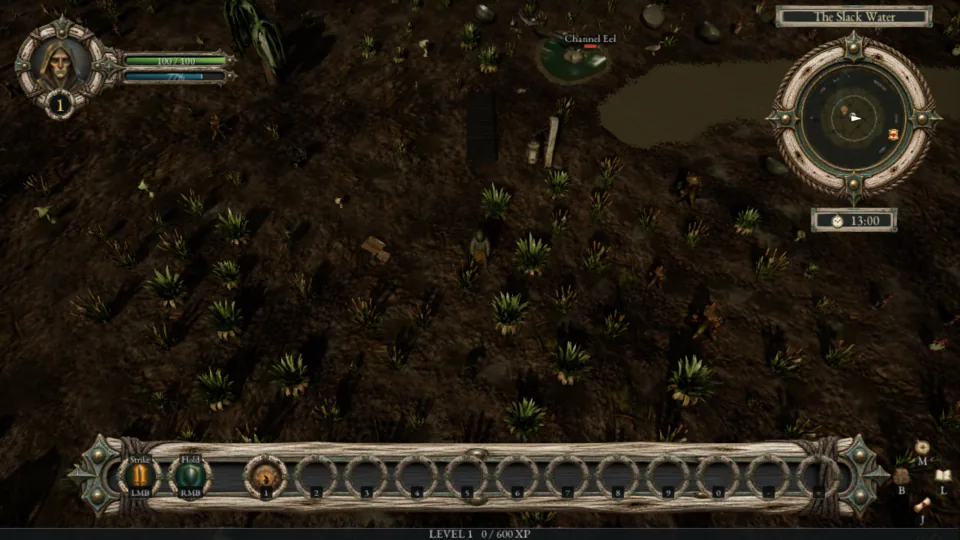
 The Slack WaterA stretch of channel so far from any throsseld's ground that the reed-warblers never once go quiet.
A stretch of channel so far from any throsseld's ground that the reed-warblers never once go quiet. The Roost sends every new hand here first, to pole for channel-eels and glean the old, safe kill-sites the gulls picked over seasons back. No hunt here has ever needed a spear.
Up close
3 things to look at closer
- You pole the slack. The reed-warblers never once go quiet, which is the whole reason the Roost sends its new hands here first.
- The water is so far from any throsseld's ground that the birds have never learned the alarm call. You could sleep on this stretch.
- It is a quiet piece of channel and it stays quiet. There is nothing else to find in it and that is the point of it.
Gathered here
- Fen Catch
- Rough Hide
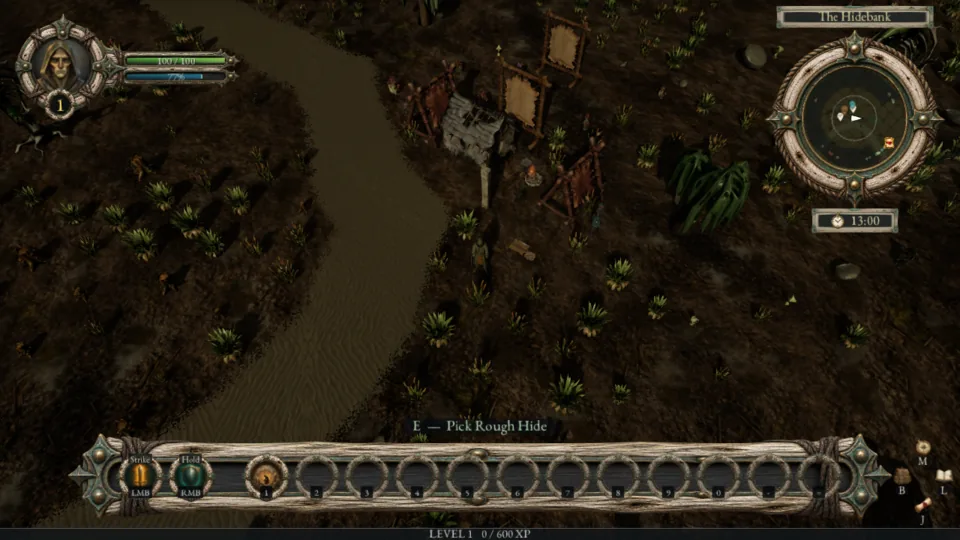
 The HidebankA curing yard the Roost keeps upwind and out of easy sight: reed-drying racks strung with throsseld-kill hides too rank or too raw for Vrenna's own board, worked here first before they go to market.
A curing yard the Roost keeps upwind and out of easy sight: reed-drying racks strung with throsseld-kill hides too rank or too raw for Vrenna's own board, worked here first before they go to market. Fenna Hidewright runs it and keeps the second request board, the plainest work the fens have to offer a new hand.
Up close
3 things to look at closer
- You work the drying racks. Throsseld hide cures rank enough that the yard is upwind of everything and out of sight of most of it.
- The hides are scored where the kill went in, and every score is in the same place — whoever takes these knows exactly where a throsseld is soft.
- The racks are full and the yard is empty. Nobody stands in this smell longer than the work takes.
People here
| Name | Does |
|---|---|
 Fenna Hidewright | quest giver, vendor |
Gathered here
- Marsh Herbs
- Rough Hide
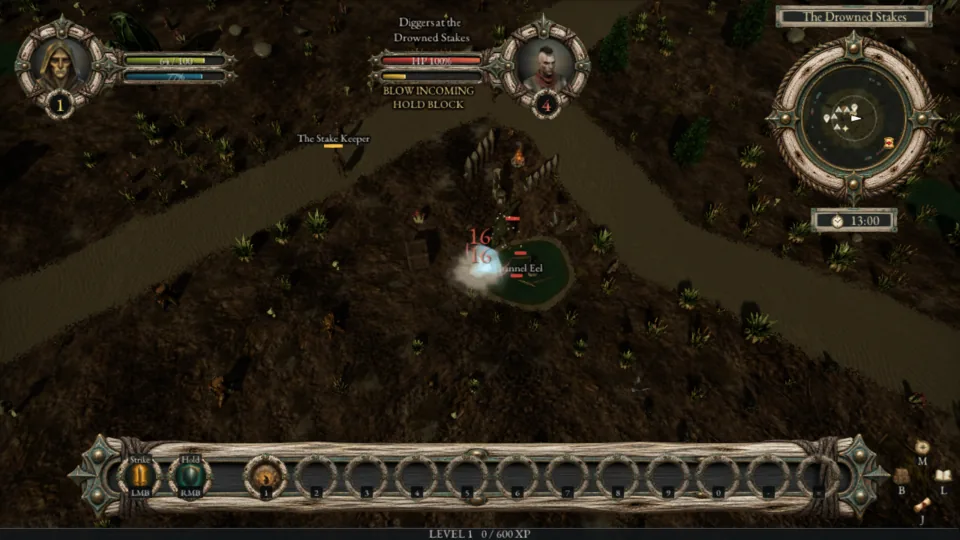
 The Drowned StakesThe rotted stake-line of a trapper's camp that worked this mudbank before the Roost ever existed, half-swallowed by silt now and picked bone-white by the gulls that finish what a throsseld starts.
The rotted stake-line of a trapper's camp that worked this mudbank before the Roost ever existed, half-swallowed by silt now and picked bone-white by the gulls that finish what a throsseld starts. What the old stakes still hide is worth digging for; what the bank leaves lying in the open is worth a rod and a little patience.
Up close
3 things to look at closer
- You wade the stake-line. It runs in a shape the Roost does not use — a closed pen rather than an open run, which means whoever set it was holding things alive.
- Under the silt the stakes are cut, not broken. This camp was dismantled rather than lost.
- Half the line is gone into the mud and the rest is going. It worked this bank before the Roost existed and nobody at the Roost mentions it.
Foes here
| Who | Levels |
|---|---|
| Diggers at the Drowned Stakes | 4–5 |
 The Stake Keeper | 5–6 |
Gathered here
- Bent Scrap
- Fen Catch
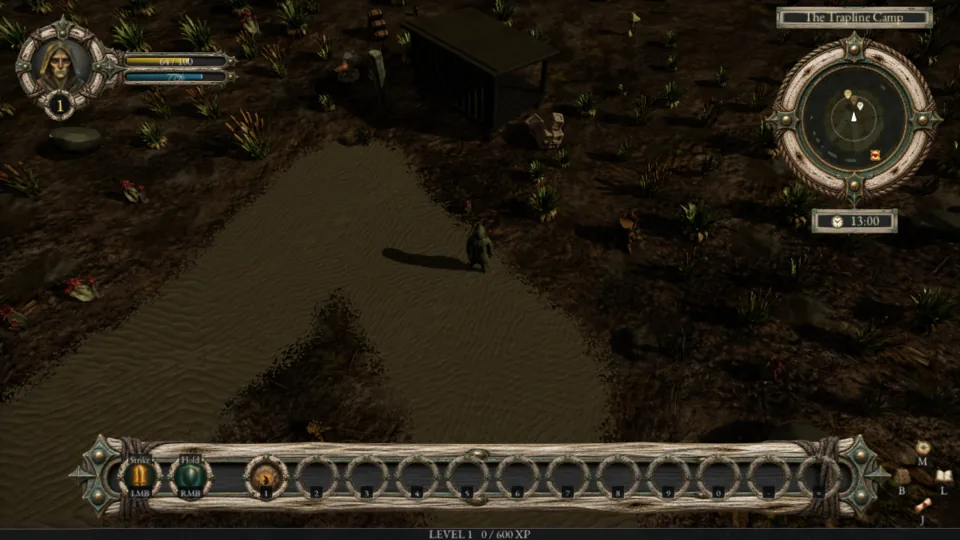
 The Trapline CampA lean-to and a request board on the road out of the Roost, where trapline runs get logged before anyone poles further into the fens.
A lean-to and a request board on the road out of the Roost, where trapline runs get logged before anyone poles further into the fens. No one lives here long; it is a stop, not a home, but it is the last place to pick up work before the channels stop being forgiving.
Up close
3 things to look at closer
- You read the request board. Runs are logged before anyone poles further in, in three hands, and the last entry has no return time against it.
- The lean-to holds spare poles, spare baskets and a spare pair of boots, all of them somebody's and none of them claimed.
- It is a board, a bed and a rule: write down where you are going. Everything else the fens sort out themselves.
Gathered here
- Reed Cordage
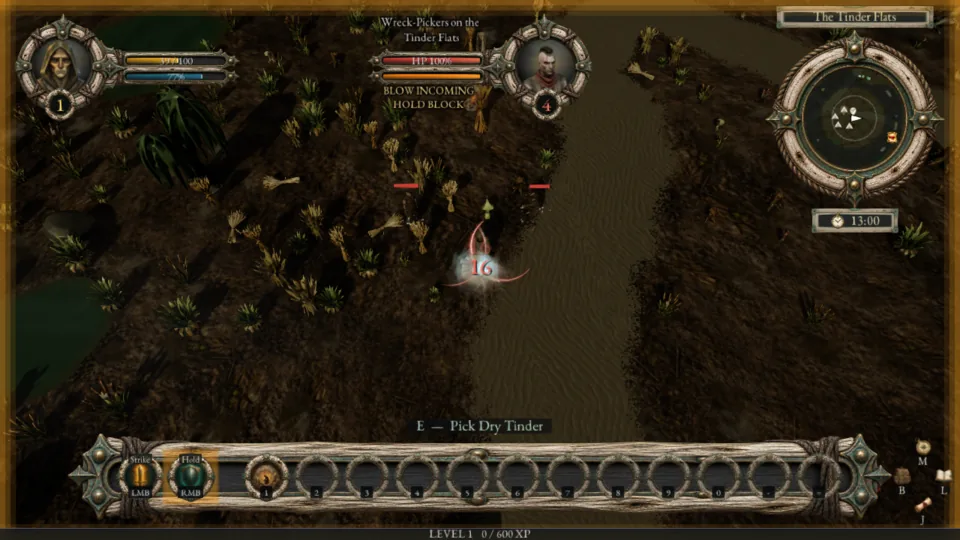
 The Tinder FlatsSun-cured reed stands at the edge of the working ground, cut and dried for thatch and tinder rather than left to rot in the wet — the kind of unglamorous labor that keeps the Roost's hearths lit through a wet season.
Up close
3 things to look at closer
- You cut in the sun-cured stands. Reed that has dried standing takes a flame at a touch, which is why this ground is cut rather than left.
- The cutting line is straight and old — the same stands have been worked in the same order for years, which keeps the flats producing instead of collapsing.
- What is left standing is this year's growth, and it is not ready. Cutting it now would cost next season.
Foes here
| Who | Levels |
|---|---|
| Wreck-Pickers on the Tinder Flats | 4–5 |
Gathered here
- Dry Tinder
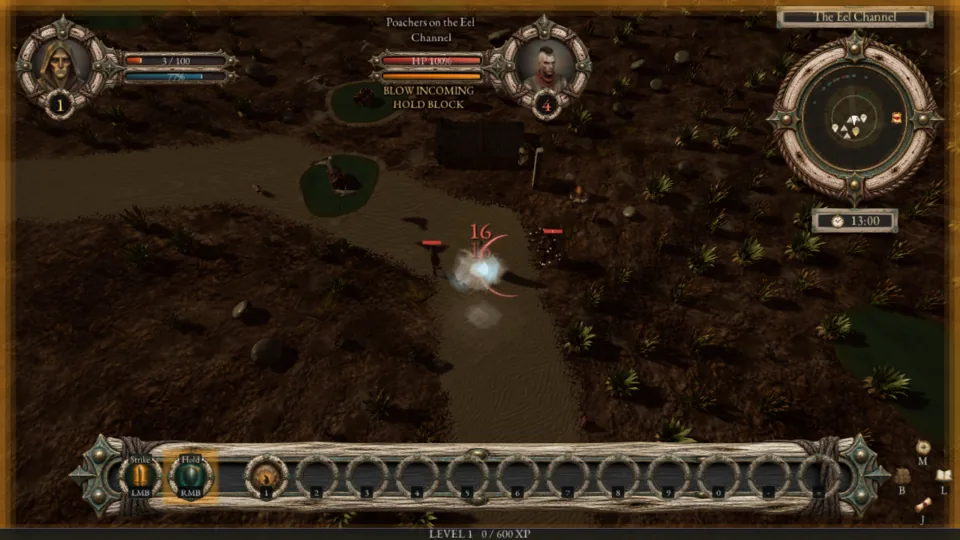
 The Eel ChannelA broad, slow-running cut where channel-eels run thick enough to work with a pole and a basket, the fens' one dependable haul.
A broad, slow-running cut where channel-eels run thick enough to work with a pole and a basket, the fens' one dependable haul. A narrow strip of picked-clean bank runs along its edge, where the gulls have already done half the scavenger's work.
Up close
3 things to look at closer
- You work the pole and basket. The eels come in a slow rope of bodies and the basket takes what it takes — the fens' one dependable food.
- The channel has been staked at both ends, loosely, so the run slows without being blocked. Somebody engineered this and nobody mentions it.
- The strongest run has passed. Patient work still finds eels against the stakes, but the easy basket is a matter of hours away.
Foes here
| Who | Levels |
|---|---|
| Poachers on the Eel Channel | 4–5 |
Gathered here
- Bent Scrap
- Channel Eel
 The Bleaching BankThe mudbank the Roost takes its name from: bone bleached white by sun and gull, scattered wherever a throsseld has fed and moved on.
The mudbank the Roost takes its name from: bone bleached white by sun and gull, scattered wherever a throsseld has fed and moved on. Channel-eels run the water at its edge, and everyone in the Roost knows the same rule about working it — stay small, stay quiet, and never make it look like more than gulls have been at it.
Up close
3 things to look at closer
- You walk the bone bank. Sun-white and scattered, most of it thross-picked, and the Roost took its name from this rather than from anything it built.
- Not all of it is animal. One piece is a jaw, and it is not a bird's, and it has been there long enough to bleach through.
- The gulls have had everything worth having off this mud. What is left will still be here in ten years.
Foes here
| Who | Levels |
|---|---|
| Claim-Jumpers on the Bleaching Bank | 5–6 |
Gathered here
- Channel Eel
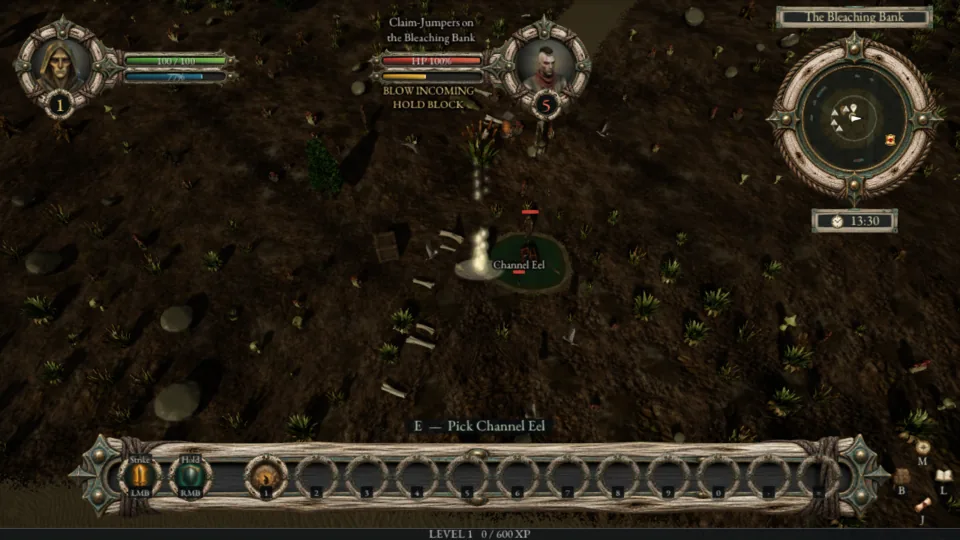
 The Driftwood StandAn old salvager's look-out lashed together from wreck-timber, high enough to see the channels running clear to the far bank — and now the Overreach's own ground, hoarding a stash no one else is meant to find.
An old salvager's look-out lashed together from wreck-timber, high enough to see the channels running clear to the far bank — and now the Overreach's own ground, hoarding a stash no one else is meant to find. The view is worth the climb; the company at the top is not.
Up close
7 things to look at closer
- You climb the salvager's lash-up. Wreck-timber, bound green and dried tight, and it holds — whoever built it built boats.
- From the top the channels run clear to the far bank and you can see exactly which of them the Roost poles and which it does not.
- It is a look-out with nothing in it. Everything it is for happens at eye level, a long way off.
- You test the lashings. Green-bound and dried tight — a boat-builder's work, and it has held through more weather than the Roost has been here.
- From the platform the channels read as a map: the poled ones dark with traffic, the others reed-choked and even.
- There is a notch cut in the rail at eye height, aligned on the far bank's one gap. Somebody used this stand to watch a specific place.
- There is nothing up here but the view and the wood. Everything the stand is for happens somewhere else.
Foes here
| Who | Levels |
|---|---|
 The Overreach | 5–6 |
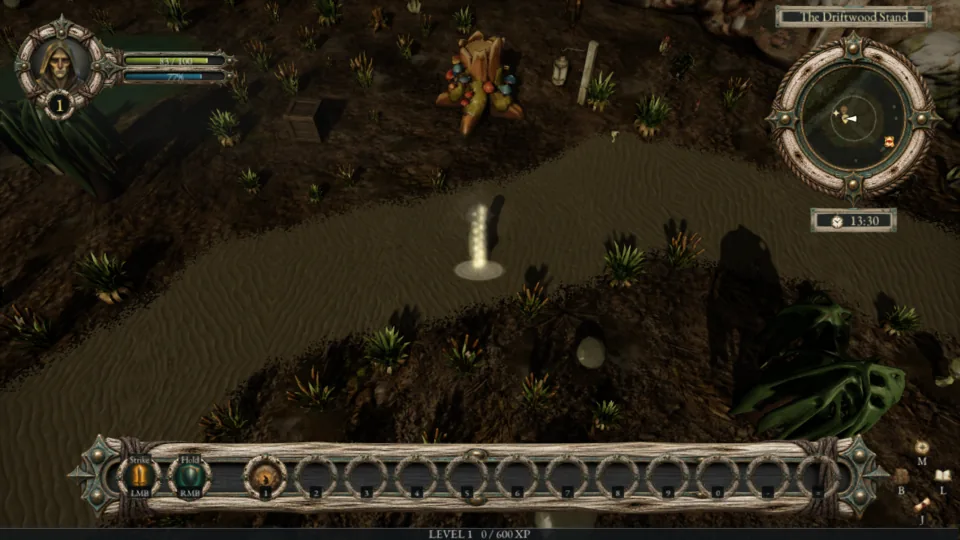
 The Throsseld WaterThe deep channel where the fens' resident throsseld keeps its station, the one stretch of water the Roost's own bird-read exists to steer people around.
The deep channel where the fens' resident throsseld keeps its station, the one stretch of water the Roost's own bird-read exists to steer people around. Anyone still fighting here chose to be, and the fens are unforgiving about that choice.
Up close
3 things to look at closer
- You come up on the deep channel slowly. The resident keeps its station here, and the Roost's bird-readers can name the hour it moves.
- The reeds along one bank are flattened in a long arc, the width of something that turned around in a hurry and was not the throsseld.
- There is nothing else in this water and there is not meant to be. That is what a resident means.
Foes here
| Who | Levels |
|---|---|
| Throsselds in the Roost Channel | 4–6 |
| Throsselds Off the Channel Mouth | 5–6 |
Gathered here
- Fen Catch
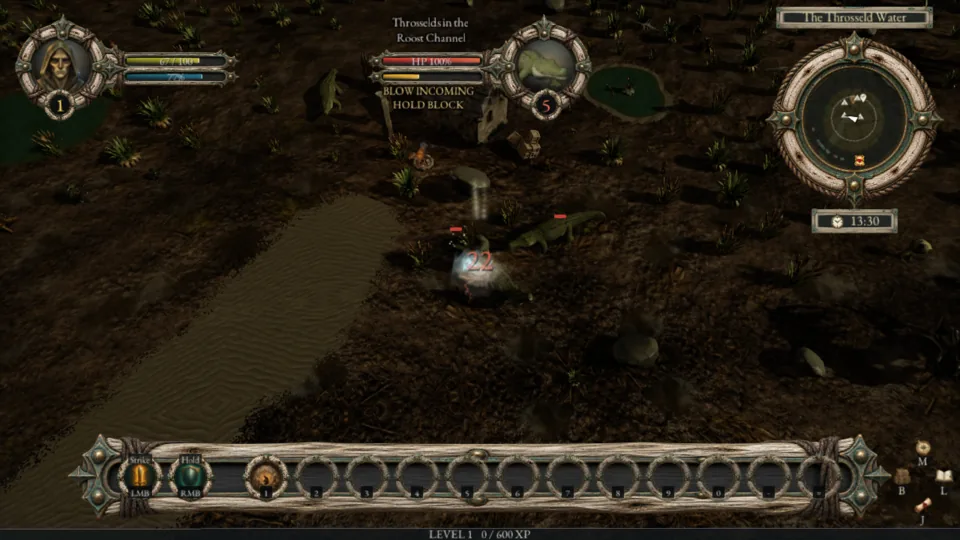
 The Channel WatchA staked platform where the last of the Roost's charted channels gives way to the branches the maps mark worse, not better — the crossing point toward Drelthdren's own hidden hold.
A staked platform where the last of the Roost's charted channels gives way to the branches the maps mark worse, not better — the crossing point toward Drelthdren's own hidden hold. Kessin Fenwarden keeps the roster here and sends nothing further in without a word first.
Up close
3 things to look at closer
- You climb the staked platform. Past here the maps mark the branches worse rather than better, which is the politest way anyone has found to write unknown.
- The platform's own charts are corrected in a different hand from the Roost's, and the corrections all go the same way: outward.
- It is a stake, a platform and the edge of what anybody has bothered to know.
People here
| Name | Does |
|---|---|
 Kessin Fenwarden | quest giver, guard |
Gathered here
- Reed Cordage
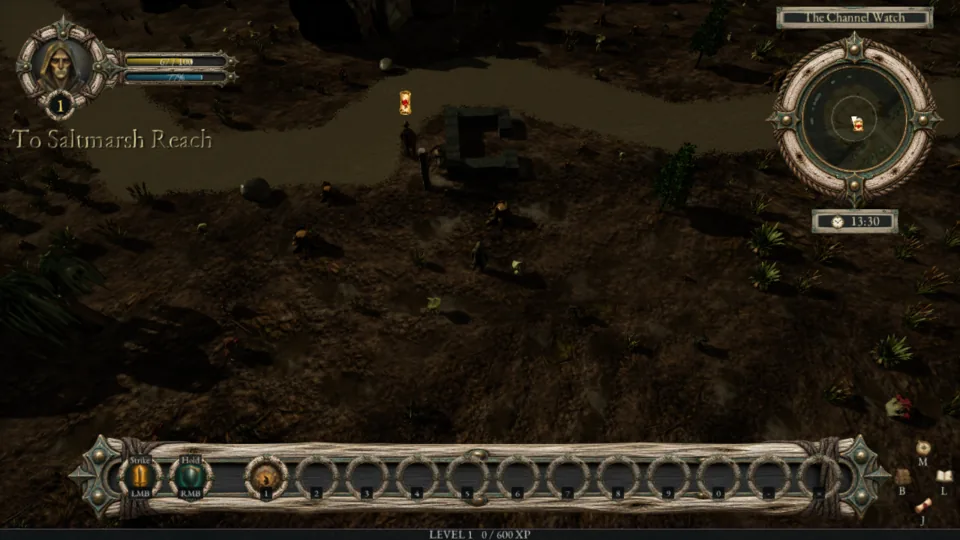
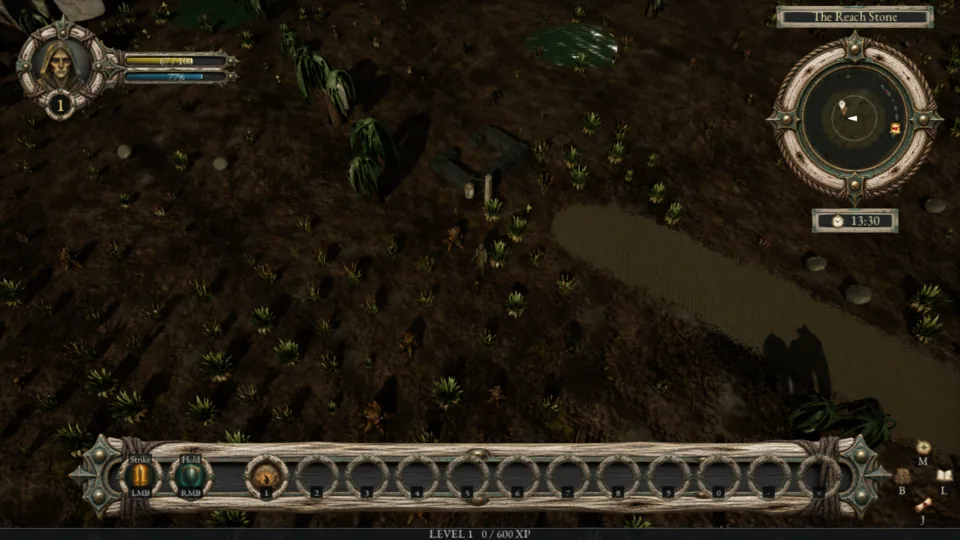
 The Reach StoneA marked stone and a lean-to shelter where the fens thin back out toward Saltmarsh Reach's charted water, the quiet hand-off point for anything the Roost would rather the Trade found on its own doorstep, no questions asked.
A marked stone and a lean-to shelter where the fens thin back out toward Saltmarsh Reach's charted water, the quiet hand-off point for anything the Roost would rather the Trade found on its own doorstep, no questions asked. No one keeps it; the marker keeps itself.
Up close
3 things to look at closer
- You read the marked stone. The fens thin out from here and Saltmarsh's charted water starts — a quiet hand-off between two ways of living.
- The shelter has been used by both sides of that hand-off and neither has left a mark claiming it.
- Stone, lean-to, and a channel getting shallower behind you. This is where the fens stop being the fens.
Gathered here
- Bent Scrap
Krelthnael
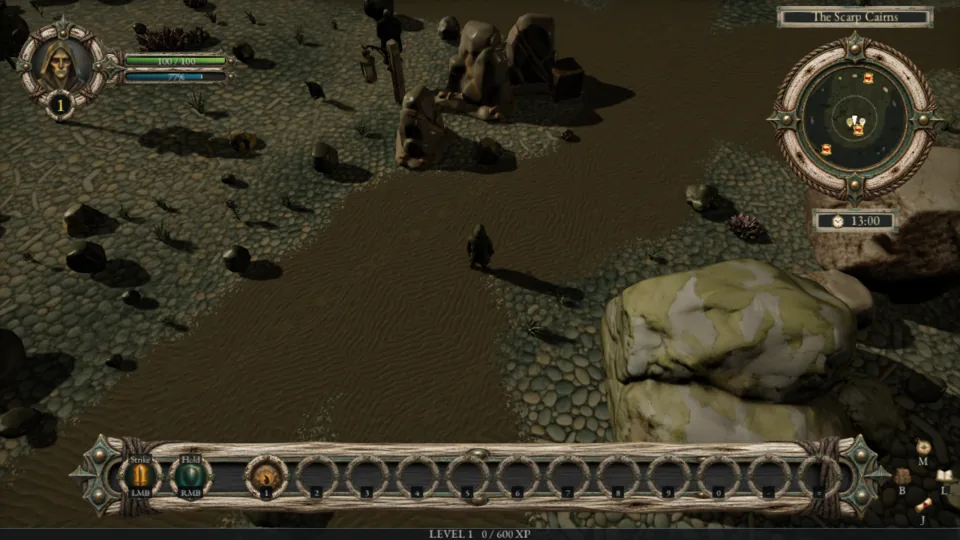
 The Scarp CairnsThe second cairn marks the zone's near edge; past it the stacking tradition fails on rock and crews chalk marks into the cleft-faces instead.
Up close
3 things to look at closer
- You read the second cairn. The stack is Relay-Chain work, and above it the chalk starts: the same shorthand cut into the cleft-face, because rock will not hold a stack.
- The chalk marks are dated. The most recent is this season; the one under it is from before the sweep everybody is arguing about.
- You go over the cairn and the faces around it and find no fourth mark, whatever the crew swore they counted.
People here
| Name | Does |
|---|---|
 Fenkathr Voskresketh | quest giver |
Gathered here
- Quarried Stone
- Unbroken Wing Feather

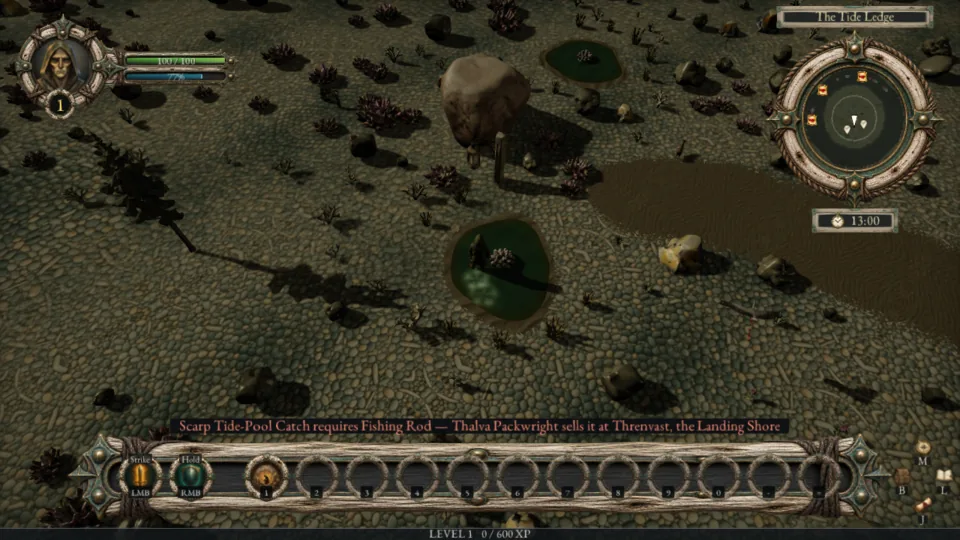
 The Tide LedgeA low rock shelf below the second cairn where the tide still climbs twice a day, leaving pools sweep crews work for shellfish and bait.
A low rock shelf below the second cairn where the tide still climbs twice a day, leaving pools sweep crews work for shellfish and bait. A scatter of rock-doves nests in the cleft-faces just above, tame enough that a crew's first morning on the scarp is spent gathering and watching rather than fighting. The wilder cliff-dove flock works higher ledges past these nests, but here stays safe ground, no fights.
Up close
3 things to look at closer
- You work the pools at the ebb. Shellfish, bait, and one pool that has been picked clean and left dry — somebody was here at this tide.
- The rock-doves go off the cleft-faces above you and settle again twenty feet along, tame enough to have been fed.
- The ledge is worked out for this tide. It will be worth coming back at the next one and not before.
Gathered here
- Cliff-Dove
- Scarp Tide-Pool Catch
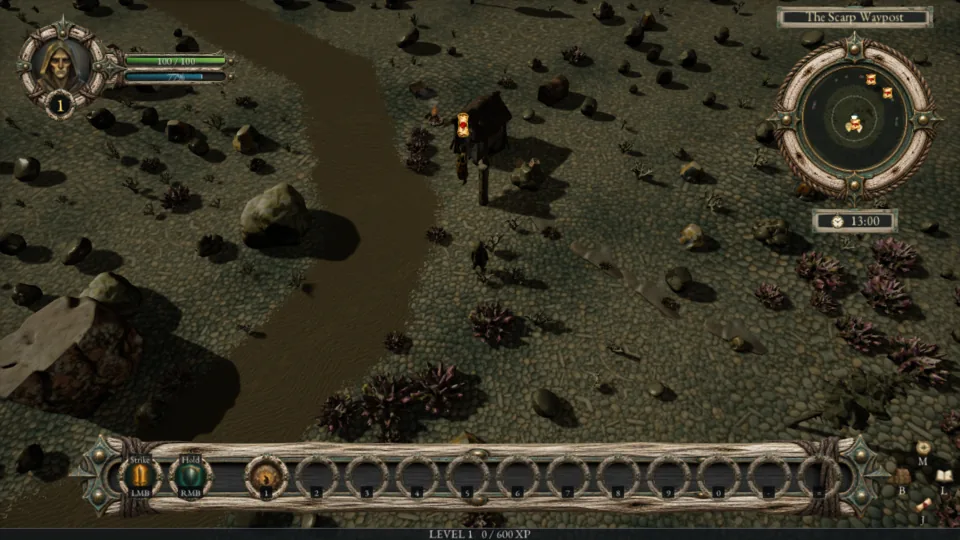
 The Scarp WaypostA lean-to and a supply chest on the path west of the cairns, kept for crews whose case-by-case clearance has already cleared them past the boundary — nobody claims the ground, only the traffic through it.
A lean-to and a supply chest on the path west of the cairns, kept for crews whose case-by-case clearance has already cleared them past the boundary — nobody claims the ground, only the traffic through it. A job-board nailed to the lean-to's post catches whatever odd work a crew can pick up before the scarp forces harder choices further out.
Up close
3 things to look at closer
- You look in the supply chest. Chalk, cordage, water, and a tally of what has been taken with no names against it — the crews out here trust each other or they do not come out here.
- The lean-to is set with its back to the boundary. Whoever built it wanted to see what came up the path, not what came down it.
- Everything in the waypost is a consumable. Nothing here is worth stealing, which is why it is still here.
People here
| Name | Does |
|---|---|
 Torvek Stockward | quest giver, vendor |
Gathered here
- Scavenger Scrap
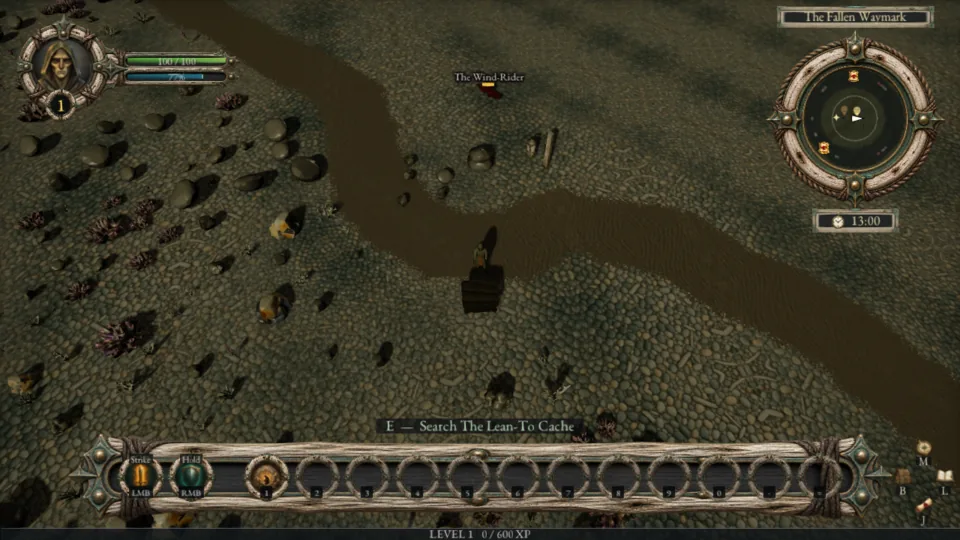
 The Fallen WaymarkThe collapsed stub of a stone cairn east of the boundary marker — older than the sweep crews' own chalk-marking, from before anyone learned the rock wouldn't hold a stack the way marsh mud does.
The collapsed stub of a stone cairn east of the boundary marker — older than the sweep crews' own chalk-marking, from before anyone learned the rock wouldn't hold a stack the way marsh mud does. In the cleft above the scree, the wing-scarred hen crews call the Wind-Rider has denned longer than any crew's memory, and what's left of an old lean-to's stores sits tucked in the fallen stone's lee, hidden from the path.
Up close
3 things to look at closer
- You go over the collapsed stub. The stones are dressed and they are not scarp rock — somebody carried them up here from the marsh, before anyone learned the rock would not hold a stack.
- Underneath, where the stack fell away, the base stone carries a mark cut deeper than chalk and older than the Chain's shorthand.
- The rest of it is scree, and scree is all it has been for longer than the Trade has been on this coast.
Foes here
| Who | Levels |
|---|---|
 The Wind-Rider | 5–6 |
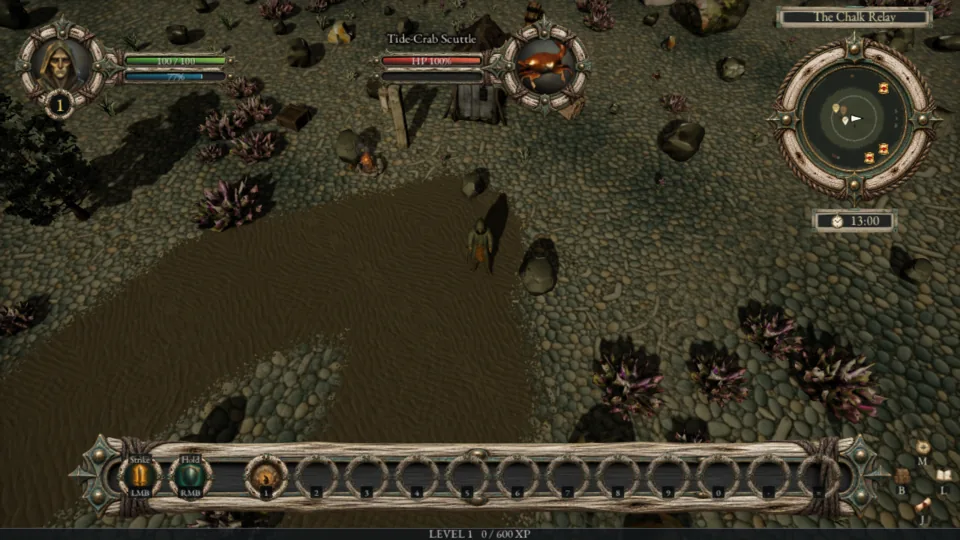
 The Chalk RelayA forward camp on the road out, restocked with chalk, cordage and water for crews already cleared past the second cairn — no cell holds this ground either, just the relay traffic moving through it.
A forward camp on the road out, restocked with chalk, cordage and water for crews already cleared past the second cairn — no cell holds this ground either, just the relay traffic moving through it. Its own job-board is the road's third giver, catching the work a crew picks up before pushing on toward the narrows and the border beyond.
Up close
3 things to look at closer
- You check the relay stock. Chalk in three grades, cordage, water — and the water is the thing that is short, which tells you which way the traffic has been going.
- The chalk tallies on the post do not match the chalk that is left. Either somebody is marking more than they log, or somebody is taking chalk.
- It is a camp made of what the next camp needs. There is nothing here that is for the people standing in it.
Gathered here
- Unauthorized Survey Kit
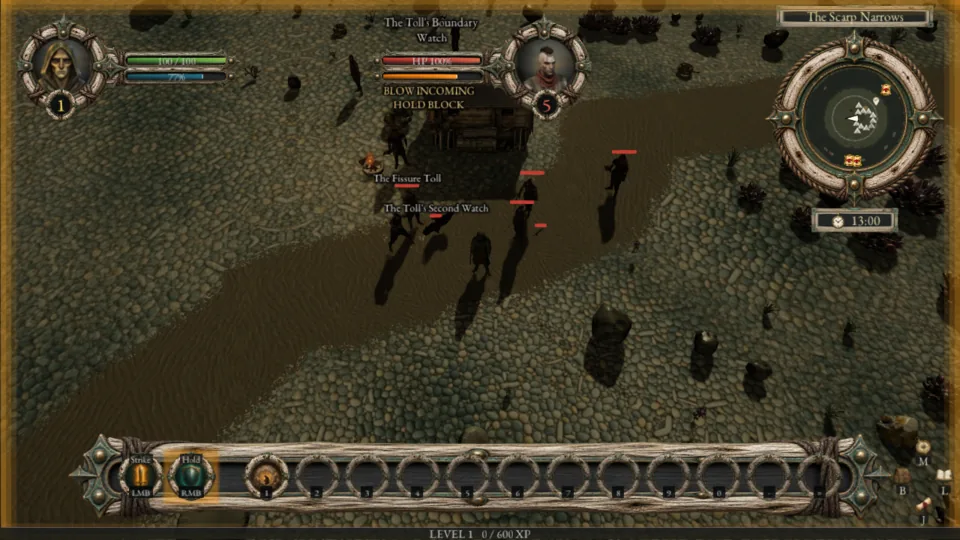
 The Scarp NarrowsWhere the path pinches to single file between two cleft-faces, a tide-cleft low on the rock still floods enough to catch driftwood, cordage and scrap from wrecks nobody can name — the wrack-catch sweep crews work at its edge.
Where the path pinches to single file between two cleft-faces, a tide-cleft low on the rock still floods enough to catch driftwood, cordage and scrap from wrecks nobody can name — the wrack-catch sweep crews work at its edge. The same choke point draws a small band of frontier opportunists, no banner and no cell to answer to, who work the narrows itself for whatever a crossing crew is carrying.
Up close
3 things to look at closer
- You work the tide-cleft at the pinch. Driftwood, cordage, scrap — and a strake of hull-timber with a joint on it that no boat this coast builds.
- The passage is single file for thirty paces, and the chalk on both walls is at shoulder height: crews mark it going in and coming out.
- The cleft has given up everything the last tide put in it. The next tide is the only thing that will change that.
Foes here
| Who | Levels |
|---|---|
| The Fissure Toll | 4–6 |
| The Toll's Second Watch | 4–6 |
| The Toll's Boundary Watch | 4–6 |
Gathered here
- Sea-Worn Cordage
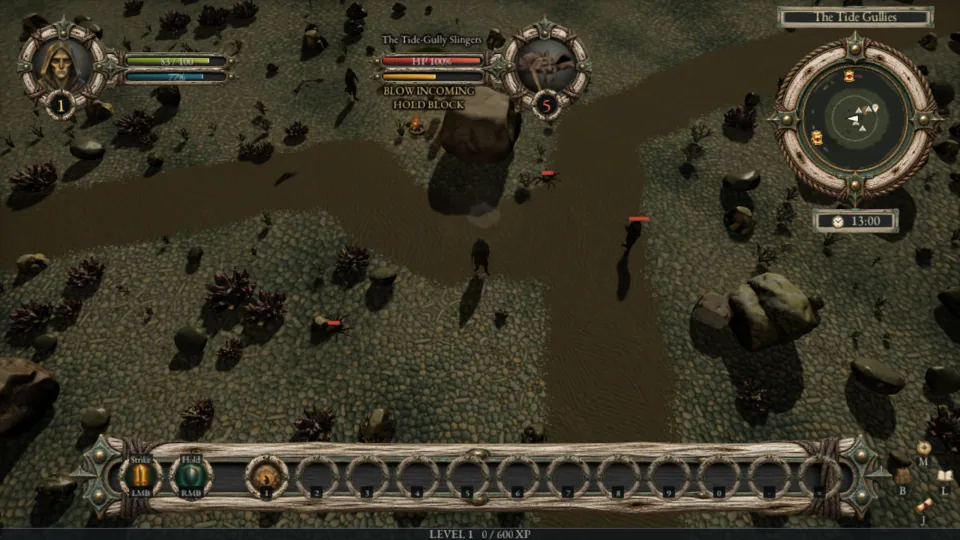
 The Tide GulliesDeep gullies further up the scarp than the tide-ledge below, where the tide still reaches at the high mark and feeds the wilder cliff-dove flock nesting along the rims.
Deep gullies further up the scarp than the tide-ledge below, where the tide still reaches at the high mark and feeds the wilder cliff-dove flock nesting along the rims. This is the ground the professions actually come for — feather, egg and whatever the tide leaves wedged in the cracks — past the tame gathering the tide-ledge offers a crew fresh to the scarp.
Up close
3 things to look at closer
- You reach into the high-mark cracks. The tide leaves what it is done with wedged where only a hand can reach, and the first thing your hand finds is cordage.
- The cliff-doves along the rims are wilder than the ledge birds below — these have been hunted, and they know the shape of a person.
- You have been over the reachable cracks twice. What is left is further out than an arm and further down than a rope.
Foes here
| Who | Levels |
|---|---|
| The Tide-Gully Slingers | 5–6 |
Gathered here
- Cliff-Dove
- Scarp Tide-Pool Catch
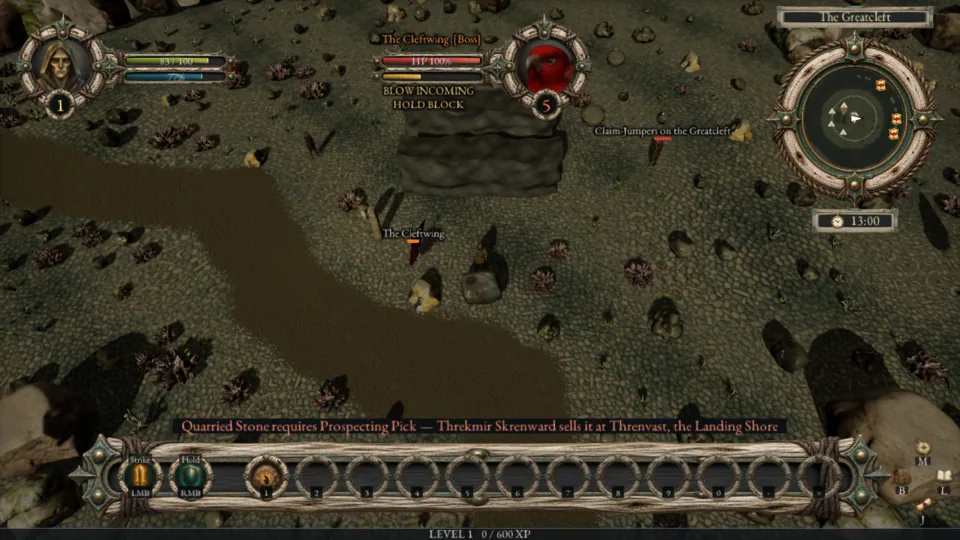
 The GreatcleftThe single vast fissure that splits the headland clean through, wider and deeper than any of the narrower clefts worked elsewhere on the scarp — the cleft-rock the zone itself is named for.
The single vast fissure that splits the headland clean through, wider and deeper than any of the narrower clefts worked elsewhere on the scarp — the cleft-rock the zone itself is named for. No crew has ever found a way down its far wall, and sweep-crew talk holds it as the reason no route out here was ever going to stay charted.
Up close
3 things to look at closer
- You go to the lip and look down the fissure. It splits the headland clean through, and the bottom of it is dark at midday.
- The cleft-rock here is the same rock the whole scarp is named for, and up close it is layered like something stacked rather than something grown.
- No crew has worked this, and standing at the edge of it you understand why nobody has volunteered.
Foes here
| Who | Levels |
|---|---|
| Claim-Jumpers on the Greatcleft | 4–5 |
| The Cleftwing | 6 |
Gathered here
- Quarried Stone
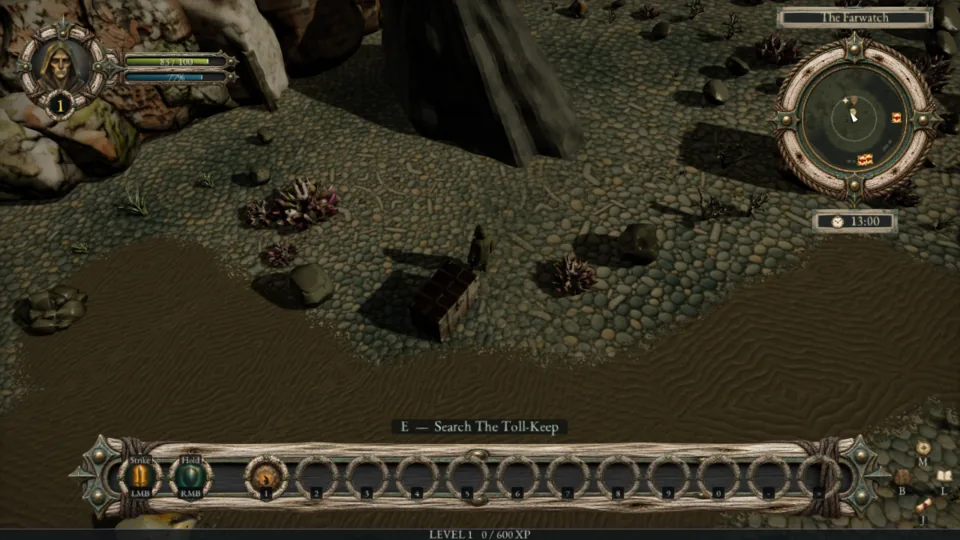
 The FarwatchThe highest lookout on the scarp path, past the second cairn and short of the third, faintest chalk-mark — the longest view on the headland, and the hardest ground to reach it from.
The highest lookout on the scarp path, past the second cairn and short of the third, faintest chalk-mark — the longest view on the headland, and the hardest ground to reach it from. Aldorn Ornsen, the Hush scout who kept working past his return window, has held the cleft below the lookout ever since, and the narrows' own opportunists have taken to stashing what they lift from crossing crews in a shelf near the climb, banking on nobody else coming this far out.
Up close
3 things to look at closer
- You climb to the lookout. From here the headland lies out to the third chalk-mark and past it, and the fog stops exactly where the charts say it should not.
- The lean-to in the cleft below has been lived in — a bed, a fire ring, and a return-window roster with every date after one particular week left blank.
- There is nothing else up here. The view is what the place is, and somebody stayed for it long past the day they were told to come home.
Foes here
| Who | Levels |
|---|---|
 The Unmandated | 5–6 |
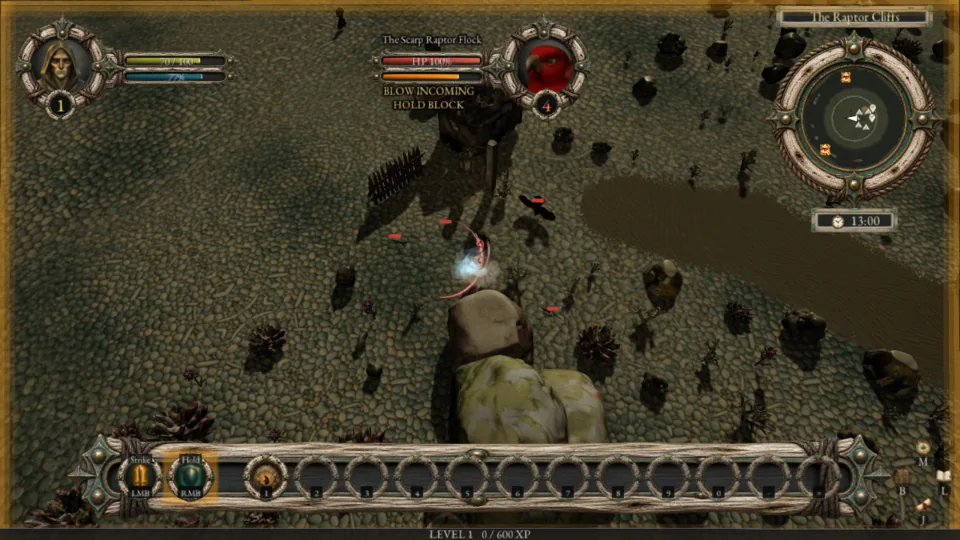
 The Raptor CliffsCliff-faces east of the fallen waymark where a bounded flock of scarp-raptors dives and scatters at anything working the path below — a crew that lingers near the nesting cracks draws a real fight, not just a startle.
Cliff-faces east of the fallen waymark where a bounded flock of scarp-raptors dives and scatters at anything working the path below — a crew that lingers near the nesting cracks draws a real fight, not just a startle. This is the hostiles' own ground: no camp and no banner, just a territory the flock has held longer than any sweep crew's tenure.
Up close
3 things to look at closer
- You work along under the nesting cracks. The flock goes up in a spiral and comes down behind you, which is how they hunt anything that walks the path below.
- The cracks hold bones — small ones, and one that is not small — picked clean and dry.
- There is nothing on this ground but the flock and what the flock has eaten.
Foes here
| Who | Levels |
|---|---|
| The Scarp Raptor Flock | 4–5 |
Gathered here
- Cliff-Dove
- Unbroken Wing Feather
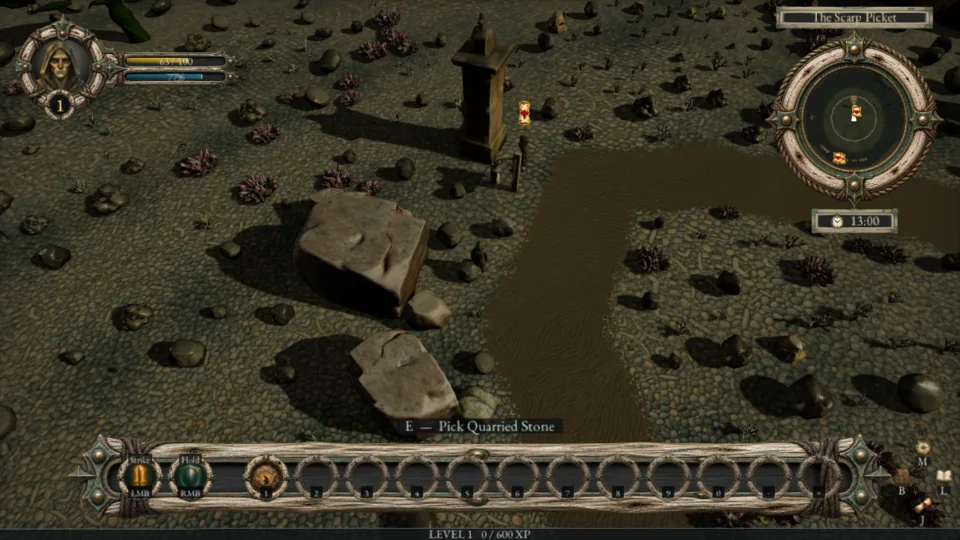
 The Scarp PicketThe last hand-off before the ground turns properly dark — a hearth, a roster, and a warden who checks a crew's clearance before waving them on toward Dreskneld.
The last hand-off before the ground turns properly dark — a hearth, a roster, and a warden who checks a crew's clearance before waving them on toward Dreskneld. Respawn point and border marker both: past here the case-by-case authorization that covers the rest of the scarp stops applying.
Up close
3 things to look at closer
- You read the picket roster. Every crew waved on toward Dreskneld is written down twice; the column for crews coming back has three entries all season.
- The hearth is the last fire on this road. The warden keeps it high, which is not what a warden does when the ground ahead is quiet.
- The picket is a hearth, a roster and a warden, and all three of them are pointed the same way.
People here
| Name | Does |
|---|---|
 Kaldrin Farwarden | quest giver, guard |
Gathered here
- Quarried Stone
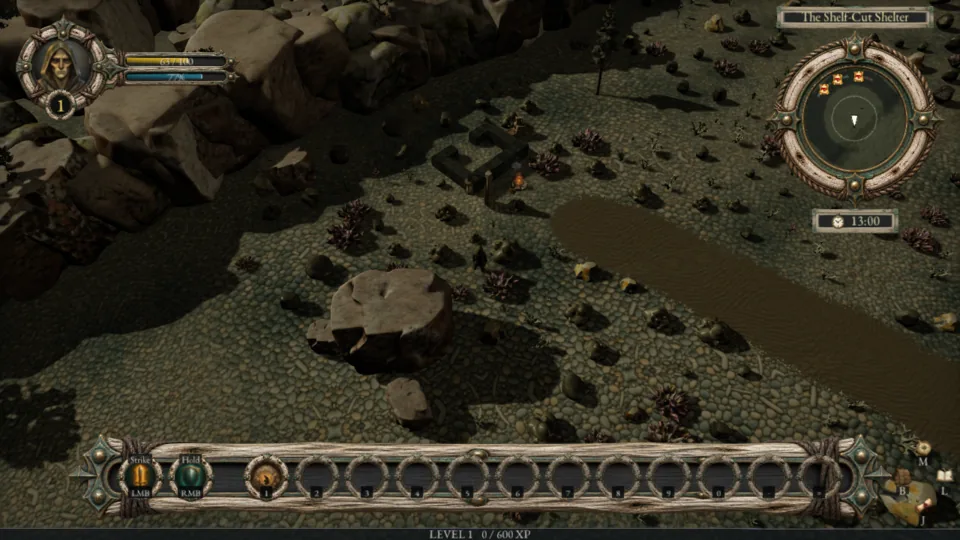
 The Shelf-Cut ShelterA dry cut in the rock on the path down toward Skarnmar's tide-cut ore shelf, marked with a runner's stone and a fire kept lit for whoever's crossing.
A dry cut in the rock on the path down toward Skarnmar's tide-cut ore shelf, marked with a runner's stone and a fire kept lit for whoever's crossing. Hand-offs to the ore shelf leave from here rather than the scarp itself — the other border, and the one that never puts a crew anywhere near the third chalk-mark.
Up close
3 things to look at closer
- You duck into the cut. The runner's stone at the mouth is chalked with hand-off times, and the last three are all within the same hour of the day.
- The fire is kept lit rather than banked — whoever crosses here does it often enough that letting it go out would cost more than the wood does.
- The cut is dry, the stone is marked, and there is nothing else in it. Hand-offs do not leave things behind.
Skarnmar
 The Skarnmar ShelfA tide-exposed rock shelf carrying a visible seam of workable ore, worked on a cycle the tide itself rations.
Up close
3 things to look at closer
- You work the seam at the ebb. The ore comes off in flat plates where the water has already done half the splitting for you.
- The tide has its own opinion about how long you have. The wet line on the rock moves while you work and you find yourself checking it.
- The exposed band is picked to the waterline. The rest is under, and it will be under again in an hour whatever you do.
People here
| Name | Does |
|---|---|
 Vrensveth Dreskorn | quest giver |
Gathered here
- Skarnmar Ore
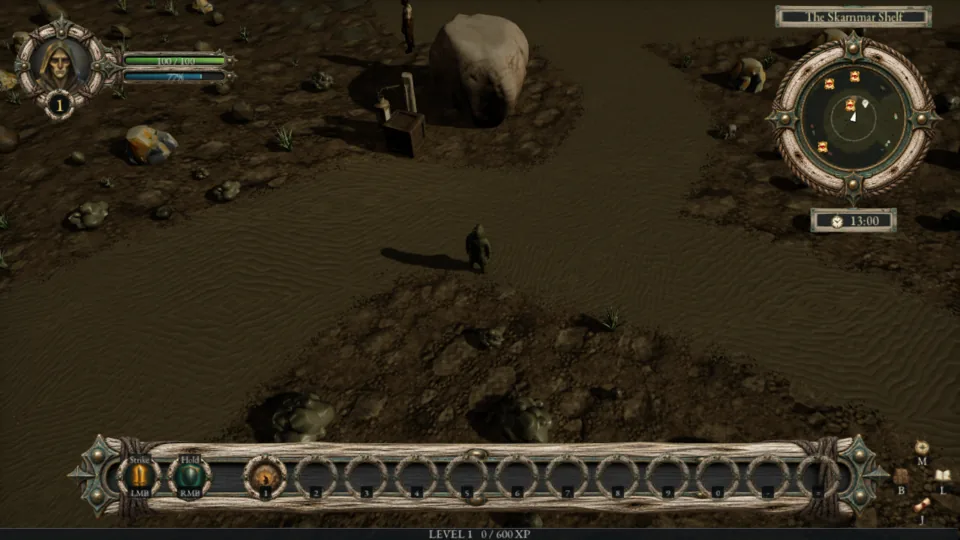

 The Ebb LineThe band of rock nearest the anchor's south face, drowned at high water and the first ground a crew ever sets foot on at the ebb.
The band of rock nearest the anchor's south face, drowned at high water and the first ground a crew ever sets foot on at the ebb. Hermit crabs and barnacle clusters crowd its pools, anemones closing at a footstep, and the ordinary shelf-crabs feed here thick enough that nobody needs to go further out to eat well. No camp has ever bothered to hold it, which is exactly why it is where a new hand learns the tide before the shelf asks anything harder.
Up close
3 things to look at closer
- You go along the first ground the ebb gives back. Hermit crabs and barnacle scrape, and every rock turned over has been turned over before.
- The anchor's south face above you is streaked where the water reaches at spring tide — a good arm higher than today's mark.
- The ebb line is the same fifty paces of rock everybody starts on. It has nothing left that a crew has not already had.
Gathered here
- Shelf-Crab
- Skarnmar Ore
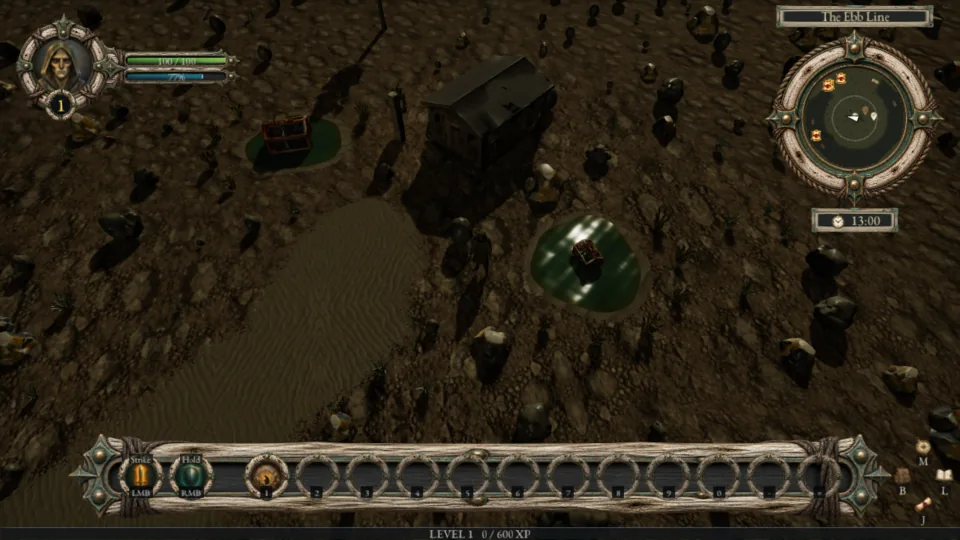
 The Landward CampThe sweep-crew's own fire, pitched above the tideline on the shelf's landward edge where the water never reaches even at the highest spring tide.
The sweep-crew's own fire, pitched above the tideline on the shelf's landward edge where the water never reaches even at the highest spring tide. A handful of hands wait out the drowned hours here between tide-windows, cooking, mending gear, and posting whatever work the shelf has turned up, rather than losing half a cycle to the walk back to the port. Fenkorva Chalkwright keeps the camp's own board and sells what a crew burns through fastest: chalk for the tide-relay, cordage, oilskins.
Up close
3 things to look at closer
- You come up to the sweep-crew's fire, pitched above the highest spring tide by somebody who measured rather than guessed.
- The hands here work a rota by the tide-table, not the clock, and the table nailed to the post is corrected in three different hands.
- It is a fire, a rota and a row of packs. Everything the camp owns is above the water line and ready to move.
People here
| Name | Does |
|---|---|
 Fenkorva Chalkwright | quest giver, vendor |
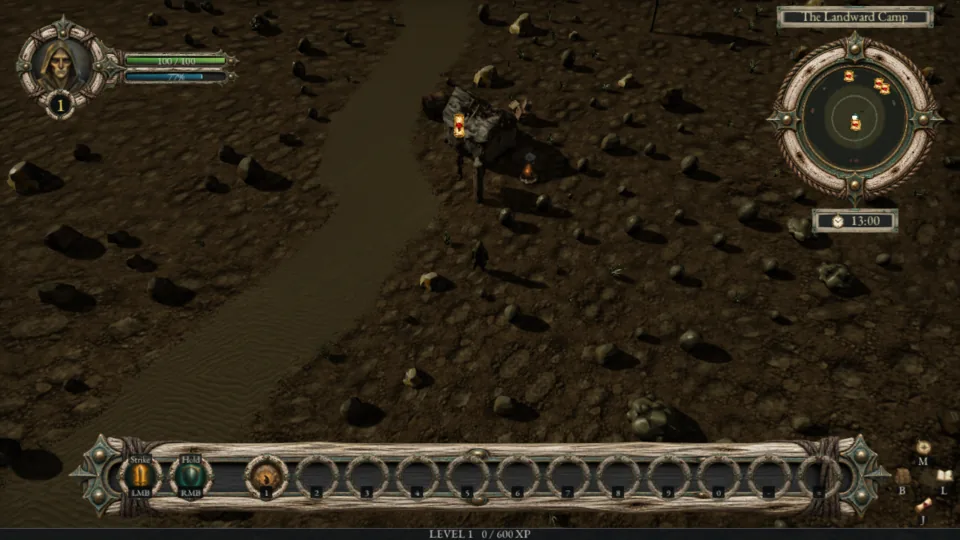
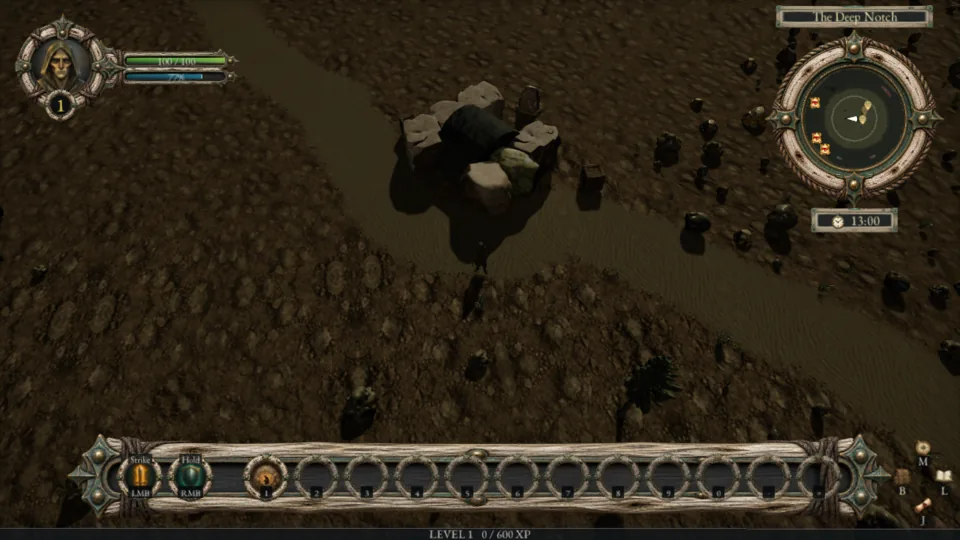
 The Deep NotchA sea-cave notch cut into the shelf's base east of the anchor, half-drowned even at low water and dug out by a claim-jumper seasons before the sweep-crew ever petitioned for a tide-window pass.
A sea-cave notch cut into the shelf's base east of the anchor, half-drowned even at low water and dug out by a claim-jumper seasons before the sweep-crew ever petitioned for a tide-window pass. The sweep-crew's own honest tallies write it off as already scoured, which is exactly wrong: a richer, un-scoured vein still runs at its back, and the Last Claim still dens there, territorial and half-feral, refusing to leave water everyone else calls dangerous. The surge-throat at its rear floods on its own schedule, not the shelf's — a crew that doesn't read the tide-state first pays for it.
Up close
3 things to look at closer
- You get into the notch at the low water. It is a sea-cave that somebody has made deeper, and the dig marks are old.
- A claim-jumper cut this out seasons before the sweep-crew ever came, which means somebody knew about this shelf before the survey did.
- The back of the notch is under water even now. Whatever is behind it stays behind it.
Gathered here
- Deep-Vein Ore
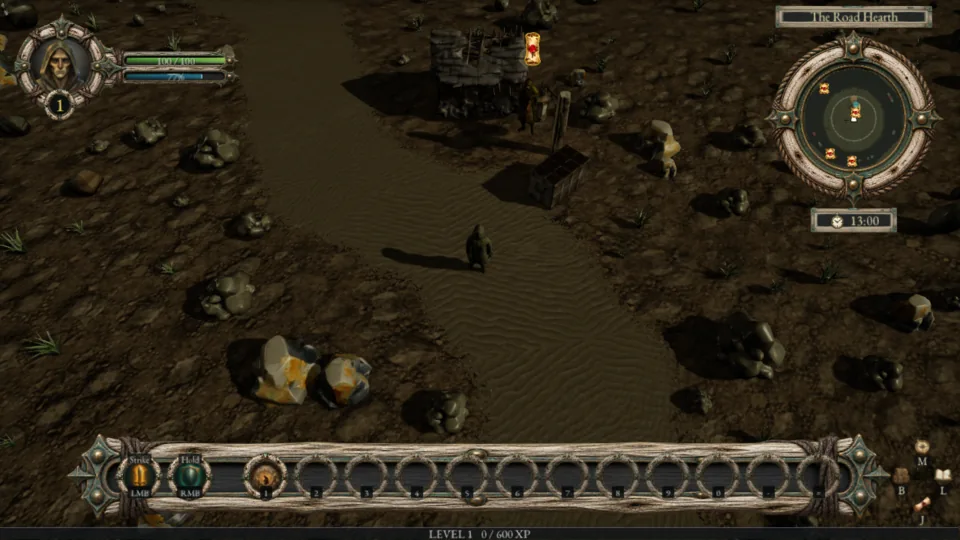
 The Road HearthA hearth and lean-to on the road out from the anchor toward the ore ground, kept by Kreskava Fenmend now that she has moved her practice off the shelf itself.
A hearth and lean-to on the road out from the anchor toward the ore ground, kept by Kreskava Fenmend now that she has moved her practice off the shelf itself. Sweep-crew hands who cut a hand on the seam or turn an ankle on wet rock stop here rather than carrying the injury back to the port, and Kreskava keeps a running account of who owes her for it. The road runs on from here to the ore ground and back to the anchor, so nothing passes this hearth twice in a day unnoticed.
Up close
3 things to look at closer
- You sit at Kreskava's hearth. She has moved her practice off the shelf and onto the road, which tells you where the injuries actually happen.
- Her kit is laid out by frequency rather than by kind: crush, cut, cold, in that order.
- The hearth is warm, the road is quiet, and she is not busy today. She says that is the best sentence anybody says out here.
People here
| Name | Does |
|---|---|
 Kreskava Fenmend | quest giver, vendor |
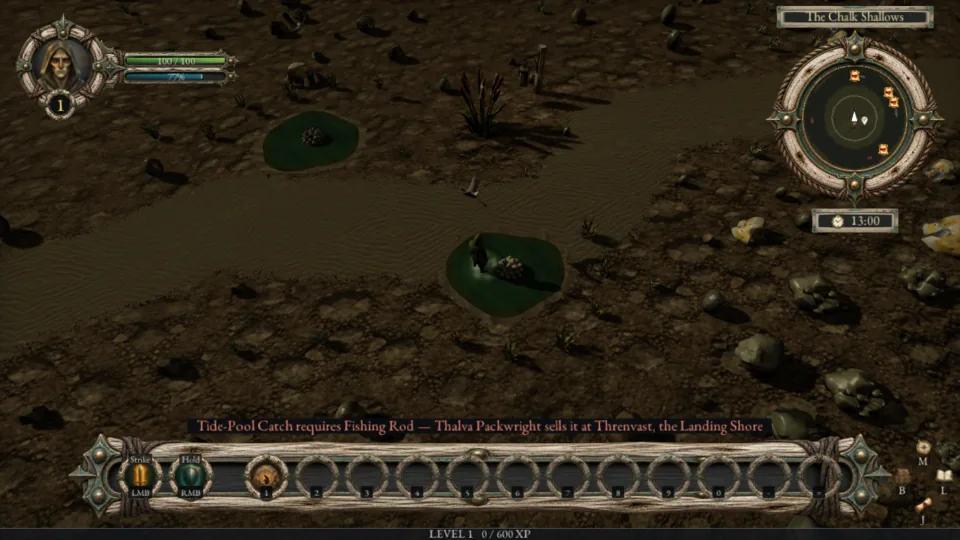
 The Chalk ShallowsA wide, gently-sloped stretch of tide-pool ground north-west of the anchor, at the working edge of the camp rather than its own — this is where the sweep-crew's chalk-relay actually gets tested, marks scraped onto bare rock to flag where the tide turns fast and where it doesn't.
A wide, gently-sloped stretch of tide-pool ground north-west of the anchor, at the working edge of the camp rather than its own — this is where the sweep-crew's chalk-relay actually gets tested, marks scraped onto bare rock to flag where the tide turns fast and where it doesn't. The pools run deep enough to fish at their richest in the same low-water window that bares the ore seam, and a crew that reads the chalk right works both without the water catching them. Nodes crowd its edges rather than its centre, since the deepest pools are worth leaving undisturbed.
Up close
7 things to look at closer
- You work the tide-pools at the camp's working edge. Shallow, sloped and safe, which is why the new hands are sent here first.
- Somebody has chalked the safe line along the rock, and re-chalked it after the last spring tide moved it.
- The pools are worked and re-worked. What is here is what the sea puts back, and it puts it back slowly.
- You work the pools at the shallow end where the new hands are put. Everything in them is small and everything in them is easy.
- The chalk line along the rock has been re-cut four times in different hands, each a little further in than the last.
- The slope is gentle enough to work at any tide, which is why this is the ground nobody else bothers with.
- The pools are worked out for this tide and will fill again on the next. That is the whole rhythm of this end of the shelf.
Gathered here
- Tide-Pool Catch
 The Crab FlatsThe widest bare stretch of the shelf, north of the road hearth, where the ore-bearing seam the whole zone is named for finally breaks the surface in a band wide enough for more than one crew to work at once.
The widest bare stretch of the shelf, north of the road hearth, where the ore-bearing seam the whole zone is named for finally breaks the surface in a band wide enough for more than one crew to work at once. The same flats crawl with shelf-crabs at their edges, easy game worked the same tide-windows as the ore itself, so a haul out here is never just one thing. Everything the sweep-crew's Prospect work comes for is worked from this ground.
Up close
3 things to look at closer
- You get down onto the widest bare stretch. The seam the whole zone is named for breaks the surface here, and it is close enough to reach without a tool.
- The crabs work the seam's own cracks, and the crews work around the crabs, and neither has ever been described as a problem by the other.
- You have taken what the surface gives. Everything else is on the far side of a shift's digging.
Gathered here
- Bog Iron
- Shelf-Crab
- Skarnmar Ore
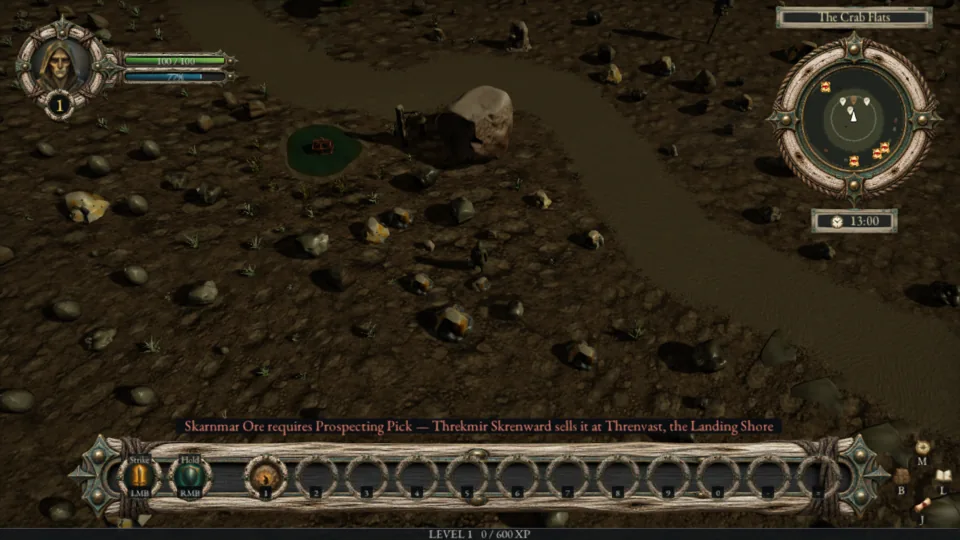
 The Tide CliffThe bare rock face south-east of the anchor that gives Skarnmar its name — Skarn for the cliff, mar for the tidal edge it drops into, the tide-cliff plainly.
The bare rock face south-east of the anchor that gives Skarnmar its name — Skarn for the cliff, mar for the tidal edge it drops into, the tide-cliff plainly. Loose rubble scatters its base where the scour has worked the seam back further than any crew has bothered to follow, and every low tide strips a little more of it bare. It is the one place on the shelf where the whole reason for Skarnmar's own name is standing in front of you rather than argued from the rock underfoot.
Up close
7 things to look at closer
- You go along the cliff foot. Skarn for the rock, mar for the edge it drops into — the name is a description and nothing more.
- The face carries a band of the same ore at head height, out of the water entirely, and nobody has touched it.
- The cliff is bare rock and the sea below it. There is no way up and no reason to want one.
- You go along the foot at the lowest water and find the ore band running unbroken at head height for forty paces.
- The rock above the band is scoured smooth and the rock below it is not, so the sea reaches the band and no higher.
- There are no marks on the face anywhere. Nobody has ever worked this, and it is the richest thing on the shelf.
- You have walked the whole foot. The cliff is what it looks like and there is nothing hidden in it.
Foes here
| Who | Levels |
|---|---|
| The Tide Cliff Roost | 6–7 |
Gathered here
- Deep-Vein Ore
- Quarried Stone
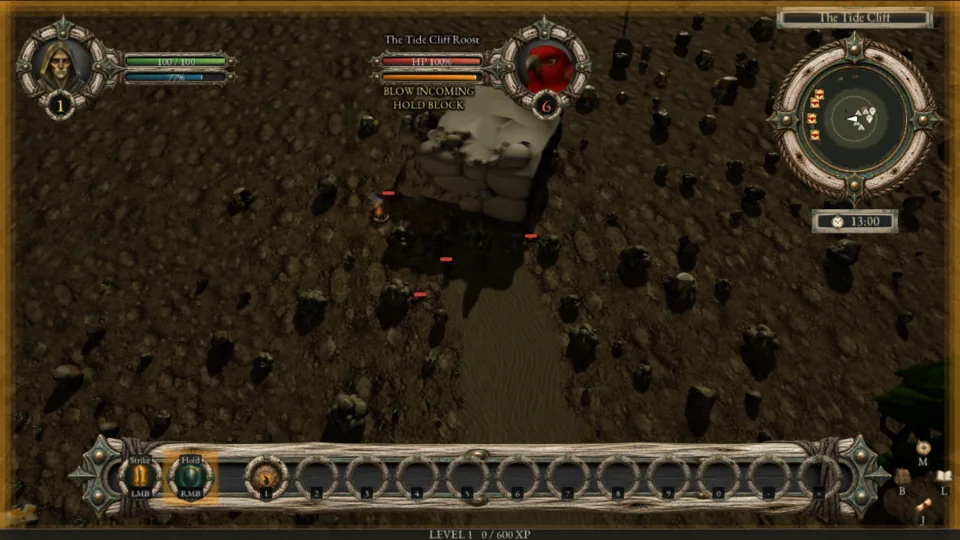
 The Scarp EyeA lookout perch north-west of the Chalk Shallows, where Krelthnael's scarp finally drops low enough that a climber can see the whole shelf laid out below — every pool, every scoured band, and whether the tide is coming or going before it's obvious at ground level.
A lookout perch north-west of the Chalk Shallows, where Krelthnael's scarp finally drops low enough that a climber can see the whole shelf laid out below — every pool, every scoured band, and whether the tide is coming or going before it's obvious at ground level. It's the vista a proper tide-pool tally is actually taken from, and the path up gets harder past the Shallows on purpose. The Last Claim's own patrol runs this far when the notch below floods it out, which is the only warning a climber gets before the fight finds them instead of the other way around.
Up close
7 things to look at closer
- You climb to the perch. The whole shelf lies out below — camp, notch, flats, seam — and the scarp behind you drops just low enough to make the climb possible.
- From here the jumpers' camp and the sweep-crew's fire are four hundred paces apart with a rock spur between them. Neither can see the other; both could be seen from here.
- It is a lookout and nothing else, and whoever cut the footholds knew what it was for.
- You count from the perch: sweep-crew fire, jumpers' fire, and the spur between them that stops either from seeing the other.
- The footholds cut into the climb are old, worn, and sized for somebody smaller than the crews who use them now.
- From here the seam's line is visible under the water at low tide, running out further than anybody works it.
- There is nothing on the perch itself but a flat place to sit and everything you can see from it.
Foes here
| Who | Levels |
|---|---|
| The Scarp Eye Aerie | 6–7 |
 The Last Claim | 6–7 |
| The Eyrie Elder | 6–7 |
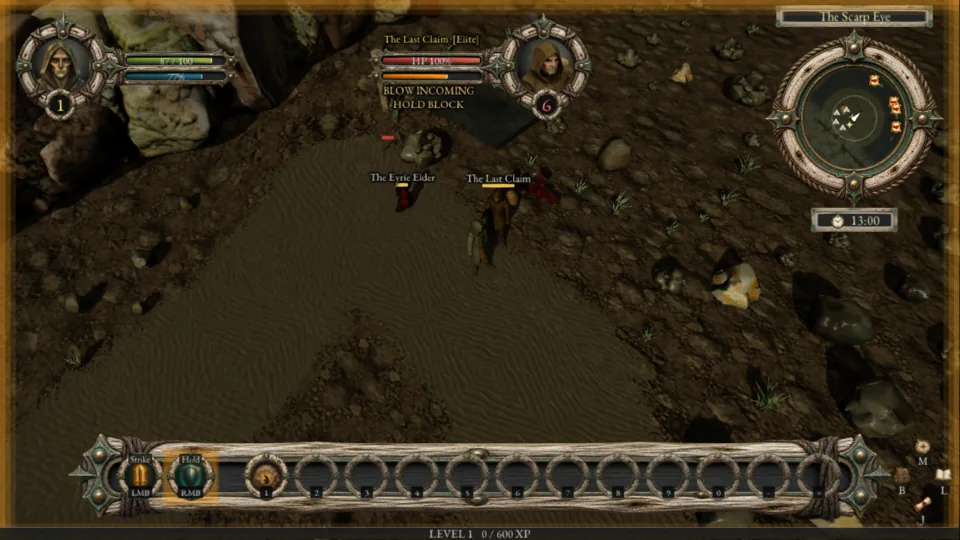
 The Jumpers' CampA scatter of lean-tos and driftwood windbreaks east of the Deep Notch, where the shelf-jumpers squat between raids on whatever the sweep-crew hasn't hauled off yet.
A scatter of lean-tos and driftwood windbreaks east of the Deep Notch, where the shelf-jumpers squat between raids on whatever the sweep-crew hasn't hauled off yet. They are opportunists rather than claim-holders, come and go on word of mouth, unlike whatever still dens in the notch below, but there are enough of them, often enough, that this is where the shelf's fights actually happen. The sweep-crew gives the camp a wide berth rather than clearing it outright; it costs less than the fight would.
Up close
7 things to look at closer
- You go through the windbreaks. Driftwood, hides, and a stack of ore plates that came off a seam nobody here has worked.
- Their fire is set behind the spur so the sweep-crew cannot see it, and their lookout faces the camp rather than the sea.
- They raid what the crew has not hauled yet, which means they know the crew's rota better than the crew's own tide-table does.
- You go through the stacked plates. They are cut, not broken — worked off a face with a tool, by somebody who knows how.
- The lookout position faces the sweep-crew's camp, and there is a worn place where somebody sits for hours.
- The lean-tos are pitched to be struck in minutes and the fire is set where the spur hides its light.
- Nothing here is kept longer than a raid's turnaround. There is no store, no cache, and nothing anybody would miss.
Foes here
| Who | Levels |
|---|---|
| The Shelf Jumpers | 5–6 |
| Shelf-Jumpers' Squat | 5–6 |
| The Driftwood Windbreaks | 5–6 |
Gathered here
- Bog Iron
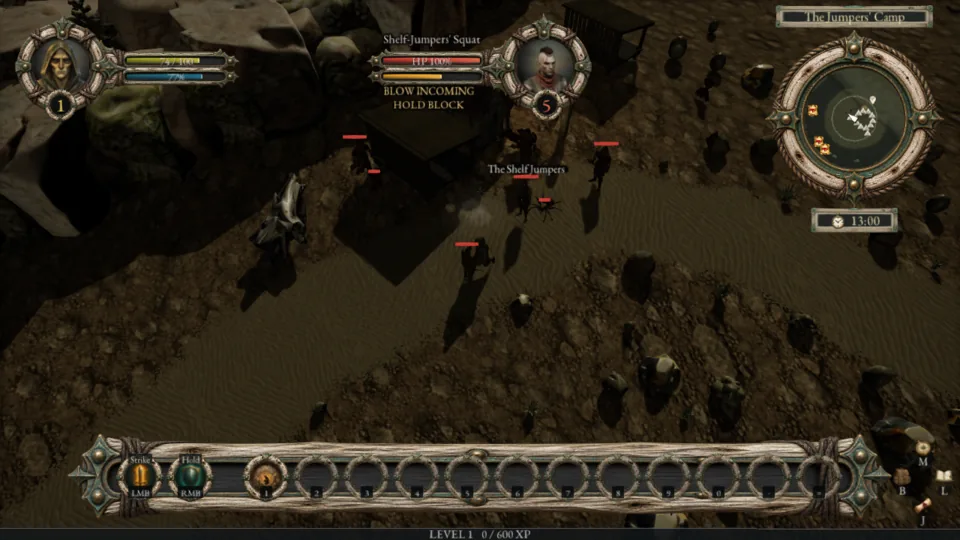
 The Scarp StairA cut stair climbing back up off the shelf toward Krelthnael's own scarp, the last stone underfoot before the ground turns to broken headland above.
A cut stair climbing back up off the shelf toward Krelthnael's own scarp, the last stone underfoot before the ground turns to broken headland above. Gremveth Scarpwarden holds it: respawns raised here, hand-offs to and from Krelthnael logged at the stair's own cairn, and nobody works the shelf without Gremveth knowing they went down.
Up close
3 things to look at closer
- You take the cut stair. Proper steps, cut into the rock, worn in the middle — a great many loads have gone up this way.
- The last step is dressed differently from the rest, and older. Somebody cut a stair here twice, generations apart.
- Above the stair the ground turns to broken headland and the stone underfoot ends. This is the last worked thing on the shelf.
People here
| Name | Does |
|---|---|
 Gremveth Scarpwarden | quest giver, guard |
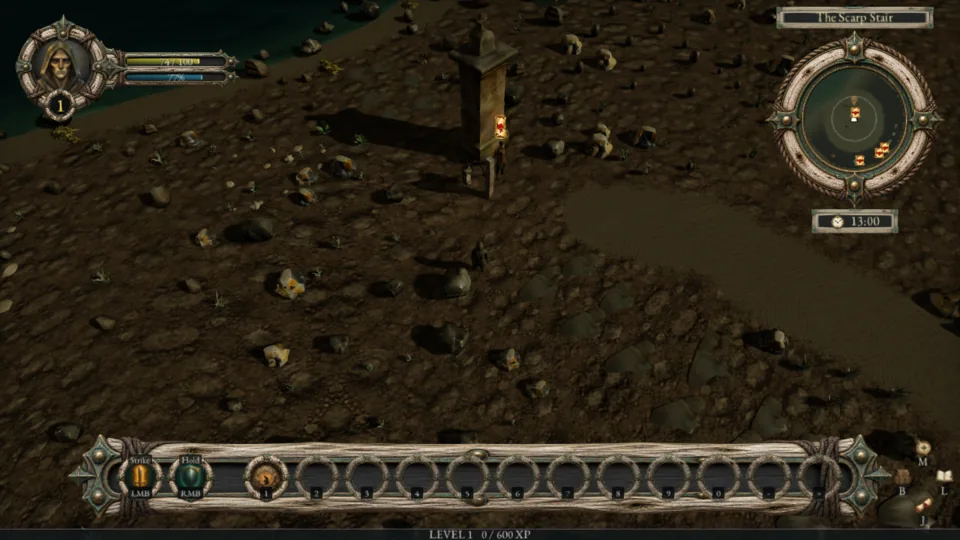
 The Ridge ShelterA stone-roofed shelter south-west of the Landward Camp, on the ridge path that climbs from the shelf toward Stolkeld's dig.
A stone-roofed shelter south-west of the Landward Camp, on the ridge path that climbs from the shelf toward Stolkeld's dig. No one keeps it yet — runners between the two sites use it to wait out weather or a bad tide, the fire inside banked rather than tended — but it already does what a border shelter needs to: give a hand-off somewhere dry to happen.
Up close
3 things to look at closer
- You look in. Stone roof, dry floor, and a fire ring nobody has claimed — runners use it and leave it exactly as they found it.
- The path outside is worn in one direction more than the other: more goes up toward the dig than comes down.
- There is nothing here to keep, which is why it is still here to use.
Foes here
| Who | Levels |
|---|---|
| The Ridge Shelter Squat | 5–6 |
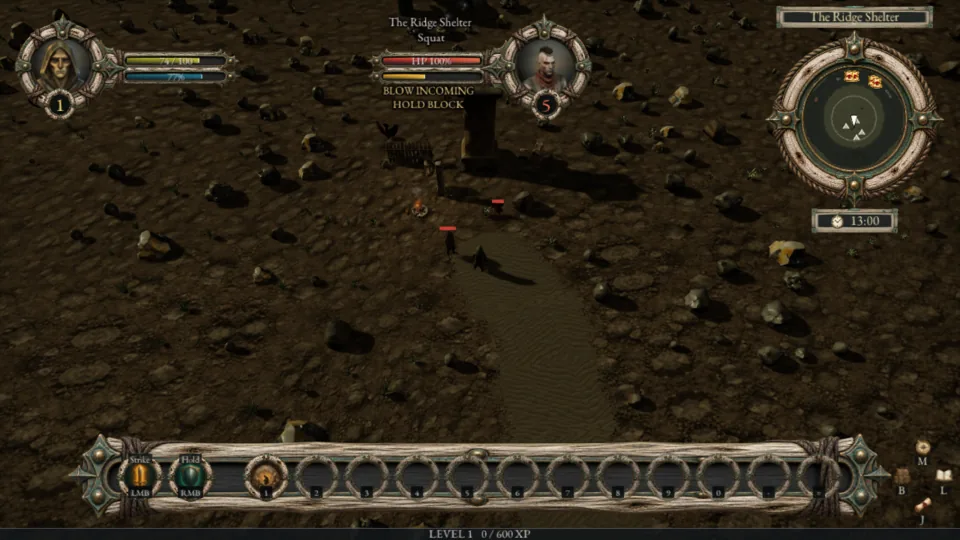
Stolkeld
 The Stolkeld MineAn outpost-tier dig with a working adit, a lantern-lit bunkhouse and a small forge for on-site repair — independent of the Trade.
Up close
3 things to look at closer
- You go in as far as the lantern line. The adit is properly shored and properly cut — this is a working dig, not a scratch, and somebody with training laid it out.
- The bunkhouse ledger is Dreneth's own, kept in his own hand, and it balances. There is not a single Trade mark anywhere in it.
- The forge is small and honest: repairs, not manufacture. Everything this dig makes, it makes to keep itself digging.
People here
| Name | Does |
|---|---|
 Dreneth Thralkorn | quest giver, vendor |
 Selkorn | quest giver |
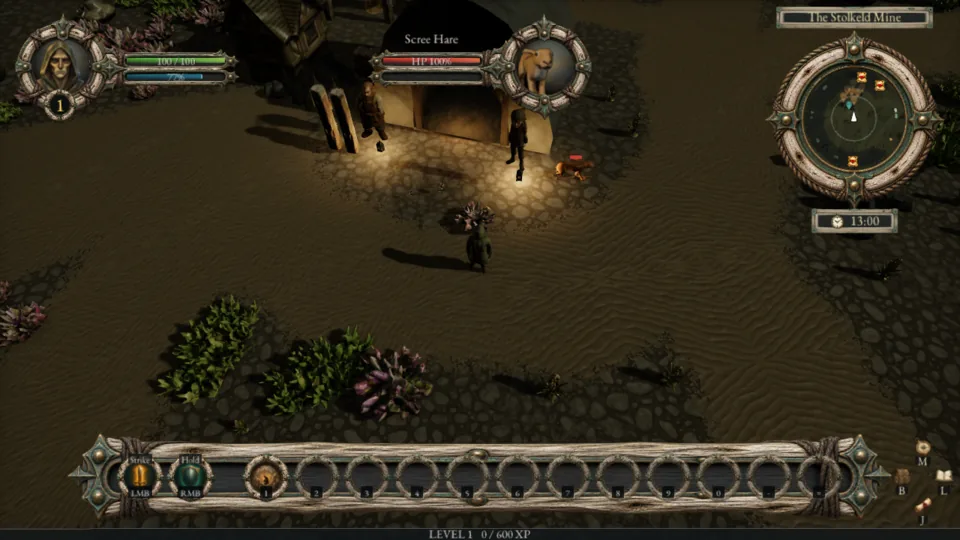

 The Scree RunLoose rock fans down from the ridge below the mine's own approach, riddled with scree-hare warrens and raked over each dawn by rock-martens working the slope for eggs and pups.
Loose rock fans down from the ridge below the mine's own approach, riddled with scree-hare warrens and raked over each dawn by rock-martens working the slope for eggs and pups. A thin, weathered vein-trace breaks the surface here and there, easy pickings before the rock gets hard, and old cordage — worn lashings some crew dropped generations back — still turns up half-buried in the rubble. No fights on this stretch; the mine's approach road runs clean past it.
Up close
3 things to look at closer
- You work the scree at the fan's edge. The hares go into the warrens ahead of you, and the martens come out of them behind you, which is the whole arrangement here.
- The rake-marks of the dawn martens cross the whole fan in one direction. Nothing crosses back.
- Loose rock all the way down and nothing under it. The run is a slope with animals on it, and that is the honest sum of the place.
Gathered here
- Scree-Hare Hide
- Stolkeld Ore
- Worn Cordage
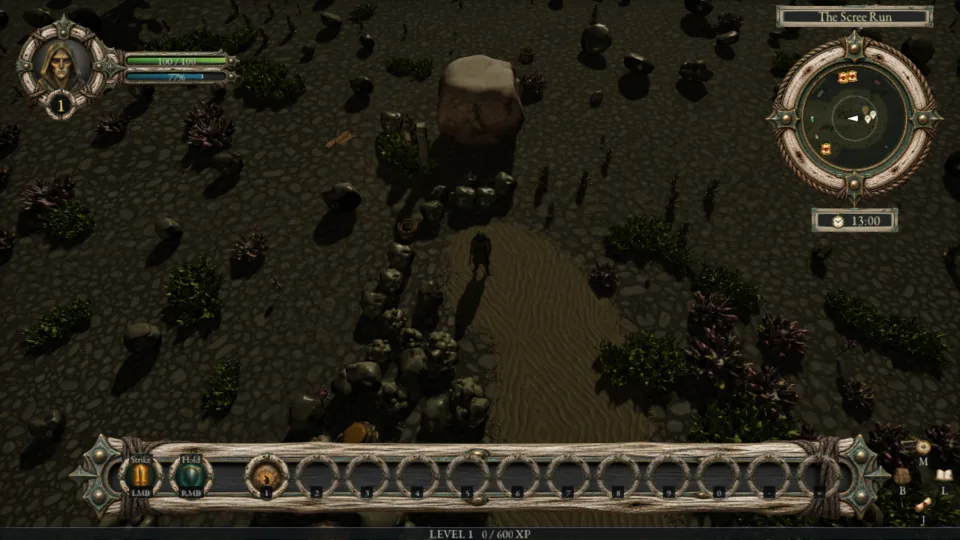
 The Scale CampA lean-to and a weighing scale pitched a short walk from the mine's own bunkhouse, kept by an outsider Dreneth's crew lets deal with travelers so the dig itself never has to.
A lean-to and a weighing scale pitched a short walk from the mine's own bunkhouse, kept by an outsider Dreneth's crew lets deal with travelers so the dig itself never has to. Rough tools go out over the same scale that weighs ore coming in, priced for a stranger rather than a hand until trust is earned, per the crew's own rule. A contract board hangs here too, work posted for anyone willing to earn that trust the hard way.
Up close
3 things to look at closer
- You watch the scale work. It is honest to the eye and the weights are stamped — by nobody, which is not the same as by no one.
- The outsider deals with travellers so Dreneth's crew does not have to, and every price he quotes is a fraction under the port's. He wants the traffic, not the margin.
- There is nothing behind the lean-to but rock. The camp is a scale, a man and a rate, pitched exactly far enough from the bunkhouse to be deniable.
People here
| Name | Does |
|---|---|
 Fenneth Scalewright | quest giver, vendor |
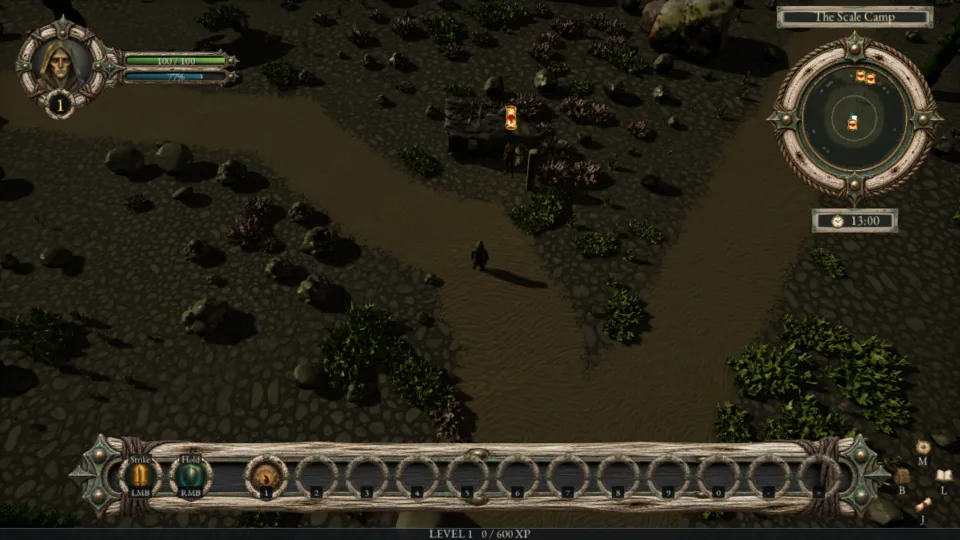
 The Sealed DriftThe mouth of an older seam, sealed and marked exhausted on Dreneth's own survey before his crew ever drove the new adit — dressed stone gone dark with age around a drift nobody has worked in a generation.
The mouth of an older seam, sealed and marked exhausted on Dreneth's own survey before his crew ever drove the new adit — dressed stone gone dark with age around a drift nobody has worked in a generation. A stretch of it gave way sometime since, opening a pocket of ore richer than anything the old diggers left behind, untouched because no one on this crew has reason to look. The rock behind the fall cuts dense and clean for anyone who can get past it; deeper in, the dark keeps whatever else the old seam is still hiding.
Up close
3 things to look at closer
- You get the seal-stones apart far enough to see in. The old seam runs on past where the survey called it exhausted, and it is not exhausted.
- The dressed stone of the mouth has gone dark, and under the dark it carries tool-marks that are not the crew's pattern.
- Somebody sealed a seam that still had ore in it, marked it worked-out on their own survey, and drove a new adit instead. That is a decision, and it cost money.
Gathered here
- Deep-Vein Ore
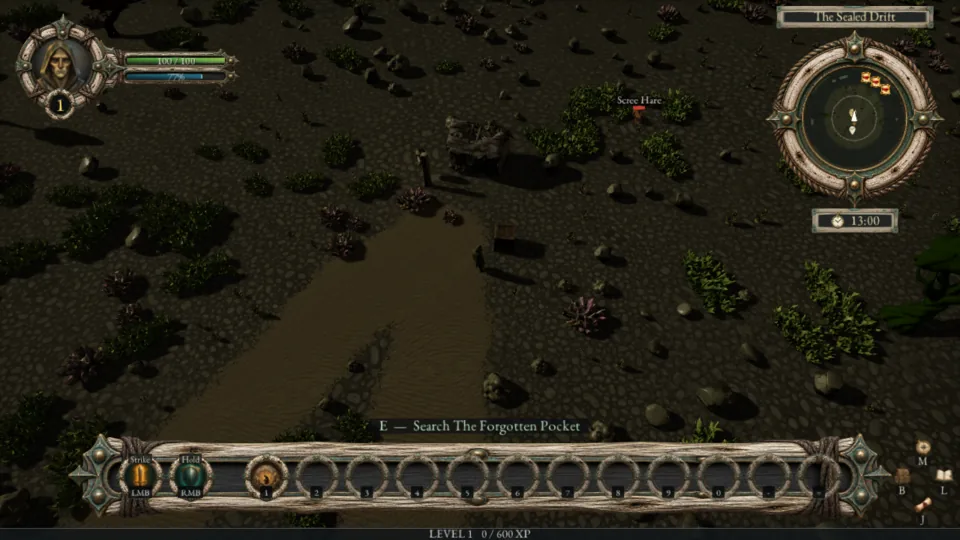
 The Shoring CampA staging ground on the road out from the mine, where cut props and braces are racked before they go down into the workings.
A staging ground on the road out from the mine, where cut props and braces are racked before they go down into the workings. Borrek keeps this stretch — the timber-shoring and rock-hauling the adit needs and the rest of the crew is glad not to carry alone — and hands out the same steady, plain-spoken work to anyone who'll take a haul. Ore carts headed down off the headland pass through here too, loaded and checked before the trail starts.
Up close
3 things to look at closer
- You go along the racks. Props cut to two lengths only, both of them right for the adit below, all of them from the same stand of timber.
- Borrek's tally of what has gone down and what has come back up does not balance, and the gap is all one week.
- The staging ground is props, braces and rope. Everything here is going somewhere else, downward.
People here
| Name | Does |
|---|---|
 Borrek | quest giver |
Gathered here
- Cut Timber
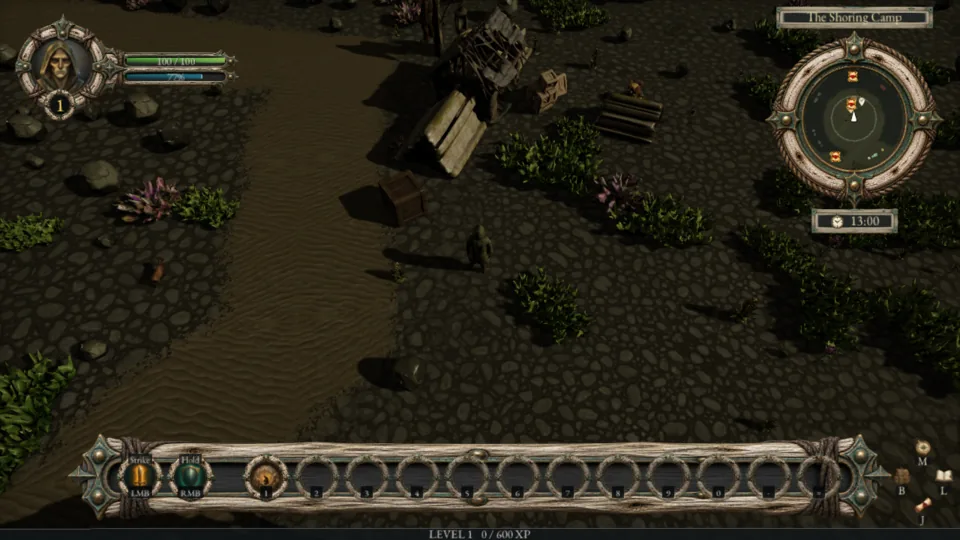
 The Timber CutA felled stand at the working ground's edge, where the crew cuts what little timber the rocky highland actually offers for shoring the adit below.
A felled stand at the working ground's edge, where the crew cuts what little timber the rocky highland actually offers for shoring the adit below. Raw props and rounds are racked here fresh from the axe before they go down to be braced and hauled in. Past the tree line the ground turns to bare rock again — this stand is the last green ground before the dig proper starts.
Up close
3 things to look at closer
- You work the cut face. The highland gives up bad timber slowly — knotted, short, and worth felling only because the alternative is carrying it up from the coast.
- The stumps are cut at a good height and squared off. Whoever works this stand expects to still be here next season.
- Everything that would season into a prop has already been taken. What is left is the stand's own bones.
Gathered here
- Cut Timber
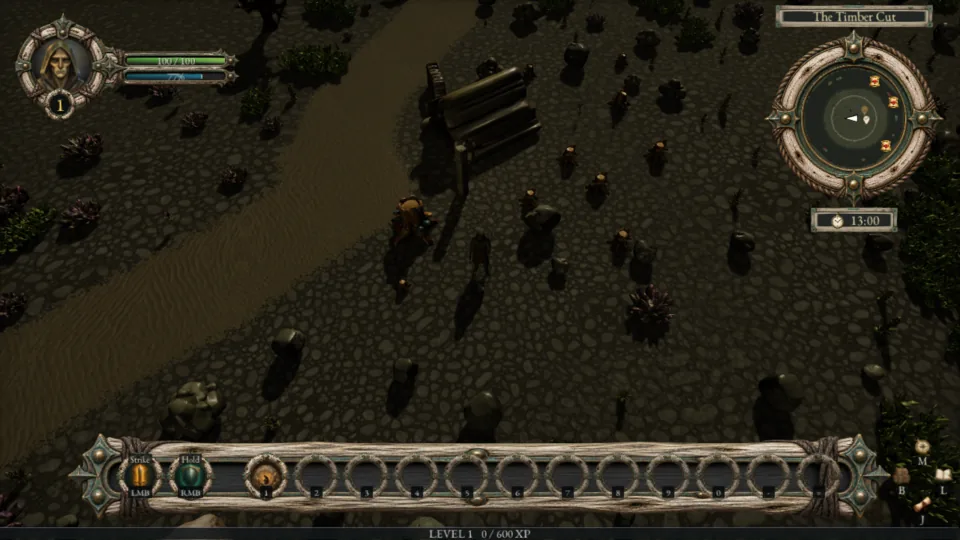
 The Hard VeinWhere the headland's rock finally gives up a vein worth driving into — not the tide-timed surface seam Skarnmar's crews scrape by the water, but ore locked deep enough that it wants a crew who stays.
Where the headland's rock finally gives up a vein worth driving into — not the tide-timed surface seam Skarnmar's crews scrape by the water, but ore locked deep enough that it wants a crew who stays. This is what the dig is actually for: the working face the professions come to work, its scree-choked apron pooling thick where the trail climbs above the mine. The warrens riddling that scree are the same the scree-hares keep lower down the slope.
Up close
3 things to look at closer
- You get down to the vein. It runs deep and clean, and it is nothing like the tide-timed scrape down on Skarnmar's shelf — this is ore you drive into rather than pick off.
- The face has been worked with two different tool patterns, one older than the other by a long way, and the older one goes deeper.
- You have taken everything the face gives without a shift's worth of driving. The rest wants a crew, a prop and a week.
Gathered here
- Bog Iron
- Scree-Hare Hide
- Stolkeld Ore
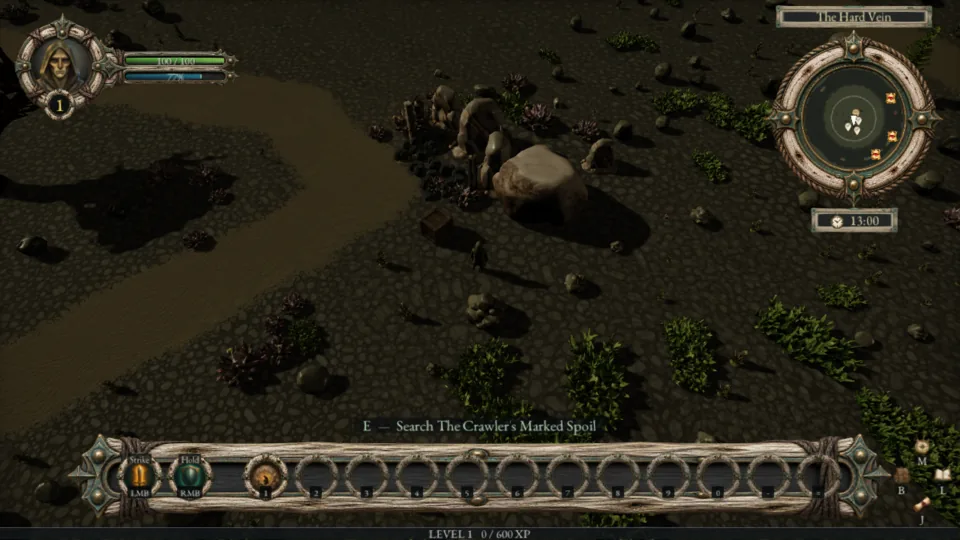
 The Standing PillarA spire of weather-cut rock standing clear of the ridgeline — Stol-keld's own namesake, the pillar the first Korthen to climb this headland called a hold before anyone had driven a single adit.
A spire of weather-cut rock standing clear of the ridgeline — Stol-keld's own namesake, the pillar the first Korthen to climb this headland called a hold before anyone had driven a single adit. Frost has been peeling it for longer than anyone can account for; the rubble fanning from its base is scree same as anywhere else on the headland, just steeper and looser for how long it's been falling. Borrek hauls timber out this way when the crew needs bracing set at its foot, since the ground here shifts more than the rest of the dig ever has to worry about.
Up close
3 things to look at closer
- You walk the pillar's base. Weather-cut, freestanding, and the first Korthen up this headland called it a hold-stone and named the whole place after it.
- There are marks at the base, low down, worn nearly smooth: the same shorthand the Relay-Chain uses, cut long before the Chain existed.
- The pillar is rock and wind. Standing under it you understand why somebody who had climbed this far decided it counted as a landmark.
Foes here
| Who | Levels |
|---|---|
| The Pillar's Rook | 7–8 |
| The Pillar's Elder | 7–8 |
Gathered here
- Quarried Stone
 The Broken CrestWhere the ridge trail gives out and the climbing starts, a broken crest lays the whole dig out below it and the pass beyond in view on a clear day — worth the harder ground for the sightline alone, and a thin trace of ore breaks the surface right along the crest itself.
Where the ridge trail gives out and the climbing starts, a broken crest lays the whole dig out below it and the pass beyond in view on a clear day — worth the harder ground for the sightline alone, and a thin trace of ore breaks the surface right along the crest itself. Past it, off the marked way, an older seam-mouth marked exhausted on Dreneth's own charts opens into the dark, and something has squatted it longer than anyone here can account for. Chalk marks still show on the rock nearby, from a subsidence survey that passed through and flagged a spoil-pocket worth a look, not worth the detour, and moved on.
Up close
3 things to look at closer
- You climb to where the trail gives out. The whole dig lies below you and the pass beyond it opens on a clear day — which today it does.
- From up here the switchback's drifter camp is plainly visible from the mine, and the mine from the camp. Both of them know exactly where the other is.
- The crest is a view and a wind and the place a climb starts. Nothing else has ever been up here.
Foes here
| Who | Levels |
|---|---|
| The Broken Crest Aerie | 7–8 |
 The Holdfast | 7–8 |
Gathered here
- Vein Salt
 The Switchback WatchWhere the ridge trail down to Krelthnael doubles back on itself below the mine's own approach, a loose handful of drifters have dug in — opportunists who've worked out that no Trade charter watching this dig also means no Trade muscle riding its ore off the headland.
Where the ridge trail down to Krelthnael doubles back on itself below the mine's own approach, a loose handful of drifters have dug in — opportunists who've worked out that no Trade charter watching this dig also means no Trade muscle riding its ore off the headland. This is where the road's danger concentrates, past Krelthnael's own contested ground and short of the mine's real light and muster. Dreneth's crew, Selkorn, and Borrek all stay well clear of it; this is where the fights are, not the dig itself.
Up close
3 things to look at closer
- You come down on the doubled-back trail and see the camp before it sees you: a handful of lean-tos on the one stretch of road nobody can avoid.
- What they have stacked is all portable and none of it theirs — rope, props, a crate with a mine-mark burned into the end.
- They are opportunists on a corner, and the corner is why they are there. Take the corner and they have nothing.
Foes here
| Who | Levels |
|---|---|
| The Switchback Watch | 6–7 |
| The Switchback Watch — Upper Turn | 6–7 |
| The Switchback Watch — Slingers Above | 6–7 |
 The RidgewatchA cairn-marked waystone where the trail off Stolkeld's headland meets Krelthnael's own scarp road — the safer route down, clear of the switchback drifters, and the last hand-off before travelers are back on charted ground.
A cairn-marked waystone where the trail off Stolkeld's headland meets Krelthnael's own scarp road — the safer route down, clear of the switchback drifters, and the last hand-off before travelers are back on charted ground. A crew that falls here rises again from this cairn, and Torvenn Ridgehand keeps it lit and the roster straight, since a dig that answers to no cell still needs someone minding its one door out. Ore bound down to Krelthnael and anyone bound up to the mine both pass this stone.
Up close
7 things to look at closer
- You read the cairn. It marks the safer way down — the one that misses the switchback entirely, which is not an accident of geography but a choice somebody made with stones.
- The waystone underneath is older than the cairn stacked on it, and it faces the pass rather than the road.
- The Ridgewatch is a marker and a view of two roads. Everything else about it is the choice it offers.
- You read the cairn's stones. They are river-rounded, carried up from a watercourse, which is a long way to carry a marker.
- From the cairn both roads down are visible at once, and only one of them passes the switchback.
- The waystone under the cairn faces the pass rather than either road. It was here before the choice it now marks.
- There is nothing else at the Ridgewatch but the two roads and the wind between them.
People here
| Name | Does |
|---|---|
 Torvenn Ridgehand | quest giver, guard |
Foes here
| Who | Levels |
|---|---|
| The Ridgewatch Wing | 7–8 |
 The Low CampWhere the trail drops off Stolkeld's headland toward Skarnmar's own tide shelf, a lean-to and a banked fire kept going by whoever passes it last.
Where the trail drops off Stolkeld's headland toward Skarnmar's own tide shelf, a lean-to and a banked fire kept going by whoever passes it last. No one is posted here — neither crew answers to the other — but the fire never quite goes out, the same wary, informal courtesy the two digs already keep across the ridge between them. The other hand-off: respawn and gear left here for anyone crossing to Skarnmar.
Up close
7 things to look at closer
- You bank the fire back up, because that is the arrangement: whoever passes last keeps it going for whoever passes next.
- The lean-to holds a dry blanket, a tin, and a scratched tally of nights. Nobody owns it and everybody uses it.
- There is nothing here to take, and taking it would end the only reason the fire is lit.
- You go through what the passing hands leave. A tin, a blanket, a whetstone, and none of it belongs to anybody.
- The fire has a season's ash under it in layers, unbroken, which means it has not gone out in that time.
- The tally of nights scratched into the lean-to post is kept by more than one hand and none of them signed it.
- There is nothing here worth taking, which is exactly why everything here is still here.
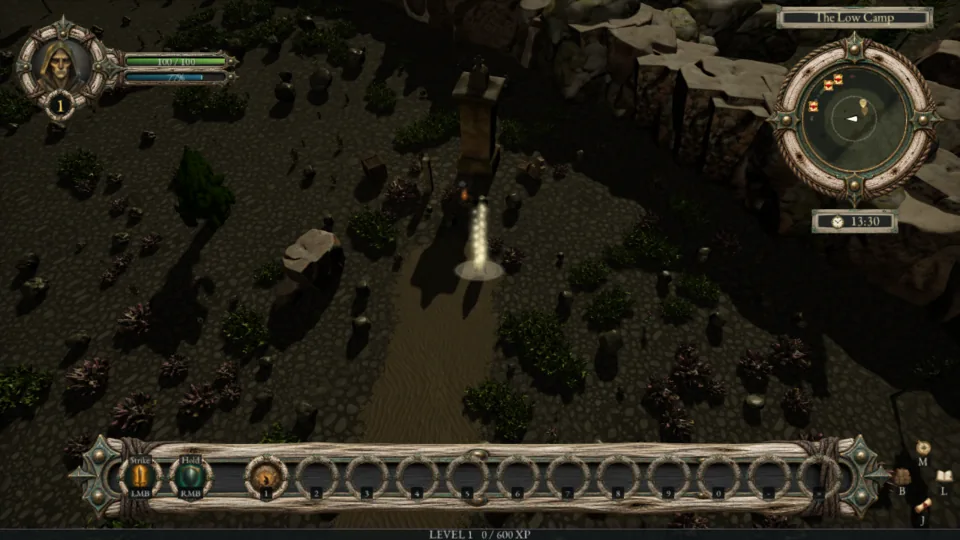
Dreskneld
 The Fallen LineA collapsed timber-and-earth palisade running further than a survey crew could chart in a day.
A collapsed timber-and-earth palisade running further than a survey crew could chart in a day. The wood is scorched. There are no bodies.
Up close
4 things to look at closer
- You walk the fallen line. It runs further than you can see in either direction, and every timber went down in the same direction, away from the interior.
- The scorching is on the INSIDE faces. Whatever burned this palisade was already past it when the fire started.
- You go along until you have to accept it: no bodies. Not bones, not gear, not a grave. A wall this long was held by somebody, and nobody died on it.
- The last stretch has been re-set — three timbers stood back up, badly, by hands that had no tools. Somebody came back here after.

Dreskvath
 The TurnTwo collapsed palisade sections meeting at a right angle, with a worn threshold where a gate once stood.
Up close
3 things to look at closer
- You stand in the gate-gap where the two lines meet. The threshold stone is worn in a curve, which takes years of feet, which means this was a gate people used rather than a wall people manned.
- The right angle is exact. Whoever laid this out worked from a plan, on ground where the Trade's own charts still stop.
- You go over the corner twice. Both lines fell outward from the joint, which is what happens when something pushes from the inside.

Tornkeld
 The Well-HouseA squared fieldstone structure over the hollow's spring, the settlement's name cut into its lintel and the well inside deliberately capped.
Up close
3 things to look at closer
- You read the lintel. The settlement's name is cut into it properly, by a mason, which is what people do when they expect to be somewhere a long time.
- The well is capped — not fallen in, not fouled. Somebody put a lid on the water and walked away, and a capped well is a well people meant to come back to.
- Inside, the fieldstone is dry and the floor is swept. Not swept recently. Swept the day they left.

 The TerracesA dozen shallow stone-lined terraces under ash-grey scrub — an ordinary working settlement that grew food here for years.
Up close
3 things to look at closer
- You walk the terrace lines. A dozen of them, stone-lined, each one levelled by eye and holding: this was somebody's whole working life, twice over.
- The last season's stubble is still standing in three of them. It was never cut.
- There is nothing under the ash-grey scrub but the terraces themselves. Whatever the settlement took with it, it took while there was still time to pack.
Gathered here
- Wild-Grown Grain
 The Well-Road WaymarkA dressed benchmark stone raised beside the road past the wellhouse, cut and levelled to the port standard the surveyors' loft set — the relay practice the sweep contracts already log, walked one zone deeper and made permanent.
Up close
3 things to look at closer
- You check the benchmark against the port standard. Cut, levelled, and correct to the fraction — the surveyors' loft got out this far and did the work properly.
- The date on it is four years before the settlement's last season, which means the road here was official before the hollow was empty.
- It is a dressed stone by a road. Everything else about it is in the ledger it belongs to.
People here
| Name | Does |
|---|---|
 Skennor Gatewarden | quest giver, guard |
 The Sown TerraceA shelf of the old cleared terracing closest to the well-house, gone to volunteer grain that has reseeded itself every year since the settlers stopped harvesting it.
A shelf of the old cleared terracing closest to the well-house, gone to volunteer grain that has reseeded itself every year since the settlers stopped harvesting it. Feral hens their owners never came back for still nest in the stone terrace walls, tame enough to walk up on. Nothing here raises a hand against a crew — the safest ground in Tornkeld, only the work of gathering what nobody claims any more.
Up close
3 things to look at closer
- You go through the volunteer grain. It has reseeded itself every year since the last hand left, and it is thinner every year — a crop keeping going out of habit.
- In the middle of the shelf somebody has cut a patch by hand, recently, with a blade. One patch, taken neatly, nothing trampled.
- The rest of the terrace is bird-work and wind. Nothing here is being farmed; it is simply refusing to stop.
Gathered here
- Terrace-Fowl
- Wild-Grown Grain
 The Tinker's CampA cluster of Trade canvas west of the well-house, the first ground the sweep crews claimed once the roster started sending them out here.
A cluster of Trade canvas west of the well-house, the first ground the sweep crews claimed once the roster started sending them out here. A board nailed to a post carries the crew's own standing orders, and a field bench set up alongside it mends gear and buys back whatever salvage a crew hauls out of the ruin before it goes anywhere else. Nobody camps here who isn't cleared through the roster; the outpost exists to keep the crews fed, armed, and accounted for.
Up close
3 things to look at closer
- You go along the Trade canvas. Everything is pitched to be struck in an hour — this is the first ground the sweep crews claimed and none of it is meant to stay.
- The bench holds mends waiting on parts that are not coming: three tools, one lamp, and a hinge that came off a door nobody here has seen.
- The camp is canvas, a bench and a rota. What it has instead of roots is a road out.
People here
| Name | Does |
|---|---|
 Vetra Ironmend | quest giver, vendor |
Gathered here
- Worn Cordage
 The RoadwatchA permanent Trade watch-house further out along the road toward the border waymark, with green hides drying on timber racks beside it.
A permanent Trade watch-house further out along the road toward the border waymark, with green hides drying on timber racks beside it. Its keeper logs every crew that passes and hands out the next leg of the roster's work. Closer to the empty gate than the tinker's camp dares to sit, but still short of where the real danger starts.
Up close
3 things to look at closer
- You come up to the second post: a low gabled watch-house with three racks of green hides standing beside it — a permanent claim on the next stretch of road.
- House and drying racks are kept to the same practical standard as the well-house below. Somebody up here is still working to the loft's rules.
- The hides are freshly stretched and the road ledger is current. This post is waiting for an order rather than for a season.
 The Channel BankWhere the well-house's capped spring finds its outlet and becomes the stream that will carry on to become the Cut further downstream — reed-choked banks, a fishing stand worn smooth by crews' boots, and stone flagging half-buried where the settlement's own washing-steps used to be.
Where the well-house's capped spring finds its outlet and becomes the stream that will carry on to become the Cut further downstream — reed-choked banks, a fishing stand worn smooth by crews' boots, and stone flagging half-buried where the settlement's own washing-steps used to be. Close enough to camp's edge that Trade calls it safe working ground, cutting reeds and drawing water without going looking for trouble.
Up close
3 things to look at closer
- You follow the outlet from the capped spring. The water is clean, fast, and going somewhere that will eventually be called the Cut.
- The bank has been worked: a stone lip, a set-in step, and a worn place where somebody knelt to fill a vessel every day for years.
- Below the worked stretch the channel is just a stream through scrub. The work stops exactly where the settlement's ground did.
Gathered here
- Marsh Herbs
- Reed Cordage
- Spring-Cut Catch
 The Feral SteadingA stretch of low terrace given over entirely to what the settlers left running loose — wild grain gone to seed in the old plots, and hens nesting thick in the field walls with nobody left to check them.
A stretch of low terrace given over entirely to what the settlers left running loose — wild grain gone to seed in the old plots, and hens nesting thick in the field walls with nobody left to check them. Harvest crews come this far out for feather, meat, and grain in the same afternoon; the ground is generous, in the same unsettling way the rest of Tornkeld is empty.
Up close
3 things to look at closer
- You go through what was left running loose. Grain gone to seed in the old plots, and animals that have forgotten to be afraid of a person walking towards them.
- One plot has been kept clear — not farmed, cleared — and there is a fire-scar in the middle of it that is not four years old.
- The steading is what a farm becomes when nobody tells it to stop. It is doing well, and it is nobody's.
Gathered here
- Terrace-Fowl
- Wild-Grown Grain
 The Hollow GateThe settlement's actual gate — twin fieldstone gateposts and a fallen crossbeam, the old boundary hedge running thick along both sides with self-seeded herbs nobody has cut back.
The settlement's actual gate — twin fieldstone gateposts and a fallen crossbeam, the old boundary hedge running thick along both sides with self-seeded herbs nobody has cut back. This is the pass the settlement's own name comes from: the gate-approach whoever built Tornkeld thought was worth walling and watching. The posts stand open the way they were left, and nothing has closed them since.
Up close
3 things to look at closer
- You stand in the gate. Twin posts, a fallen crossbeam, and a boundary hedge that has thickened rather than died — the hollow shut its own door behind it.
- The crossbeam fell inward and the hedge has grown across the gap, which means nothing wheeled has come through this way since.
- The posts are sound. Anyone who wanted to could hang a beam back on them in an afternoon.
Gathered here
- Bitter Salt
- Marsh Herbs
 The Terrace CrownThe highest of the old terrace tiers, climbing above the settlement's stub-walls to where the whole hollow opens out below — the well-house, the gate, the low terraces, all of it visible at once from the ground the settlers clearly worked hardest to hold onto last.
The highest of the old terrace tiers, climbing above the settlement's stub-walls to where the whole hollow opens out below — the well-house, the gate, the low terraces, all of it visible at once from the ground the settlers clearly worked hardest to hold onto last. The footing turns root-heaved and half-collapsed past here, and it is where the terraces' huge feral boar keeps its own patrol, undisturbed by anyone who isn't looking for it.
Up close
3 things to look at closer
- You climb to the top tier. The whole hollow opens out below — terraces, well-house, gate, the road going out — laid out as clearly as a plan.
- From here the settlement reads as one decision: everything faces inward, and the only thing facing out is the road.
- The crown is a view of an empty place, and the emptiness is tidier from up here than it is from inside it.
Foes here
| Who | Levels |
|---|---|
 The Rootbreaker | 6–8 |
Gathered here
- Terrace-Fowl
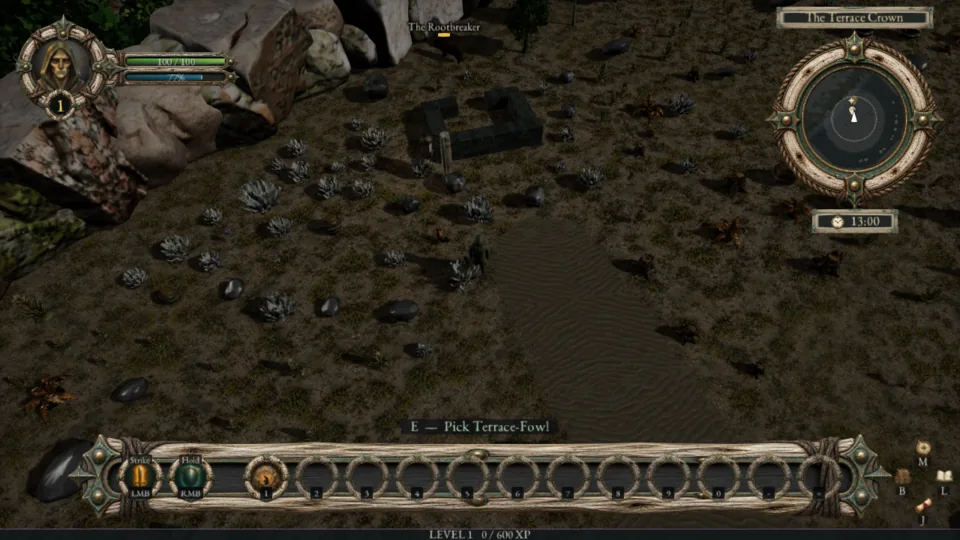
 The Salvage HollowA stretch of collapsed roof-timber and stripped door-frames east of the terraces, where a strand-scavver band has been working since well before any sweep crew arrived — prying iron fittings and hinges off anything that will carry, including what they've already torn from the well-house door.
A stretch of collapsed roof-timber and stripped door-frames east of the terraces, where a strand-scavver band has been working since well before any sweep crew arrived — prying iron fittings and hinges off anything that will carry, including what they've already torn from the well-house door. No leader, no banner, just opportunists who found an empty settlement first and mean to pick it clean before Trade gets organized. This is where Tornkeld's fights happen; nothing else in the hollow lifts a hand.
Up close
3 things to look at closer
- You go through the stripped frames. The scavvers have taken hinges, nails, and every squared timber, and left the roof-slates stacked as if somebody might want them.
- Their working line runs from the terraces to the gate and stops. They are stripping the settlement in order, house by house, the way a crew works a seam.
- What is left is what was too heavy to carry. In a season they will be back for it.
Foes here
| Who | Levels |
|---|---|
| Scavvers at the Well-House | 6–7 |
| Scavvers at the Salvage Hollow | 6–7 |
Gathered here
- Scavenger Scrap
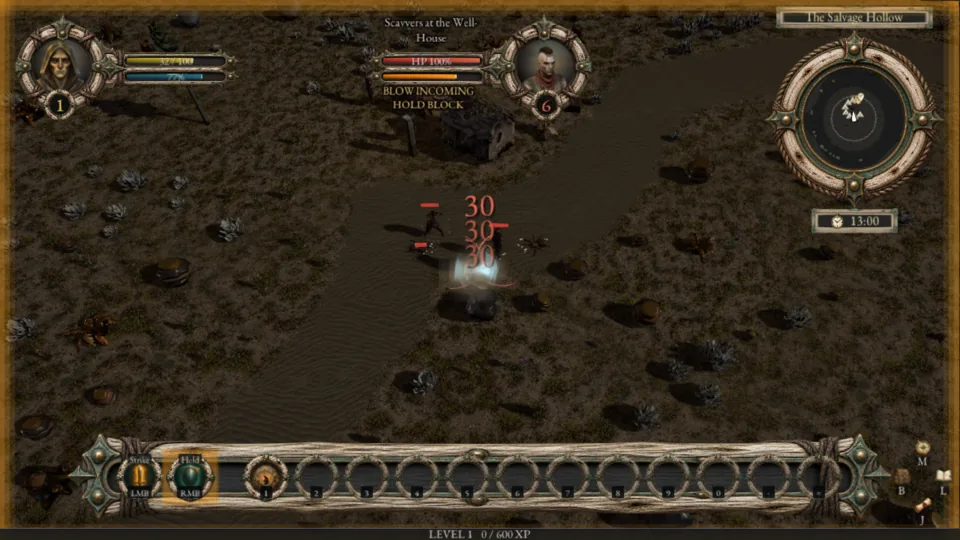
 The Fording ShelterA lean-to and a marked stone southwest of the tinker's camp, where the path drops toward the ford that carries on into the outlying fields beyond Tornkeld's own boundary.
A lean-to and a marked stone southwest of the tinker's camp, where the path drops toward the ford that carries on into the outlying fields beyond Tornkeld's own boundary. Runners and hand-offs bound the other way — away from the deep spine road — start and end here, a fire kept going for whoever comes back wet and short on daylight. The quieter of Tornkeld's two borders; nothing past the ford answers to the waymark's own authority.
Up close
3 things to look at closer
- You look into the lean-to. Dry, marked, and stocked with exactly enough for one night — the courtesy of a road nobody administers.
- The marked stone outside carries three names scratched in three hands, all crossed through, which on this coast means arrived rather than lost.
- Below the shelter the path drops toward the ford and the outlying ground. Everything past here is somebody else's map.
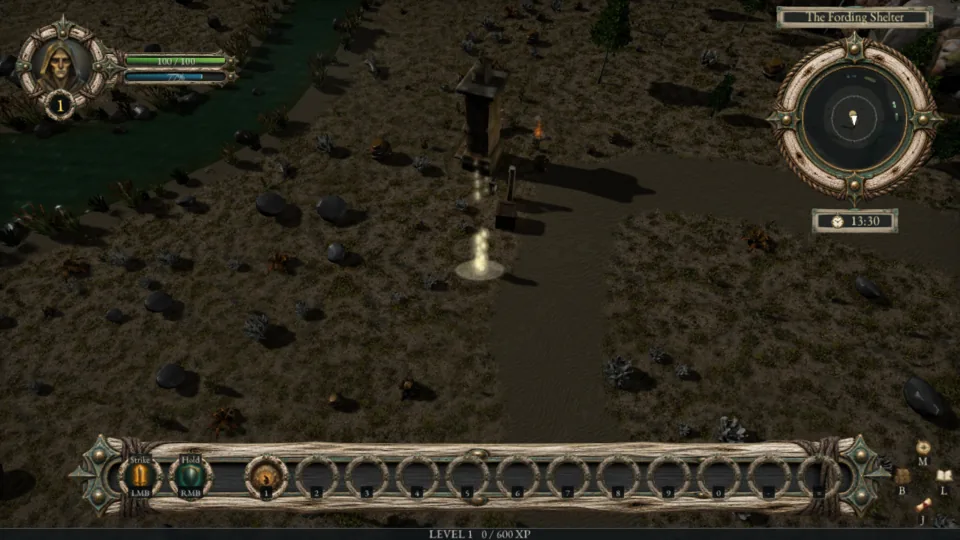
Vronveld
 The FordA cobble-lined crossing wide enough for a loaded cart; the only built thing in the zone besides the fields.
Up close
3 things to look at closer
- You walk the cobbles. Laid properly, wide enough for a loaded cart, and the only built thing in this zone that is not a furrow.
- The cobbles are worn in two ruts a cart's width apart, and the ruts stop at the far bank. Whatever was carried across here was carried in one direction.
- The crossing is sound and the road either side of it is not. Somebody built the hard part and never finished the easy part.
Gathered here
- Ford Shallows Catch
- Marsh Herbs
- Worn Cordage
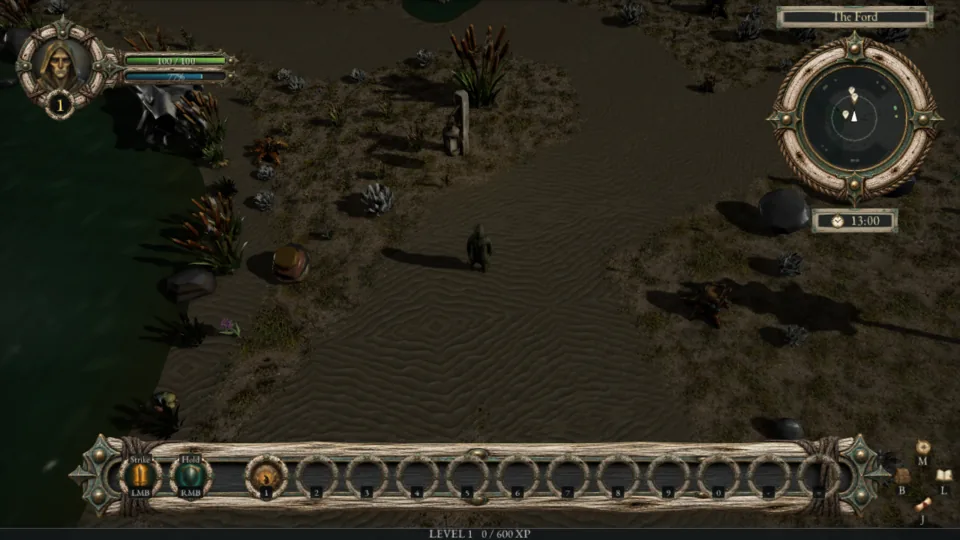

 The Fallow RowsThe nearest run of Tornkeld's old field-strip rows, close enough to the ford's cobbles that a first sweep out from the crossing can gather here without meeting anything worse than the wind.
The nearest run of Tornkeld's old field-strip rows, close enough to the ford's cobbles that a first sweep out from the crossing can gather here without meeting anything worse than the wind. Reeds have spread thick along the furrow edges since the fields went untended, and a scatter of the settlement's own feral goats browses the rows for the taking. Crows work the turned earth behind them, the same thin, wary flock that covers every furrow this far out.
Up close
3 things to look at closer
- You walk the nearest of Tornkeld's old strips. The rows are still readable underfoot, four years on, because whoever cut them cut them deep.
- The fallow is not weeds — it is the same volunteer grain as the terraces, thinner each year, still coming up in the shape of somebody's plan.
- Nothing here has been sown or cut since the hollow emptied. The rows are a drawing of a farm.
Gathered here
- Fallow-Goat Hide
- Field Cuttings
- Ford Reeds
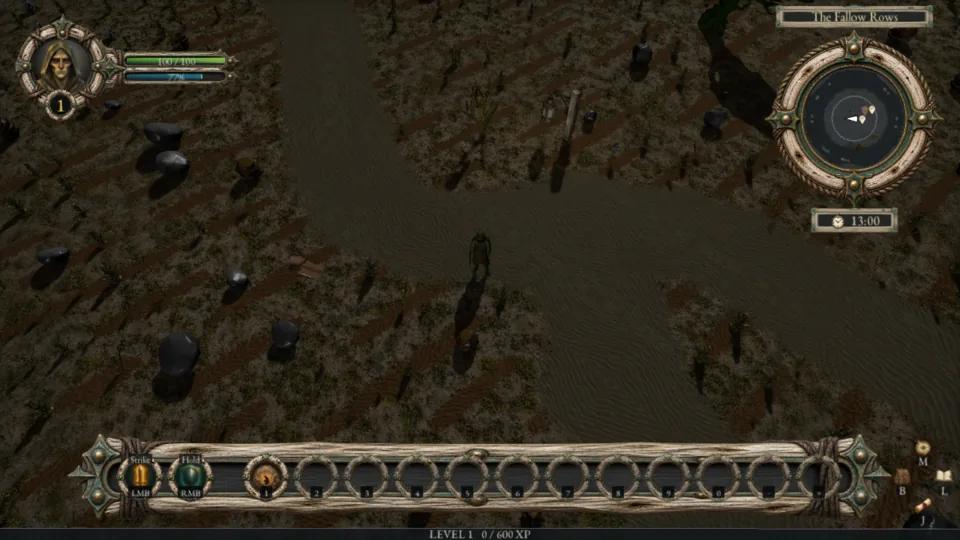
 The Crossing CampA canvas lean-to and a picket line raised west of the ford once Brendorn's authorization opened the crossing to regular sweep traffic — no real settlement, just Drenna Cartwright and whichever hands rotate through for the work.
A canvas lean-to and a picket line raised west of the ford once Brendorn's authorization opened the crossing to regular sweep traffic — no real settlement, just Drenna Cartwright and whichever hands rotate through for the work. Drenna mends tack, buys hide and cordage off crews coming back from the rows, and keeps the board that names what Trade still wants carried out of the fields. It is the only roof in Vronveld that anyone sleeps under twice.
Up close
3 things to look at closer
- You go through the canvas. Trade issue, picket line, everything raised after Brendorn's authorization opened the crossing — this camp is younger than the paperwork that allowed it.
- The picket line holds four horses' worth of rope and no horses. Whatever came through went on.
- The camp is here to be here. That is its whole function: the crossing is now watched, and everybody upstream and downstream knows it.
People here
| Name | Does |
|---|---|
 Drenna Cartwright | quest giver, vendor |
Gathered here
- Tanned Goat Hide
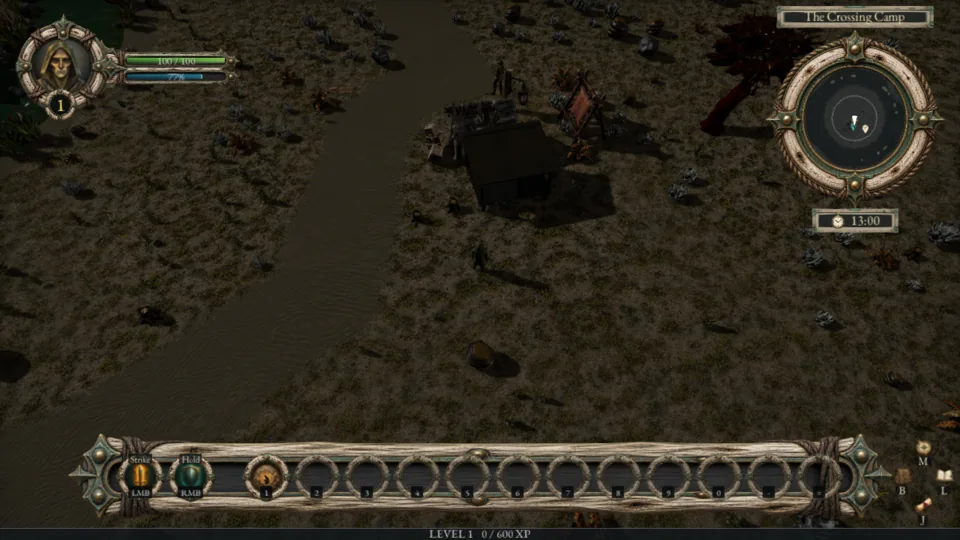
 The Fording StoneA weathered marker stone half-swallowed in the silt upstream of the built crossing, worn smooth long before Tornkeld ever laid a cobble here — whoever farmed this ground first found the ford already known and only built over it.
A weathered marker stone half-swallowed in the silt upstream of the built crossing, worn smooth long before Tornkeld ever laid a cobble here — whoever farmed this ground first found the ford already known and only built over it. The settlement's own field cart lies part-sunk in the drift beside the stone, stripped and quietly restocked by something that has claimed the hollow as its own. Nothing else stands here; the stone is the oldest thing in the fields by a wide margin.
Up close
7 things to look at closer
- You dig the marker out of the silt. Worn smooth long before Tornkeld ever cut a furrow, and the smoothing is hands, not water.
- There is a cut on the upstream face, filled with silt, in a shorthand that predates the Chain's.
- The stone marked this crossing before the cobbles, before the fields, before the settlement that farmed them.
- You clear more silt. The stone is dressed on the upstream face only, which is the face a crossing party would see coming down.
- The cut on it fills with water when you clear it and empties when you stop, so it has been under and out of this river many times.
- Under the smoothing there are tool-marks after all — fine ones, close-spaced, cut with something harder than the stone.
- You have taken the silt down to the base. It goes deeper than you can dig with your hands.
Gathered here
- Worn Cordage
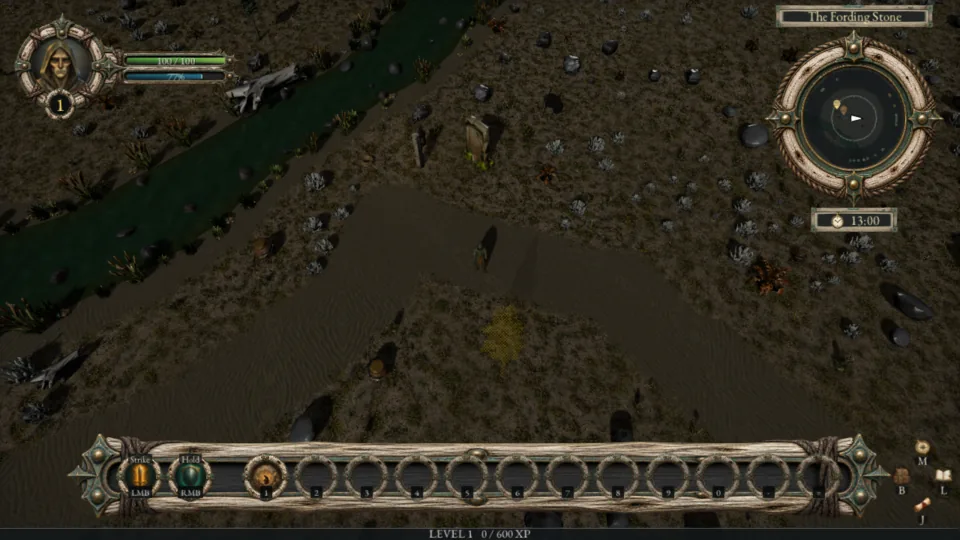
 The Tally PostA lean-to and a weighted ledger board on the road that leaves the crossing for the deeper fields, where Trade's own tally-keepers leave standing work for whoever passes rather than waiting out here themselves.
A lean-to and a weighted ledger board on the road that leaves the crossing for the deeper fields, where Trade's own tally-keepers leave standing work for whoever passes rather than waiting out here themselves. No one is posted at the board itself — the crows and the wind get to it before most sweep crews do — but the postings stay current, renewed every time a crew rides back through the crossing camp. It is as far out as the paperwork reaches before the fields stop answering to anyone.
Up close
3 things to look at closer
- You read the weighted ledger board. Everything that leaves for the deeper fields is written down; everything that comes back is written down beside it, in a different hand.
- The two columns have not matched for three weeks and nobody has ruled a line under it.
- It is a lean-to and a board on a road. The board is doing the actual work of holding this crossing.
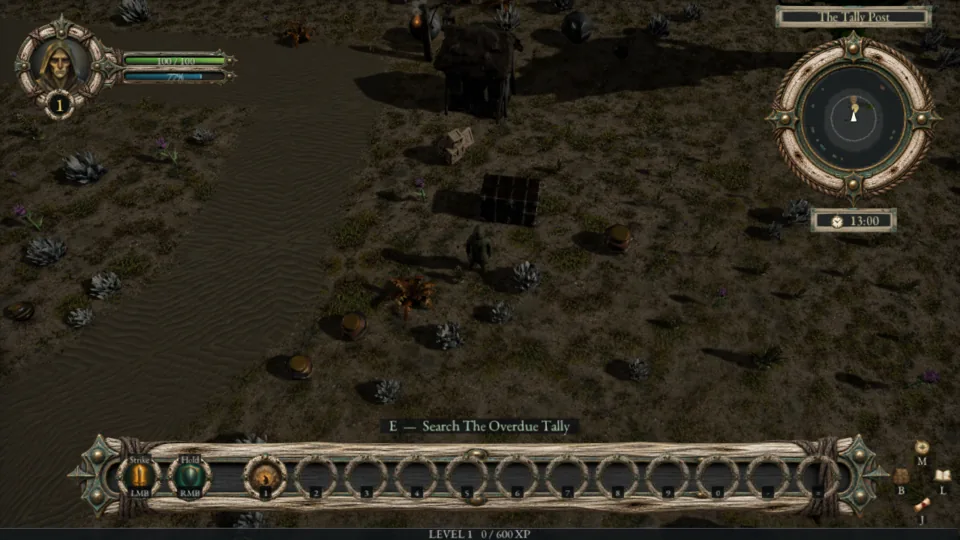
 The Shallow BendA slack bend in the ford's shallows downstream of the crossing camp, where the current slows enough to work a line without wading past the knee.
A slack bend in the ford's shallows downstream of the crossing camp, where the current slows enough to work a line without wading past the knee. The same catch that keeps this stretch worth fishing runs thick here — eel, silverfin, the odd trout wandered down off Tornkeld's own stream — and the packed mud at the bend's edge holds a season's worth of cart-wheel ruts from crews that stopped here before riding on. It is the only ground in the fields anyone comes to for something other than work.
Up close
3 things to look at closer
- You work the slack. The current slows enough here that anything the ford loosens fetches up on the inside of the bend.
- What has fetched up is fence-rail, all of it cut to the same length, all of it from the same fences.
- The bend has given up what it had this season. The next flood decides what it has next.
Gathered here
- Ford Shallows Catch
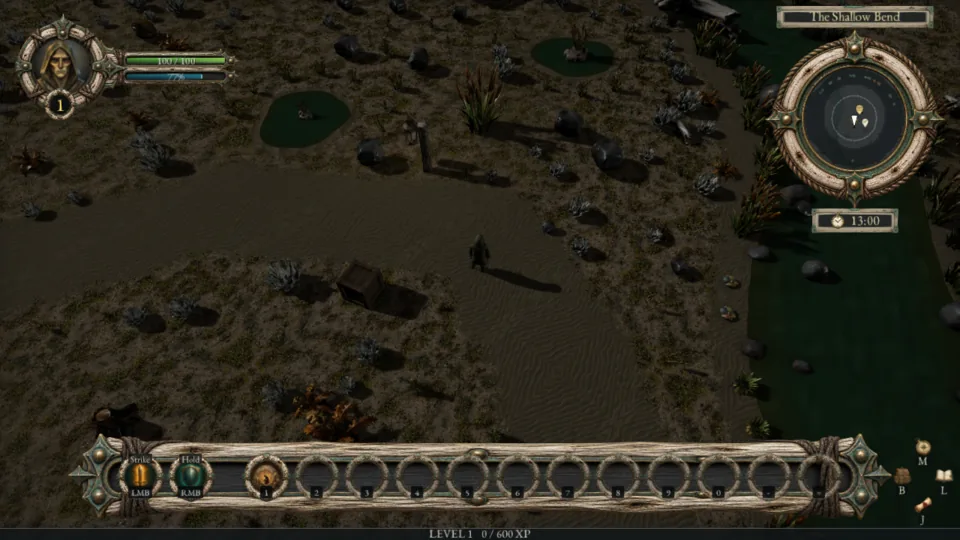
 The Reed FlatsA wide stand of marsh reed that has spread unchecked along the ford's silted banks since the fields went untended, thick enough now to hide the goat herd that grazes through it most mornings.
A wide stand of marsh reed that has spread unchecked along the ford's silted banks since the fields went untended, thick enough now to hide the goat herd that grazes through it most mornings. Sweep crews cut reeds here for Kreskava's own reagent stock back at the port, wading carefully — the herd that browses the flats answers to nobody's brand, and whoever drives it does not take kindly to being crowded. The ground stays soft underfoot the whole season through.
Up close
3 things to look at closer
- You cut in the unchecked reed. It has spread the whole silted bank since the fields went untended, which is four years of nobody stopping it.
- Under the reed the old drainage cuts are still there, still running, still doing the job they were dug for with nobody to benefit.
- The stand is thick and it will be thicker. Reed is what this ground does when it is left.
Gathered here
- Fallow-Goat Hide
- Ford Reeds
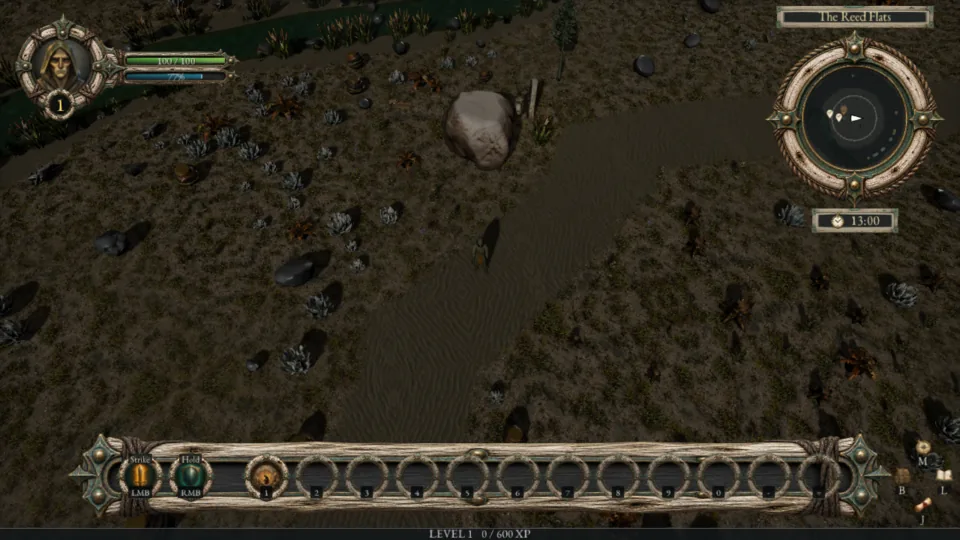
 The Open FurrowsThe widest run of Tornkeld's old field strips, laid out in furrows still readable for a good distance before the ash-grey scrub finally swallows them — the broad crossing fields the ford's own name means, more open ground than anywhere else in the zone.
The widest run of Tornkeld's old field strips, laid out in furrows still readable for a good distance before the ash-grey scrub finally swallows them — the broad crossing fields the ford's own name means, more open ground than anywhere else in the zone. The going looks solid from a distance and is not always: silt has crept up from the banks in patches soft enough to bog a cart, let alone a boot. Feral barn-fowl work the drier rows in scattered flocks, the only motion across the whole open stretch most days.
Up close
7 things to look at closer
- You walk the widest run of strips. The furrows read for a good distance and then stop dead at a line, as if the ploughing ended mid-season.
- At that line there are stones set in a row — cleared field-stone, stacked to be carted, never carted.
- The furrows past the line are shallower and rougher. Somebody was working faster than they wanted to at the end.
- You pace the length of one strip. It runs further than a family works and stops without a headland, the way a field stops when the ploughman was interrupted.
- The cleared field-stone stacked at the line has weathered on one face only. It was stacked and never turned.
- Beyond the line the furrows are shallower and crooked, and crooked furrows are what a tired man cuts in a hurry.
- You have walked every strip. The plan under them is bigger than the settlement that drew it.
Gathered here
- Field Cuttings
- Terrace-Fowl
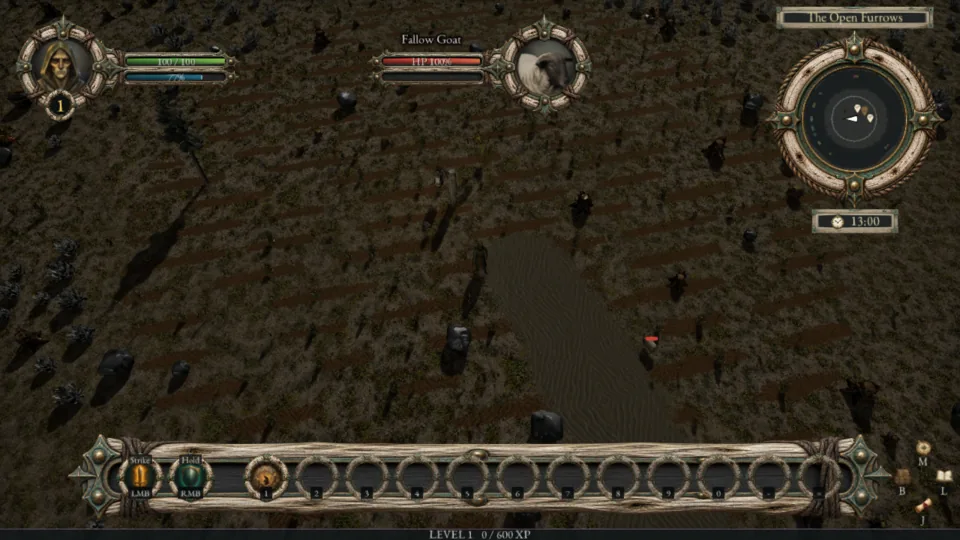
 The Drove RiseA low rise at the field strips' far edge, the only high ground in Vronveld and just tall enough to see the whole crossing — the ford, the reed flats, even Tornkeld's own well-house roofline on the horizon behind.
A low rise at the field strips' far edge, the only high ground in Vronveld and just tall enough to see the whole crossing — the ford, the reed flats, even Tornkeld's own well-house roofline on the horizon behind. Whoever has driven the settlement's feral herd across these fields for months now keeps to this rise between drives, watching for anyone working the goats without leave. Past it the going gets harder fast; the field strips end and the unmaintained ground beyond does not forgive a wrong step.
Up close
7 things to look at closer
- You go up the only high ground in Vronveld. From here the whole field system lies out — strips, ford, camps, the road east — and it is all one plan.
- The plan runs to about twice what Tornkeld could have farmed. They were clearing ground for people who never arrived.
- It is a low rise with a long view. Everything it shows you is unfinished.
- You watch long enough to read the old traffic: the herd went out in one direction and returned by the same worn line.
- From here the strips, the ford and both camps are one view, and so is the second crossing nobody uses.
- The grass on the rise is cropped to the root in a circle, which is where the herd is held rather than where it grazes.
- There is nothing on the rise but the view and the cropping. Everything it tells you it tells you about somewhere else.
Foes here
| Who | Levels |
|---|---|
 The Drover | 7–8 |
Gathered here
- Fallow-Goat Hide
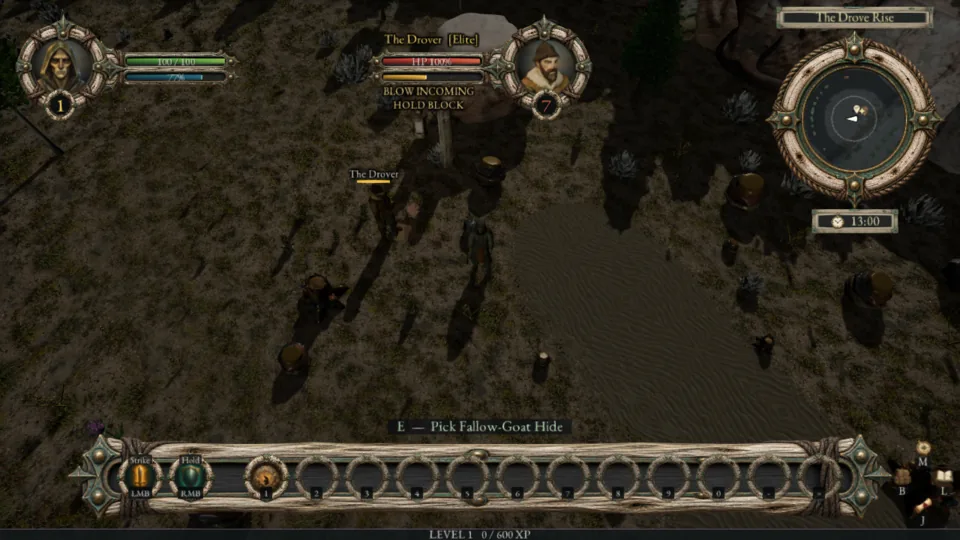
 The Cart-Road CampA huddle of lean-tos built from the settlement's own salvaged fence-rails, set up along the old cart road east of the fording stone by people with no claim on this ground beyond having found it empty first.
A huddle of lean-tos built from the settlement's own salvaged fence-rails, set up along the old cart road east of the fording stone by people with no claim on this ground beyond having found it empty first. Crates and gear lifted off crews that strayed too far from the marked crossing sit stacked in the open, the same opportunist habit that holds Tornkeld's own well-house one zone upstream. This is where anyone working the fields finds a fight, and nowhere else in Vronveld does.
Up close
3 things to look at closer
- You go through the lean-tos. Built from Tornkeld's own salvaged fence-rails, and the rails are cut rather than pulled — somebody had a saw and time.
- The cart road east is rutted fresh. Whatever this camp is taking, it is taking it away from the ford rather than through it.
- Half the shelters are stripped again already. This camp moves the way the salvage does.
Foes here
| Who | Levels |
|---|---|
| Squatters on the Cart Road | 6–7 |
| Scavvers at the Cart-Road Camp | 6–7 |
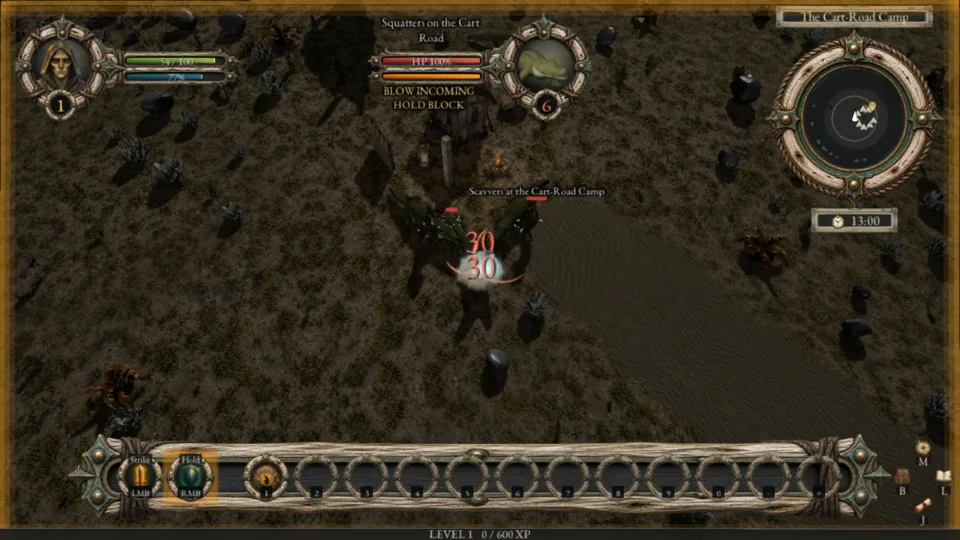
 The Vronveld WaymarkA road-marker stone and a hearth at the crossing's northern approach, where the ford's own traffic funnels back onto the road toward Tornkeld's well-house before the fields run out entirely.
A road-marker stone and a hearth at the crossing's northern approach, where the ford's own traffic funnels back onto the road toward Tornkeld's well-house before the fields run out entirely. Skeva Fordwarden keeps the roster here — every hand-off leaving Vronveld, wounded or otherwise, is logged at this hearth before it crosses back toward the settlement. It is the last maintained ground before the fields become just fields again.
Up close
3 things to look at closer
- You read the road-marker at the northern approach. The hearth beside it is warm and the traffic funnels past it whether anybody minds it or not.
- The marker is cut to the port standard, like the benchmark at the hollow — the loft got this far too, and earlier than anybody says.
- Marker, hearth, and a road that goes back to Tornkeld. Everything here faces north.
People here
| Name | Does |
|---|---|
 Skeva Fordwarden | quest giver, guard |
Gathered here
- Worn Hide
 The Runners' CairnA second, quieter crossing back toward Tornkeld, downstream of the crossing camp, where the bank dips low enough to ford on foot without touching the cobbled stones at all.
A second, quieter crossing back toward Tornkeld, downstream of the crossing camp, where the bank dips low enough to ford on foot without touching the cobbled stones at all. A stacked cairn and a fire that is rarely out mark the spot for couriers who would rather not pass the waymark's roster — anything Trade would rather hand off without a formal note goes through here instead. No warden watches this one; the cairn itself is the only fixture that never moves.
Up close
3 things to look at closer
- You take the quieter crossing. The bank dips low, the water is slack, and there are no cobbles — which is the point of it.
- The cairn is small and recent and rebuilt at least twice. Somebody keeps this crossing findable without making it obvious.
- It is a second way across for people who would rather not use the first one.
Threvdren
 The Sunken CutA narrowed channel between quarried walls where forge-revenants hold a leashed camp among Tornkeld-pattern tools and ash.
Up close
3 things to look at closer
- You come down into the cut. The quarried walls hold the heat of the forge-fires long after the fires themselves have gone out, and the air tastes of ash and iron filings.
- The tools stacked against the wall are Tornkeld-pattern, down to the haft binding — the neighbouring empty settlement, its doors still standing open.
- The revenants keep to their own ground and work it in a circuit, the way a crew works a shift. Whatever else is left of them, the shift is left.
Foes here
| Who | Levels |
|---|---|
| Revenants in the Sunken Cut | 7–9 |
 The Strayed Cutter | 9 |

Bressdren
 The ShallowsA wide fork of the channel opening into ankle-deep water over silted floor, an old flood-line stain well above the current flow.
Up close
3 things to look at closer
- You wade the fork. Ankle deep the whole width, over silt so fine it comes up in a cloud and hangs there.
- The flood-line stain sits a full arm above the water you are standing in, unbroken all the way along the wall. This channel ran four times this deep, and not long ago enough for the mark to weather.
- Nothing has washed down here in a season: no wrack, no timber, no bones. Whatever the water carried, it stopped carrying it upstream.
Foes here
| Who | Levels |
|---|---|
 The Waterline Digger | 7–9 |
Gathered here
- Dry Channel Silt

Vrelskarr
 The WatchThe promontory's high point: bare windswept rock and the collapsed footing of an old watch-post nobody has explained.
Up close
3 things to look at closer
- You climb onto the promontory's high point. Bare rock, all wind, and the footing of a watch-post that nobody has rebuilt and nobody has cleared either.
- The footing's stones are fitted, not stacked, and they are the same fit as the Old Footing below — one builder, two structures, and only one of them collapsed.
- From up here the whole coast the Trade has charted lies behind you, and what is in front of you is not on any of it.
Gathered here
- Quarried Stone

 The Hollow StairBelow the Watch's collapsed footing, the promontory's one weak seam: a natural fissure widened by hands old enough that the tool-marks have weathered past reading, dropping in narrow switchback steps toward the lower country.
Below the Watch's collapsed footing, the promontory's one weak seam: a natural fissure widened by hands old enough that the tool-marks have weathered past reading, dropping in narrow switchback steps toward the lower country. The single access edge down off the promontory, and the mouth of the Underwatch.
Up close
3 things to look at closer
- You find the seam. A natural fissure, widened by hands, and the widening is old enough that the tool marks have weathered round.
- Cold air comes up the stair steadily, which means it does not end in a chamber. It ends somewhere with another opening.
- The stair is the promontory's one weak seam and somebody found it first. Everything since has just been using their work.
Gathered here
- Forge-Country Iron
- Windglass
 The Watch-Road WaymarkA benchmark stone on the road up to the Watch, the deepest mark the relay practice has reached — raised by a sweep crew working to the port standard, not by whoever held the Watch first.
A benchmark stone on the road up to the Watch, the deepest mark the relay practice has reached — raised by a sweep crew working to the port standard, not by whoever held the Watch first. Anchors the run-back to the Underwatch's gate.
Up close
3 things to look at closer
- You check the benchmark. The deepest mark the relay practice has reached, raised by people who intended a chain to continue past it.
- It is cut to the same standard as the port's own, out here, where nothing else is to any standard at all.
- The stone is sound. What is not sound is the assumption behind it, which was that somebody would come and put the next one further on.
People here
| Name | Does |
|---|---|
 Fenneth Farwarden | quest giver, guard |
 The Relief CampA handful of sweep-crew regulars still rotate through here, the last living post before the Watch's own bare rock: a supply tent, a fire kept low against the wind, and a board where names are chalked on and struck off as rotations turn over.
A handful of sweep-crew regulars still rotate through here, the last living post before the Watch's own bare rock: a supply tent, a fire kept low against the wind, and a board where names are chalked on and struck off as rotations turn over. Threnna Stockhand keeps the board and the stores, selling what a crew needs before the climb and buying back what they carry down. It is the only stretch of the promontory that still looks lived-in rather than left.
Up close
3 things to look at closer
- You go through the last living post. Sweep-crew regulars, a rotation, and stores counted to the day — everything about it says short handed rather than short lived.
- The roster's returning column is complete and the outgoing one is not. That is the wrong way round for a camp this deep.
- It is a fire and a rota and the last one of either on this road.
People here
| Name | Does |
|---|---|
 Threnna Stockhand | quest giver, vendor |
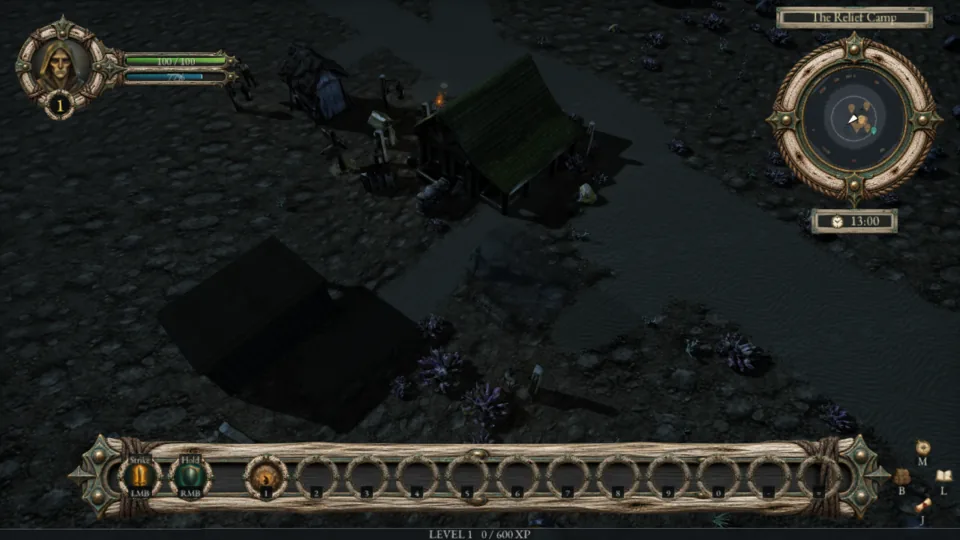
 The Old FootingA run of fitted stone older than the Watch's own collapsed post, its courses worn past reading by whatever wind and years the promontory gets — the same unexplained hands that raised the Watch, or older ones still; nobody says which.
A run of fitted stone older than the Watch's own collapsed post, its courses worn past reading by whatever wind and years the promontory gets — the same unexplained hands that raised the Watch, or older ones still; nobody says which. A crack in the footing's own crust, pried open, holds the sealed alcove: coin, a masonry-adjacent scrap, and tally-marks nobody living can read.
Up close
3 things to look at closer
- You go along the fitted courses. Older than the Watch's own post and worn past reading, and the wear is not weather — it is on the inside faces.
- The line of it runs toward the Hollow Stair and stops where the ground breaks. Whatever this was, it was oriented on the seam.
- There is nothing left of it but the courses. Everything above them has been taken away rather than fallen.
Foes here
| Who | Levels |
|---|---|
| The Old Footing Watch | 8–9 |
 The Old Footing Watch | 8–9 |
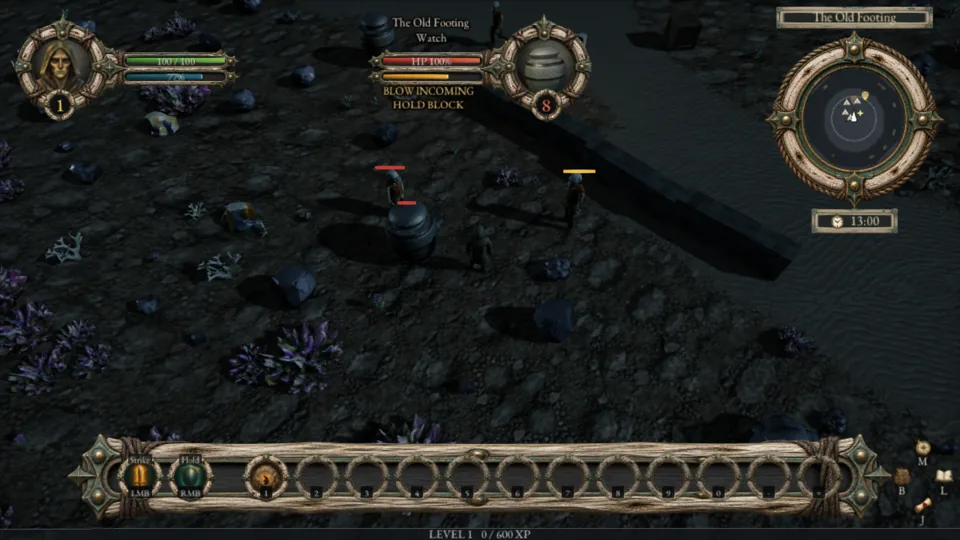
 The ForewatchA lean-to and a fire-ring on the road out from the Watch, where a sweep crew stages before the last stretch toward the Stair — packs checked, watch-logs read back, nothing left to chance this high up.
A lean-to and a fire-ring on the road out from the Watch, where a sweep crew stages before the last stretch toward the Stair — packs checked, watch-logs read back, nothing left to chance this high up. It is the third place on the promontory still handing out work, and the last one before the ground stops being anyone's to hold.
Up close
3 things to look at closer
- You stage at the lean-to like a sweep crew would: check what you carry, leave what you do not need, note the hour.
- The fire-ring holds four seasons of ash in layers, and the top layer is thin. Fewer crews are staging here than used to.
- It is the last place on this road where anybody sorts their kit rather than just carrying it.
Gathered here
- Ridge Ptarmigan
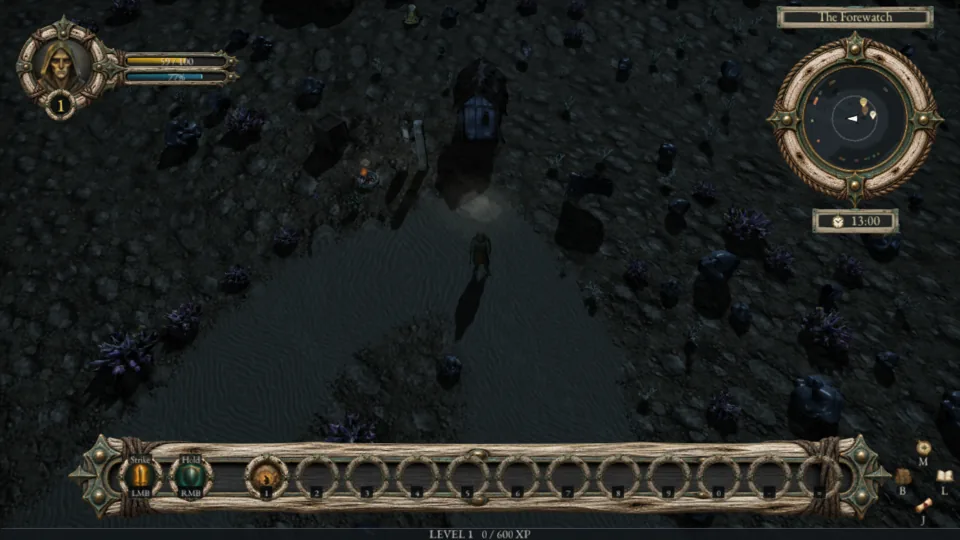
 The Ironcrust ShelfThe scree at the working camp's own edge, where the same forge-country iron the fissure walls show through breaks the surface again in a fuller run of crust — enough for a crew to work without ever descending the Stair.
The scree at the working camp's own edge, where the same forge-country iron the fissure walls show through breaks the surface again in a fuller run of crust — enough for a crew to work without ever descending the Stair. Windglass grows in the cold cracks nearby, fused there by heat the shelf has no business carrying this far from the glow.
Up close
3 things to look at closer
- You work the scree at the camp's edge. The same forge-country iron the fissure walls show, but out here it is loose and cheap and nobody has to go under anything for it.
- The crust breaks in plates with a bright fracture. Whatever bound this iron did it fast, under heat, and not in this century.
- You have taken what lies loose. The rest is in the wall, and the wall is the promontory.
Foes here
| Who | Levels |
|---|---|
| The Ironcrust Remnant | 8–9 |
Gathered here
- Forge-Country Iron
- Windglass
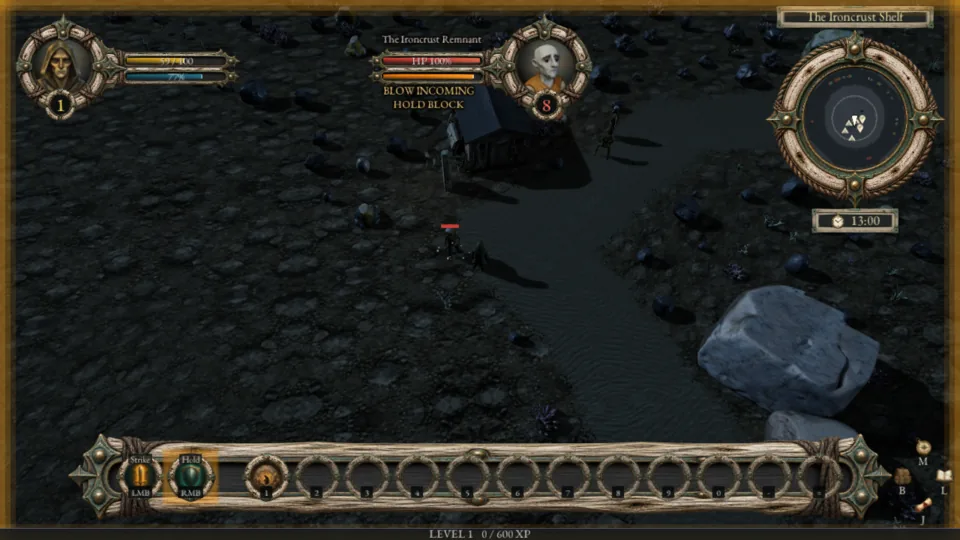
 The Far FaceA wind-scoured rock face pocked with scree ledges, thinner-flocked with ridge-ptarmigan than any lower ground, with ridge-corbies working the air above for whatever the birds — or the Glowchaser — leave behind.
A wind-scoured rock face pocked with scree ledges, thinner-flocked with ridge-ptarmigan than any lower ground, with ridge-corbies working the air above for whatever the birds — or the Glowchaser — leave behind. The face is worked for what it offers and nothing more; nobody camps here longer than the hunt takes.
Up close
3 things to look at closer
- You work the ledges. Ptarmigan, thin on the ground, and every bird here has learned that a person on the face means a thrown stone.
- The scree ledges are stepped, evenly, in a way scree does not do. Somebody cut holds along this face and the weather has nearly finished taking them back.
- The reachable ledges are cleared. What is above them wants rope and a reason.
Foes here
| Who | Levels |
|---|---|
| The Far Face Flock | 7–9 |
Gathered here
- Ridge Ptarmigan
 The Sighting RiseA second knuckle of the promontory, its own half-buried footing cracked open in patches to show hollows beneath — what the footing hides, nobody has fully dug for.
A second knuckle of the promontory, its own half-buried footing cracked open in patches to show hollows beneath — what the footing hides, nobody has fully dug for. From its edge the dull red-orange glow below reads clearer than anywhere else on the Watch's own ground, proof enough that whoever built here was watching the same thing.
Up close
7 things to look at closer
- You go up the second knuckle. Its own half-buried footing is cracked open in patches, and under the patches there are hollows.
- You drop a stone into one. It goes further than the height of the rise, which means the hollows are not in the footing — they are in the promontory under it.
- Two footings, one stair and a hollow ridge. Whoever built up here was not building a watch-post; they were capping something.
- You drop a second stone into a second hollow. It goes as far as the first, which means the hollows connect.
- The footing's cracked patches are cracked from BELOW: the stone is pushed up, not fallen in.
- You put your hand flat on the rock and the cold comes up through it steadily, the way air moves rather than the way stone is cold.
- You have opened every patch that will open. The rest wants tools this ridge has not had in generations.
Foes here
| Who | Levels |
|---|---|
| What the Footing Hides | 8–9 |
Gathered here
- Forge-Country Iron
 The Far SwitchbackA knife-edge trail climbing past the working camp's own ground, switchbacked the way the Hollow Stair is below, where the fog thins just enough on a clear pass to see the glow raw and unbroken.
A knife-edge trail climbing past the working camp's own ground, switchbacked the way the Hollow Stair is below, where the fog thins just enough on a clear pass to see the glow raw and unbroken. The Glowchaser prowls this stretch, drawn to the same sight that took them, hostile to anyone else who crosses their bounded ground.
Up close
3 things to look at closer
- You take the knife-edge past the working camp. Switchbacked the same way the Hollow Stair is inside — the same hand's idea of how to get down a hard face.
- On a clear pass the glow shows raw and unbroken, and the trail is placed to look straight at it. That is a choice.
- The trail goes where it goes. There is nothing on it but the walking and the view it was cut to give.
Foes here
| Who | Levels |
|---|---|
 The Glowchaser | 7–9 |
 The Stalled ClimbA stretch of ridge path east of the Old Footing where a handful of the blight-caught never finished their climb back up from the Stair — caught partway, stopped where they stood, and never moved again.
A stretch of ridge path east of the Old Footing where a handful of the blight-caught never finished their climb back up from the Stair — caught partway, stopped where they stood, and never moved again. It holds no line and guards nothing on purpose; it is simply where the climb gave out, and where a crew passing through does its fighting rather than its work.
Up close
3 things to look at closer
- You go along the stretch where the blight-caught stopped. Their gear is still on the rock, set for a climb none of them finished.
- The rope is anchored properly and the anchors are sound. Nothing failed here. They simply stopped.
- The line they were climbing goes on above them, unfinished, with the next piton in somebody's hand somewhere below.
Foes here
| Who | Levels |
|---|---|
| What Climbed Back Up | 7–8 |
Gathered here
- Scavenger Scrap
 The Channel ShelterA runners' shelter on the track back down toward Threvdren's own cut, tucked out of the wind at the point where the promontory's climb finally eases.
A runners' shelter on the track back down toward Threvdren's own cut, tucked out of the wind at the point where the promontory's climb finally eases. Hand-offs for anyone returning down-channel rather than pressing on to the Stair happen here, the last stop before the ground stops being Vrelskarr's at all.
Up close
3 things to look at closer
- You get into the shelter out of the wind, at the one point on the track where the rock leans the right way.
- The wall inside is scratched with a tally of crossings and a second tally beside it, shorter, that stops.
- Dry stone, a bench, and the track down to Threvdren's cut. Nothing else has ever been kept here.
Foes here
| Who | Levels |
|---|---|
| The Channel Drift | 8–9 |
The Underwatch
 The Stepped GalleryInside the Hollow Stair's seam: a single stepped gallery cut down through the promontory's own rock, narrow enough that nothing gets past two abreast.
Inside the Hollow Stair's seam: a single stepped gallery cut down through the promontory's own rock, narrow enough that nothing gets past two abreast. It is named for what it is relative to the Watch above it, not for anything new found inside it.
Up close
3 things to look at closer
- You go down the stepped gallery. Cut through the promontory's own rock, narrow, and every step the same height — this was surveyed before it was dug.
- The walls carry the same shorthand as the surface markers, cut deeper, and it stops a third of the way down.
- Below where the cutting stops, the gallery goes on as fissure. They followed something and then the something ran out of their reach.
Foes here
| Who | Levels |
|---|---|
| The Hollow Stair Remnant | 8–10 |
 The Unrelieved | 8 |

Vensvael
 The HollowA shallow bowl walled on three sides where sweep-crews rest before or after climbing the Watch; weathered climbing gear lies at its lowest point.
Up close
3 things to look at closer
- You come down into the bowl. Walled on three sides, out of the wind, and the ground is trodden flat by crews resting before and after the climb.
- The weathered climbing gear stacked against the wall belongs to nobody: taken, used and put back by whoever needed it, for long enough that the rope has gone stiff.
- It is a shallow bowl with a view of the way up. Everything in it is about the ridge above it.
People here
| Name | Does |
|---|---|
 Marekka | quest giver |
Gathered here
- Scrub-Hare Hide

 The First BreakA shelf of hardy grey-green groundcover and low berry scrub just inside the wind-line, the first ground in the hollow soft enough to kneel on and clear enough to see across.
A shelf of hardy grey-green groundcover and low berry scrub just inside the wind-line, the first ground in the hollow soft enough to kneel on and clear enough to see across. Scrub-hares graze the verge in easy reach of a snare, and the berries ripen low enough that no climb is needed to reach them. Sweep crews break here before the Hollow proper, which is why nothing here has ever needed guarding.
Up close
3 things to look at closer
- You work the first green inside the wind-line. Grey-green, low, hardy — the first thing in a long way that is alive without being watered.
- The berry scrub is picked on the side facing the path and untouched on the side facing the wind. Everyone stops in the same place.
- Past the break the ground goes back to bare. The green is a band, not a country.
Gathered here
- Hollow Berries
- Hollow Groundcover
 The Coil CampA few tents pitched where the Lee Wall breaks the worst of the wind, close enough to the Hollow to share its shelter without sharing its traffic.
A few tents pitched where the Lee Wall breaks the worst of the wind, close enough to the Hollow to share its shelter without sharing its traffic. The handful who winter here mend cordage and trade what a sweep crew has picked up along the ridge, coil for coil, scrap for scrap, and keep a board nailed to a stake for whoever passes needing work. It is the only place in Vensvael anyone actually lives, rather than only stops.
Up close
3 things to look at closer
- You go through the tents. Pitched exactly where the Lee Wall breaks the wind, close enough to the Hollow to share a fire and far enough to have their own.
- The coils here are sorted by wear: good rope, doubtful rope, and rope kept for hauling things that do not matter.
- Everything in this camp is rope, food or a place to sleep. Nobody is doing anything here but preparing to climb.
People here
| Name | Does |
|---|---|
 Fenna Cragmend | quest giver, vendor |
 The Fallen CairnA collapsed marker-cairn east of the Hollow, older than the current Watch rotation and never rebuilt: whoever stacked it climbed this face before the Hush Trade ever authorized a sweep here.
A collapsed marker-cairn east of the Hollow, older than the current Watch rotation and never rebuilt: whoever stacked it climbed this face before the Hush Trade ever authorized a sweep here. A loose slab at its base has been worked loose and packed again more than once, by hands that were not building it. No one has come to claim the cairn, and nobody local will say what else is not claimed here.
Up close
3 things to look at closer
- You go over the collapsed marker. Older than the current Watch rotation, and nobody has rebuilt it — which on this coast is a decision, not neglect.
- The stones are scattered downhill in one direction, which is not how a cairn falls. Somebody pushed it.
- Under where the cairn stood there is a flat stone with a socket cut in it, for something that is no longer there.
Foes here
| Who | Levels |
|---|---|
 The Undercairn | 11–12 |
Gathered here
- Quarried Stone
 The Line CampThe sweep crews' staging point on the way out of the hollow: spare rope, pitons and worn coils sorted before the climb back up, and a tally board fixed under the overhang for whoever is due to restock.
The sweep crews' staging point on the way out of the hollow: spare rope, pitons and worn coils sorted before the climb back up, and a tally board fixed under the overhang for whoever is due to restock. Nothing here fights and nothing here rests long; crews pass through, note what the ridge took this rotation, and move on. It is the third place in Vensvael that hands out work, though no one lives here to hand it.
Up close
3 things to look at closer
- You go through the staging. Spare rope, pitons, worn coils sorted before the crews go up — everything here is checked twice by people whose lives depend on the check.
- The reject pile is bigger than the good pile, and the rejects are all from the same batch.
- It is a staging point and it stages. There is nothing to find in it that is not exactly what it looks like.
Gathered here
- Weathered Rope Coil
 The Warren EdgeWhere the thorn-scrub thickens at the Line Camp's edge and the ground turns soft with hare-warrens, easy digging, easy snaring, and the first birdsong since the cliffs of Krelthnael.
Where the thorn-scrub thickens at the Line Camp's edge and the ground turns soft with hare-warrens, easy digging, easy snaring, and the first birdsong since the cliffs of Krelthnael. Marekka is often found here, watching the thorn-wrens wheel for what the weather off the ridge is about to do, gone again before anyone can ask her to stay.
Up close
3 things to look at closer
- You work the soft ground at the thorn's edge. Easy digging, thick with warrens, and the hares are used to being hunted here.
- The thorn-scrub thickens exactly where the digging is easiest, which is not a coincidence: the warrens are under the thorn because the thorn is why they survive.
- The reachable warrens are worked. The rest are under thorn you would need to cut, and cutting it ends the warren.
Gathered here
- Hollow Groundcover
- Scrub-Hare Hide
 The Green ShelfA wide terrace above the Line Camp where the groundcover grows thickest and the scrub-hares come to graze it, the best gathering ground in the hollow and the reason any profession bothers coming this far in.
A wide terrace above the Line Camp where the groundcover grows thickest and the scrub-hares come to graze it, the best gathering ground in the hollow and the reason any profession bothers coming this far in. Crews jar what they pick here before the climb back up, since nothing this green keeps once it's back on the ridge.
Up close
3 things to look at closer
- You go out onto the wide terrace. The groundcover is thickest here and the scrub-hares graze it in the open, which they do nowhere else on this ridge.
- The shelf holds water after rain — a shallow lens of it under the cover — and that is the whole reason anything grows.
- You have taken what the shelf gives without breaking the cover. Strip it and the water goes and the hares go with it.
Gathered here
- Coarse Salt
- Hollow Groundcover
- Scrub-Hare Hide
 The Lee WallThe exact line where the ridge's wind gives out: a shoulder of bare rock that catches everything the Watch above can't shake loose, and beneath it, silence.
The exact line where the ridge's wind gives out: a shoulder of bare rock that catches everything the Watch above can't shake loose, and beneath it, silence. Crews who miss the Hollow's own hearth sometimes settle here instead, off the rotation's own paperwork; nobody has ever logged it as a stop, and nobody has ever been told not to.
Up close
7 things to look at closer
- You stand on the line where the wind gives out. One side of the shoulder is scoured bare; the other has a hand's depth of soil on it.
- Everything the Watch above sheds — grit, chips, the odd piton — collects along this wall in a drift.
- The wall is a line on the ground you can feel with your face. There is nothing else to it and nothing else needed.
- You work the drift along the wall. Grit, rock-chips, and one piton bent double, which took more than weather.
- The soil on the sheltered side is a hand deep and full of root. On the other side there is none, and the line between is a step wide.
- Somebody has built a low course of stones along the top of the shoulder, badly, to make the lee a foot deeper.
- There is nothing else along the wall. It is a line on the ground and the line is the whole of it.
Gathered here
- Hollow Berries
 The High TraverseThe path above the Green Shelf narrows to a ledge along the rock, and the ground gets harder for every step past it, the last easy walking before the climb proper.
The path above the Green Shelf narrows to a ledge along the rock, and the ground gets harder for every step past it, the last easy walking before the climb proper. A lone scavenger works the old gear left along here, coiling what's sound and prying loose what isn't, careful to be gone before a sweep crew comes through.
Up close
3 things to look at closer
- You take the ledge above the Green Shelf. It narrows to a shoulder's width and the ground gets harder with every step past the shelf.
- There are rope-scars on the rock at hand height, spaced for somebody shorter than you, going the other way.
- Past the traverse the route is climbing rather than walking, and this is where a crew decides whether it is a crew.
Foes here
| Who | Levels |
|---|---|
 The Off-Book Climber | 7–9 |
 The Climb GateThe formal route back up to the Watch's ridge, a stone marker and a rope-anchor bolted into the rock where the hollow ends and the climb begins.
The formal route back up to the Watch's ridge, a stone marker and a rope-anchor bolted into the rock where the hollow ends and the climb begins. Every hand-off out of Vensvael that goes through channels leaves from here, logged and counted before the ascent.
Up close
3 things to look at closer
- You check the anchor bolted into the rock. Sound, recent, and set by somebody who expected other people's weight on it.
- The stone marker beside it carries a rotation of names, and the last three are the same name three times.
- This is the formal way up to the Watch. Everything about it says: use this one, and be counted.
People here
| Name | Does |
|---|---|
 Torvenn Ridgewarden | quest giver, guard |
 The Under-Ledge ShelterA dry overhang southwest of the Coil Camp, out of the wind and out of sight of the Climb Gate above: a runners' shelter rather than a post, kept stocked with what needs to move without going through channels.
A dry overhang southwest of the Coil Camp, out of the wind and out of sight of the Climb Gate above: a runners' shelter rather than a post, kept stocked with what needs to move without going through channels. A weighted note-box under the ledge holds whatever the Hollow owes and whoever comes through owes back. No one is stationed here; it only ever needs to be found.
Up close
3 things to look at closer
- You duck under the overhang. Dry, out of the wind, and out of sight of the Climb Gate above — which is three separate advantages and only one of them is weather.
- A runner's cache sits at the back: food for two days and nothing that identifies anybody.
- Whoever uses this shelter uses it instead of the gate, and nobody up the ridge counts them.
Gathered here
- Worn Cordage
 The Last GreenThe far southern corner of the hollow, where the groundcover thins back to bare rock and the wind starts to find its way in again, the last patch of green before Vensvael runs out.
The far southern corner of the hollow, where the groundcover thins back to bare rock and the wind starts to find its way in again, the last patch of green before Vensvael runs out. Nobody sends a crew this far on purpose, which is why the packs that make the trip come back heavier than expected.
Up close
3 things to look at closer
- You walk out to where the cover thins back to rock. The wind finds you again about ten paces before the green ends.
- The last living thing is a single scrub, bent flat downwind, with berries on the sheltered side.
- Past this there is nothing that grows. The hollow is the last green ground on this side of the ridge, and it is smaller than it looks from above.
Gathered here
- Hollow Berries
- Hollow Groundcover
- Scrub-Hare Hide
Throdath
 The EmberlineThe exact line where the ash-fall begins in earnest, marked by a fallen way-marker cut with Skrovenn work-runes reading dreth-keld.
Up close
3 things to look at closer
- You find the fallen way-marker at the line where the ash-fall starts in earnest. Skrovenn work, cut deep, and lying where it fell.
- On the ash side of the marker the drift is ankle deep. On the other side there is bare rock. The line is a line.
- The marker is broken across its cut face, which is the one place a stone that size does not break on its own.
Gathered here
- Cinder

 The Emberline WaymarkThe last benchmark stone before the crater — raised where the ash-fall starts to bank, and re-cut once already because the first face weathered illegible inside a season.
The last benchmark stone before the crater — raised where the ash-fall starts to bank, and re-cut once already because the first face weathered illegible inside a season. Past this mark nothing is raised, kept, or promised; the final camp before Drethold is a campfire, and a campfire is deliberately not an anchor.
Up close
3 things to look at closer
- You read the last benchmark before the crater. Raised where the ash begins to bank, and RE-CUT once already — somebody came back out here to keep it legible.
- The re-cut is in a different hand from the original and it is the better of the two.
- It is the last stone anybody has raised on this road. Everything past it is unmarked.
People here
| Name | Does |
|---|---|
 Kaldrenn Threshward | quest giver, guard |
 The Ashfall VergeWhere bare rock still shows between the first fine drifts of grey ash, on the ordinary-ground side of the Emberline itself.
Where bare rock still shows between the first fine drifts of grey ash, on the ordinary-ground side of the Emberline itself. A thin seam of the same iron-fused slag that feeds the vein below shows faintly here, warm enough to notice and safe enough to read before anyone risks the true vent. Hunters and gatherers new to the depth test their nerve on this ground, not the ash proper.
Up close
3 things to look at closer
- You walk the verge where rock still shows between the first drifts. The ash is fine, dry, and it does not blow — it sits.
- Where it has drifted against a stone the drift is layered, and the layers are seasons rather than storms.
- Past here the bare rock stops showing at all. The verge is the last honest footing.
Gathered here
- Bitter Salt
- Blight-Touched Slag
 The Last WardA ward-watch holdout at the Emberline's own safe-side campfire, the last stocked point before the ash-fall proper — a lean-to, a ward-chest, and the board Vrenveld's authorization runs through.
A ward-watch holdout at the Emberline's own safe-side campfire, the last stocked point before the ash-fall proper — a lean-to, a ward-chest, and the board Vrenveld's authorization runs through. Vosrenn Wardhand keeps both the stock and the roster; nothing crosses the line without buying ward or an anti-blight draught here first, because nothing sold past this point is worth carrying without them.
Up close
3 things to look at closer
- You come into the ward-watch's fire on the safe side. Stocked, counted and rationed — the last point on this road where anything is any of those.
- The ward-charms are kept in a sealed box and issued one at a time against a name. Nobody here treats them as decoration.
- It is a fire, a box and a line drawn on the ground. Everything the hold is, it is because of where it chose to stand.
People here
| Name | Does |
|---|---|
 Vosrenn Wardhand | quest giver, vendor |
Gathered here
- Bitter Salt
 The Broken WaypostA second way-marker, older and further gone than the Emberline's own stone, collapsed long before anyone raised that one — its fallen face carries a fragment of the same Skrovenn work-runes, cut by a different hand.
A second way-marker, older and further gone than the Emberline's own stone, collapsed long before anyone raised that one — its fallen face carries a fragment of the same Skrovenn work-runes, cut by a different hand. A narrow vent in the rubble breathes the same warm fog as the seam further down the road; reading its heat before digging is the only way to reach what is buried beside it without a faceful of scalding ash.
Up close
11 things to look at closer
- You go over the older way-marker. Further gone than the Emberline's, collapsed long before anybody now living came out here.
- The pieces lie in a scatter that points away from the crater, and the cut face is on the underside, protected — you have to lift a piece to read anything.
- What you can read of it is the same shorthand as the others, older, and it names a distance rather than a place.
- You lift a second piece. The break is old, the faces are clean under the ash, and the pieces have not moved since they fell.
- The distance cut into it is in the same measure the Emberline's stone uses, which means the two were cut by people who agreed what a mile was.
- You lay the pieces in their fallen order. They point away from the crater, and the pointing is deliberate — one face is dressed and the others are not.
- There is nothing under the scatter but ash and more ash. Whatever this marker stood on has been buried for longer than the marker has been down.
- You go over the whole scatter one more time and find the last fragment, face down, with a rune-fragment on it that is not on either of the others.
- Eight pieces, one stone, one bearing. That is everything this waypost is going to give anybody.
- The ash has already started to bank against the pieces you moved. By next season it will look untouched.
- You have read every face that has anything on it. What is left is stone.
Foes here
| Who | Levels |
|---|---|
| Revenants at the Broken Waypost | 8–9 |
Gathered here
- Bitter Salt
- Quarried Stone
 The Farthest StakeAluvi Threlveld's field table, planted further down the spine than any survey Vrenveld has ever authorized — a plane-table under canvas, a rod-rack driven into ash-packed ground.
Aluvi Threlveld's field table, planted further down the spine than any survey Vrenveld has ever authorized — a plane-table under canvas, a rod-rack driven into ash-packed ground. Every reading taken here is logged back to the Tally House as the last of its kind; past this point, the port has stopped promising there will be a next one.
Up close
3 things to look at closer
- You come to Aluvi's field table, planted further down the spine than any survey anybody has ever authorised.
- The sheets on it are weighted with ash-stone and the top one is a chart of ground nobody has walked, drawn from sightings taken from here.
- The table is out here because she is. There is no other reason and no authorisation anywhere on it.
 The Standing WaymarkA third stone in the same broken line as the Emberline's own marker and the Broken Waypost's shattered twin — this one alone still stands upright, its Skrovenn work-runes weathered but whole.
A third stone in the same broken line as the Emberline's own marker and the Broken Waypost's shattered twin — this one alone still stands upright, its Skrovenn work-runes weathered but whole. Aluvi's crews use its shadow to hold the working road's edge and pick over what fused scrap the ash gives up nearby; nobody has yet found where the line runs from, or how many more of these still stand.
Up close
7 things to look at closer
- You read the third stone of the broken line. Standing, whole, and cut by the same hand as the two that are not.
- Three markers, one line, and the line runs toward the vent rather than along the road. They were not marking a road.
- It stands because it is set deeper than the others. Somebody knew this one had to last.
- You clear the base. It is set in a socket cut into bedrock, which none of the fallen ones were.
- The runes on the sheltered face are sharp enough to read by touch, and the reading is a distance and a direction rather than a name.
- The bearing it gives runs toward the vent and past it, and at the range it names there is nothing on any chart at all.
- You have read every face. The stone is doing exactly what it was set to do and it has outlasted everybody who could have explained it.
Foes here
| Who | Levels |
|---|---|
| Revenants at the Standing Waymark | 8–9 |
Gathered here
- Blight-Touched Slag
 The Slag VeinWhere the seam that breathes has scoured the ash back to bare rock, a vein of iron-fused slag shows through — forge-remnant residue, warm to the touch even when the vent itself is quiet.
Where the seam that breathes has scoured the ash back to bare rock, a vein of iron-fused slag shows through — forge-remnant residue, warm to the touch even when the vent itself is quiet. Drifts of ash-rubble around its edge hold the same blight-touched ore for those patient enough to read the vent before they work it; cinder-moths cluster at its warmth, more blight-symptom than living thing.
Up close
3 things to look at closer
- You work the vein where the seam that breathes has scoured the ash back to rock. Iron fused to stone, still warm to the hand at noon.
- The scour marks all run one way, out from the vent, and they are fresh over old ones.
- The exposed vein gives up what it gives up. The rest is under ash that will be back over this by the season's end.
Foes here
| Who | Levels |
|---|---|
 The Cinderhide | 9–10 |
Gathered here
- Blight-Touched Slag
- Quarried Stone
 The Threshold CutA stone-cut passage between two raised flanks, carved faces worn past reading on either side — the actual ceremonial crossing the zone's own name means, cut with more deliberate intent than the Emberline's own fallen marker: whoever made this meant travelers to be cut through, not skirted around.
A stone-cut passage between two raised flanks, carved faces worn past reading on either side — the actual ceremonial crossing the zone's own name means, cut with more deliberate intent than the Emberline's own fallen marker: whoever made this meant travelers to be cut through, not skirted around. Ash has choked the carving flat; clearing a face by hand, patch by patch, is the only way to see what the ford-cut ever said.
Up close
3 things to look at closer
- You go through the cut passage. Two raised flanks, carved faces on both sides, worn past reading by ash and time.
- The carving is at head height on both walls for the whole length, which means the passage mattered enough to decorate rather than merely dig.
- This is the actual threshold. Everything before it is approach and everything past it is the crater's own ground.
Foes here
| Who | Levels |
|---|---|
| The Threshold Cut Watch | 8–10 |
 The Cinder RiseA low bluff above the ash-fall, drift thin enough here to see both the vent's smoke and the held line below from one spot.
A low bluff above the ash-fall, drift thin enough here to see both the vent's smoke and the held line below from one spot. The Emberwarden's own patrol runs wider than the rest of the line and reaches this far out — an older forge-guild bearing the rest of the camp doesn't share — and crews who climb for the view sometimes climb straight into its loop instead.
Up close
7 things to look at closer
- You climb the low bluff. From here both the vent's smoke and the held line below are visible in one look, which is why anything ever stood up here.
- The drift on the rise is thin enough to read the ground under it: worked stone, in courses, under four years of ash.
- The rise is a vantage over a fight that has not moved in a long time.
- You scrape the drift off the worked stone. Courses, laid true, and the ash on top of them is four years deep and no more.
- From the bluff the held line and the vent's smoke sit in one eye-line, and the line is drawn exactly between them.
- The rise itself is dressed stone under ash — this is not a natural bluff, it is a platform that somebody built to stand on.
- You have cleared what one pair of hands can clear. Under it the coursing goes on.
Foes here
| Who | Levels |
|---|---|
 The Emberwarden | 9–10 |
Gathered here
- Cinder
 The Cinderline HoldWhere the Emberline's held line of forge-scorched revenants keeps its ground — more of them drawn up here than any single watch the coast has faced since Threvdren's Sunken Cut, still and ranked rather than roaming, holding a stretch of bare ash like a garrison that never got the order to stand down.
Up close
3 things to look at closer
- You come up on the held line. More of them drawn up here than anywhere behind, standing in a formation that has not changed in living memory.
- They are forge-scorched and they hold ground rather than patrol it. Whatever they are doing, it is a line rather than a hunt.
- The ground in front of the line is bare of ash for a stone's throw. Something keeps it swept.
Foes here
| Who | Levels |
|---|---|
| Revenants on the Emberline | 8–9 |
| The Cinderline Hold, Forward Rank | 9–10 |
| The Cinderline Hold, Rear Rank | 9–10 |
Gathered here
- Cinder
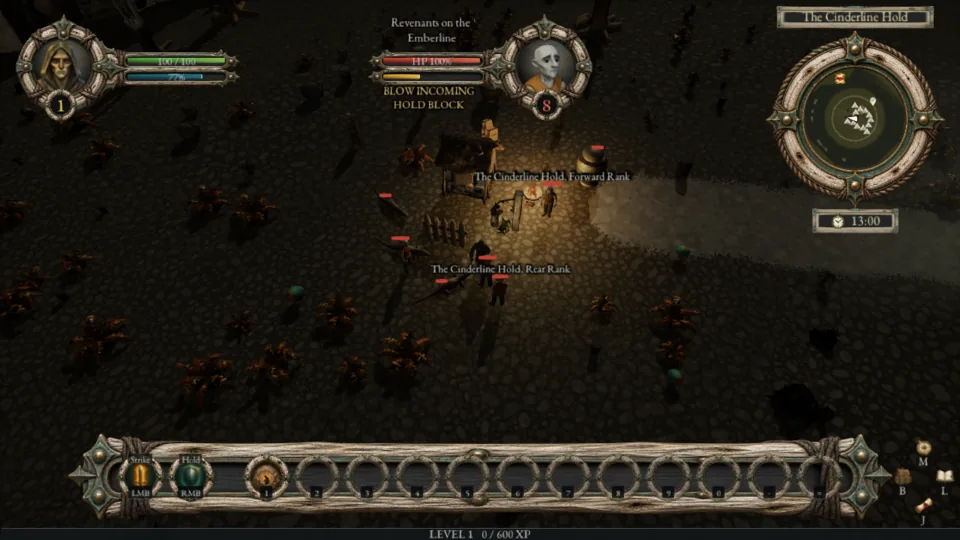
 The Ashback ShelterA runners' shelter on the path back up toward Vrelskarr's own hollowstair, the last dry stone before the ash gives way to ordinary rock again.
A runners' shelter on the path back up toward Vrelskarr's own hollowstair, the last dry stone before the ash gives way to ordinary rock again. Anything the depth sends back the other way — a courier, a wounded crew, word that another marker's been found — leaves from here, not from the Emberline Waymark.
Up close
3 things to look at closer
- You reach the last dry stone on the path back toward Vrelskarr. The shelter is swept out and the ash outside it is not.
- The tally inside counts crossings in both directions and the two columns are level, which is the only place on this road that is true.
- It is dry, it is swept, and somebody sweeps it. That is the whole finding.
Gathered here
- Quarried Stone
Drethold
 The ThresholdThe near edge of the crater, where the smoke-haze thickens and the first courses of dressed Krevorn stone break the ash.
Up close
3 things to look at closer
- You reach the crater's near edge. The haze thickens at a line you can walk across, and out of it come the first courses of dressed Krevorn stone.
- The courses do not lie where they fell. They are set — a wall, running along the rim, buried to the shoulder in ash.
- You clear a stretch of it to the course below and the stone under the ash is unweathered. It has been covered since the day the ash started.
Foes here
| Who | Levels |
|---|---|
| The Threshold Line | 9–11 |
Gathered here
- Dressed Krevorn Stone

 The ForgemouthThe crater floor's one working opening: a squared archway into the forge itself.
Up close
3 things to look at closer
- You stand in the squared archway. It is the crater floor's one opening that still opens, and the jambs are cut to a tolerance nothing else out here comes near.
- The threshold stone is swept. Not clear of ash by accident — swept, in a curve, the width of something passing through regularly.
- The arch is sound and the dark behind it is warm. Everything about this doorway says still in use.
 The Cinder ShelfA shallow shelf of packed ash and rockfall on the crater's near lip, thin enough here that the smoke-haze still breaks by midday and the ground stays cool underfoot.
A shallow shelf of packed ash and rockfall on the crater's near lip, thin enough here that the smoke-haze still breaks by midday and the ground stays cool underfoot. Coal-cinder and flecks of fused iron wash down from the seam above with every fall of ash, easy pickings for a crew testing its nerve before the ramp proper. Nothing living crosses this ground and nothing hostile holds it — the safest gather Drethold offers, and the last one before the ward and the draught stop being optional.
Up close
3 things to look at closer
- You work the packed shelf on the near lip. Ash over rockfall, thin enough here that the haze still moves across it in bands.
- The rockfall under the packing is dressed stone, broken — not quarry waste. Something built came down onto this shelf.
- You have turned everything on the shelf that will turn. The rest is packed hard enough to need a tool.
Gathered here
- Cinder
- Cracked Ward Charm
- Hearth-Fused Iron
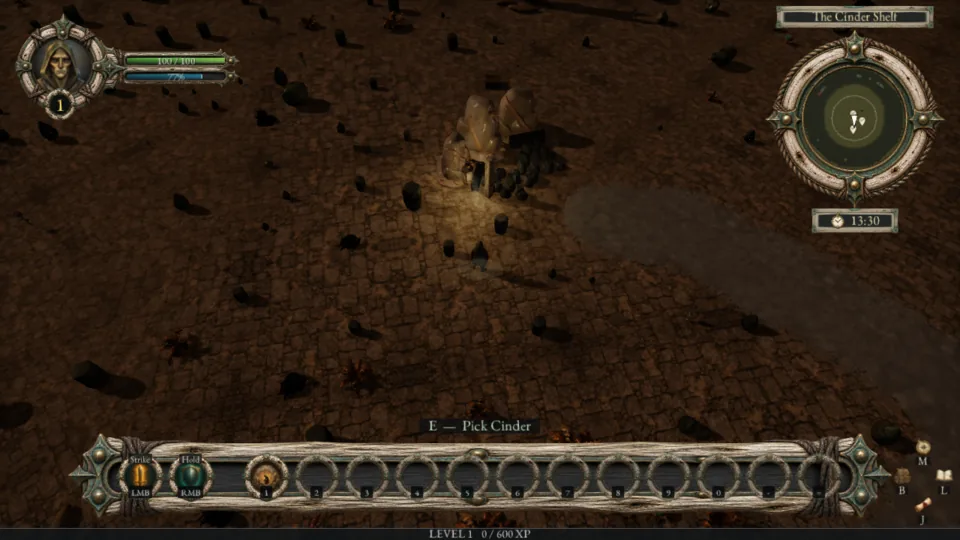
 The WardpostThe last camp before the crater proper — a handful of haulers and ward-sellers holding a lean-to and a stone hearth just short of the Threshold's own retaining wall, not large enough to call a village and never meant to be.
The last camp before the crater proper — a handful of haulers and ward-sellers holding a lean-to and a stone hearth just short of the Threshold's own retaining wall, not large enough to call a village and never meant to be. Every crew bound for the ramp buys its ward and a mending draught here first, because past this point protection and recovery stop being precautions and become the price of entry. A contract board nailed to the lean-to's post carries whatever the crater still owes somebody.
Up close
3 things to look at closer
- You come into the last camp before the crater proper. Haulers, ward-sellers, a lean-to and a stone hearth, all of it commerce rather than watch.
- The wards sold here are priced by the hour rather than the piece, which tells you exactly what they are worth and exactly how long anybody stays.
- It is the last place on this road where anything is bought. Past it, everything is carried in.
People here
| Name | Does |
|---|---|
 Renkil Wardbrew | quest giver, vendor |
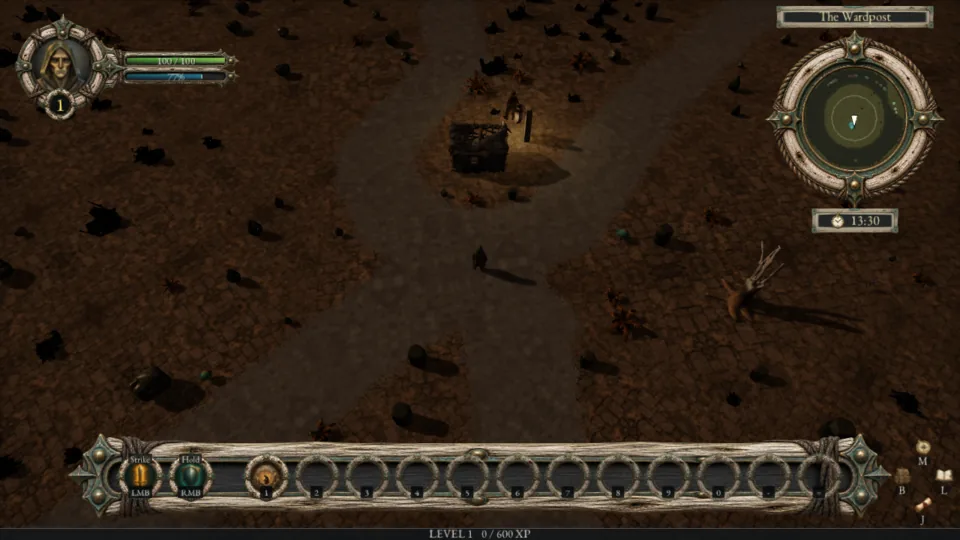

 The SweepwatchA field post on the road out from the Threshold, canvas and rope-lashed timber pitched by the sweep-crews who first went down to the Forgemouth and lived to name what they found.
A field post on the road out from the Threshold, canvas and rope-lashed timber pitched by the sweep-crews who first went down to the Forgemouth and lived to name what they found. Gear caches, a tally-slate of who went in and who came back, and a standing offer of work for anyone willing to run the ramp again. The crater's one survivor-tradition keeps its own ground here rather than at the Wardpost, closer to the risk it was earned on.
Up close
3 things to look at closer
- You go through the field post. Canvas and rope-lashed timber, pitched by crews who work the road rather than the crater.
- The log records what goes down and what comes up, and for four seasons the two numbers have been the same. Nobody who goes down this road stays down it.
- It is a post on a road with a very clear rule about how far it goes.
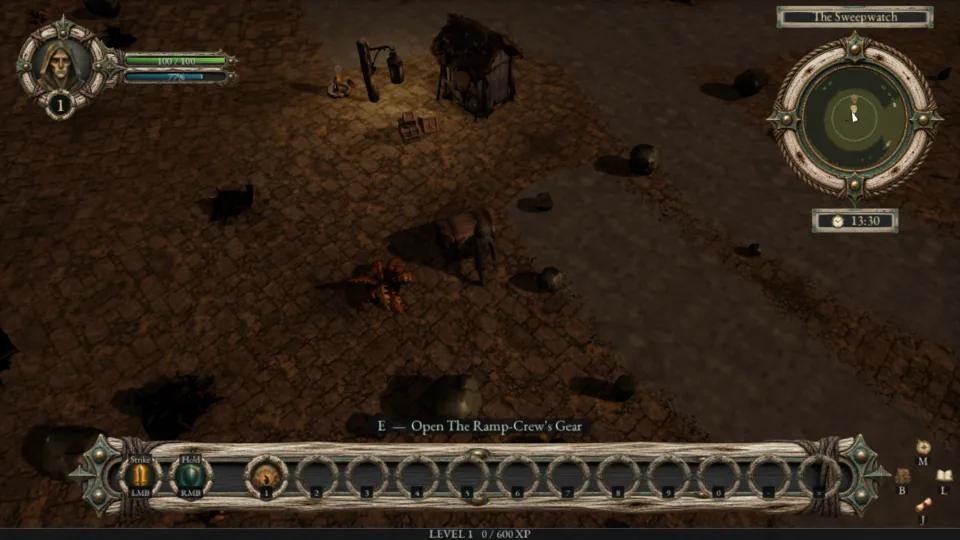
 The CullyardWhere the ash-fall's own rockslides get sorted before they're hauled out — dressed stone that held its coursing separated from rubble that didn't, laid out in ordinary heaps for whoever's doing the sorting.
Where the ash-fall's own rockslides get sorted before they're hauled out — dressed stone that held its coursing separated from rubble that didn't, laid out in ordinary heaps for whoever's doing the sorting. The Sweepwatch's own edge, working ground more than a camp, close enough to hear the coal-beds but too shallow yet for a fight to find. No one lives here; the piles just grow between hauls.
Up close
3 things to look at closer
- You go through the sorted slides. Dressed stone that held its coursing is stacked apart from stone that did not, by somebody who cares about the difference.
- The sorting is old and it is ongoing: the near stacks are ash-covered and the far ones are not.
- Somebody is still sorting a rockslide out here, on their own, in an order.
Gathered here
- Dressed Krevorn Stone
- Quarried Stone
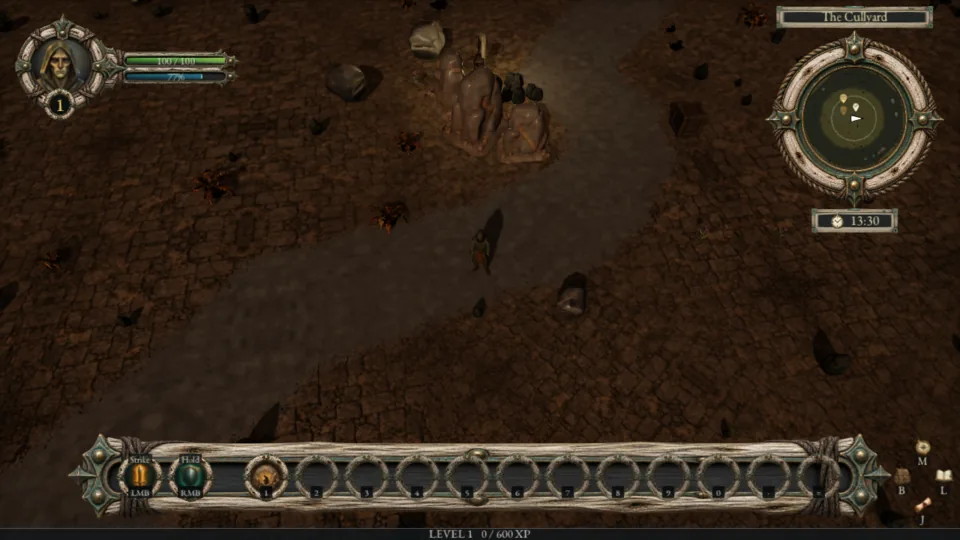
 The Kept SeamA coursed wall-face where the crater's own heat has half-fused a vein of worked iron into the stone — not a natural ore seam but iron a Krevorn smith set there on purpose, generations before the keep went quiet.
A coursed wall-face where the crater's own heat has half-fused a vein of worked iron into the stone — not a natural ore seam but iron a Krevorn smith set there on purpose, generations before the keep went quiet. Prospectors work the seam's edges for hearth-fused iron, already-worked stock rather than raw ore, warm to the touch long after it's pulled free. The clearest proof anywhere in the crater that this place was built, not simply found.
Up close
3 things to look at closer
- You work the coursed face where the heat has half-fused worked iron into the stone. This is not a natural vein — it is a wall that has begun to become one.
- The fusing runs along the courses rather than through them, which means the heat came from inside the wall.
- What comes free comes free. The rest is holding the wall up.
Gathered here
- Hearth-Fused Iron
 The FlueworksA run of chimney-flues cut clean through the coursed stone, carrying the forge's banked heat up out of the crater floor the way it has for a thousand years and more.
A run of chimney-flues cut clean through the coursed stone, carrying the forge's banked heat up out of the crater floor the way it has for a thousand years and more. No door, no room to enter — just heat radiating off dressed stone that never had reason to cool, the one place in Drethold where the fire is plainly still held rather than merely burning somewhere out of sight. The clearest single answer to why this is a fire-hold and not simply a ruin.
Up close
8 things to look at closer
- You follow the flues. Cut clean through coursed stone, carrying the forge's banked heat up and out of the crater, and every one of them is clear.
- A blocked flue would have filled in four years of ash-fall. None of them has. Somebody clears them.
- You put a hand over one. The air coming up is warm, steady, and smells of iron rather than of burning.
- You put an ear to a flue mouth. There is a sound down there, slow, that is not wind.
- The flues are cut in pairs and one of each pair is warm while the other is not, which is how a draught is made rather than how one happens.
- Along the run you count seventeen mouths. Sixteen are clear. The seventeenth has been deliberately blocked, from below, with dressed stone.
- You have followed the whole run to the wall. Everything about it says a system in use, and none of it says by whom.
- The heat has not dropped while you worked. Whatever feeds this does not notice being read.
Gathered here
- Dressed Krevorn Stone
- Quarried Stone
 The RimwatchA collapsed watch-post on the crater's outer rim, off the road proper, where the ash thins enough on a clear hour to see the whole sunk keep laid out below — the Threshold's ramp, the held line on it, and the Forgemouth's heat-shimmer past that.
A collapsed watch-post on the crater's outer rim, off the road proper, where the ash thins enough on a clear hour to see the whole sunk keep laid out below — the Threshold's ramp, the held line on it, and the Forgemouth's heat-shimmer past that. Nothing waits here to fight for the view; the danger is the ash and the drop, which is why the road doesn't run this way and the crews who climb it do it for the look, not for loot. The clearest sense anywhere in Drethold of how much of the old keep still stands under the smoke.
Up close
7 things to look at closer
- You get to the collapsed post on the outer rim, off the road, where the ash thins on a clear hour.
- It faces OUT, away from the crater — whoever watched from here was watching the coast, not the forge.
- The collapse is inward and clean. This post came down under weight rather than under attack.
- You go over the collapse. The stones fell inward and the roof went with them, which is weight rather than force.
- The post faces OUT along the coast, and the sightline it kept is still clear on a good hour.
- Under the fallen roof there is a hearth, swept, and a stack of firewood that never got burned.
- There is nothing else on the outer rim. Whoever watched from here was watching for something coming along the coast, not out of the crater.
Gathered here
- Cracked Ward Charm
 The CinderguardA second collapsed rampart on the crater floor east of the Forgemouth, where the largest leashed line of forge-scorched revenants on the coast makes its stand — not old dead left standing guard, but a line something below is still actively feeding.
A second collapsed rampart on the crater floor east of the Forgemouth, where the largest leashed line of forge-scorched revenants on the coast makes its stand — not old dead left standing guard, but a line something below is still actively feeding. This is where Drethold's fights happen, held ground rather than open hunting, the only place past the Threshold a crew comes looking for a fight on purpose. Nothing that falls here stays down for good, which is exactly the crater's own problem.
Up close
3 things to look at closer
- You come up on the second rampart. The largest line of them out here holds it, and holds it the way the Cinderline does — drawn up, not roaming.
- The rampart is collapsed on the crater side and intact on the other. They are standing behind the half that still stands.
- Ground in front of the line is swept bare, the same as at the Emberline. Something about this ground is being kept.
Foes here
| Who | Levels |
|---|---|
| Revenants on the Cinderguard | 10–11 |
Gathered here
- Quarried Stone
 The Cinderroad WaymarkThe border marker on the road that climbs back out of the crater toward the Emberline and Throdath beyond it — a squared stone with a fresh-lit ember set into its face, the only respawn point Drethold allows and the last hand-off before the descent proper.
The border marker on the road that climbs back out of the crater toward the Emberline and Throdath beyond it — a squared stone with a fresh-lit ember set into its face, the only respawn point Drethold allows and the last hand-off before the descent proper. Every crew's gear, message, or body that leaves the crater passes through here first. Held by a warden who counts crews down the ramp and, less often, counts them back.
Up close
3 things to look at closer
- You read the border marker on the road climbing out. It faces the way OUT, and its cut face is the clean one.
- It has been re-cut, like the Emberline's, in the same later hand. Whoever kept these legible worked the whole road.
- It is the last marker on the way out and the first on the way in, depending on which of those you are doing.
People here
| Name | Does |
|---|---|
 Vosrin Farwarden | quest giver, guard |
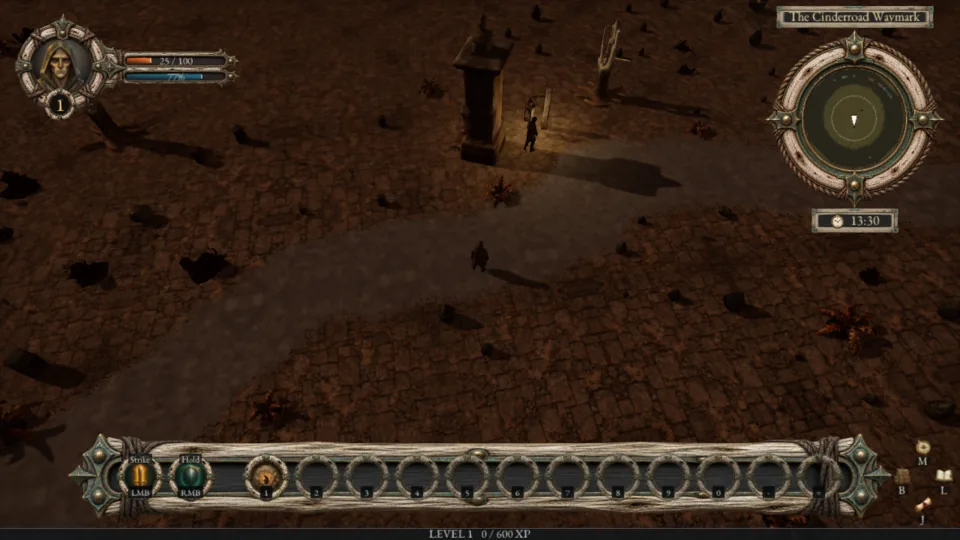
 The Quietcut ShelterA second way out of the crater, along the southwest rim well clear of the Wardpost's own watch — a dry overhang, a marked stone, and a fire kept low rather than bright.
A second way out of the crater, along the southwest rim well clear of the Wardpost's own watch — a dry overhang, a marked stone, and a fire kept low rather than bright. Hush Trade runners use it for anything they'd rather move without a warden's tally, the same quiet arrangement that keeps every coast port fed without ever quite being on the books. No respawn here, just a hand-off, the way every shelter on the coast works.
Up close
3 things to look at closer
- You find the overhang along the southwest rim, well clear of the Wardpost's watch.
- It is dry, it is out of the haze, and it is on a second way out of the crater that nobody sells wards on.
- Somebody has used this recently and left nothing behind but a swept floor.
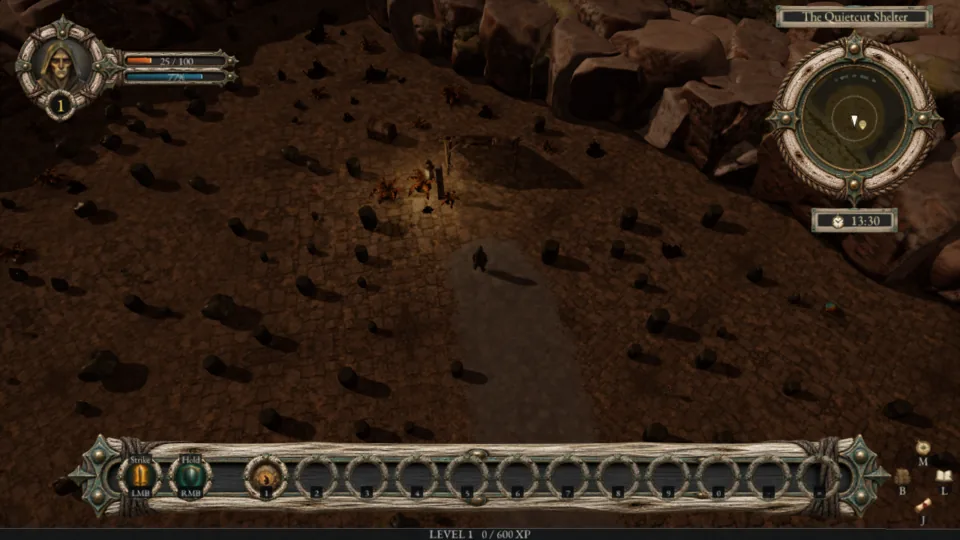
The Forge
 The Forge HallThrough the Forgemouth's archway: a single working forge-hall, scaled to a keep rather than a smithy, its banked coal-beds still glowing under a thousand-plus years of ash.
Through the Forgemouth's archway: a single working forge-hall, scaled to a keep rather than a smithy, its banked coal-beds still glowing under a thousand-plus years of ash. The coast's forge-breath made literal — this is its source, and it has never stopped breathing.
Up close
3 things to look at closer
- You go in under the arch. The hall is scaled to a keep rather than a smithy, and the banked heat in the floor comes up through your boots.
- The banks are laid in a ring, all facing inward, all still holding heat. A forge is heated at its work; this one is heated at its centre.
- There is no ash on the hall floor. Whatever else has failed out here, this room has been kept.
Foes here
| Who | Levels |
|---|---|
 The Emberfather | 10 |
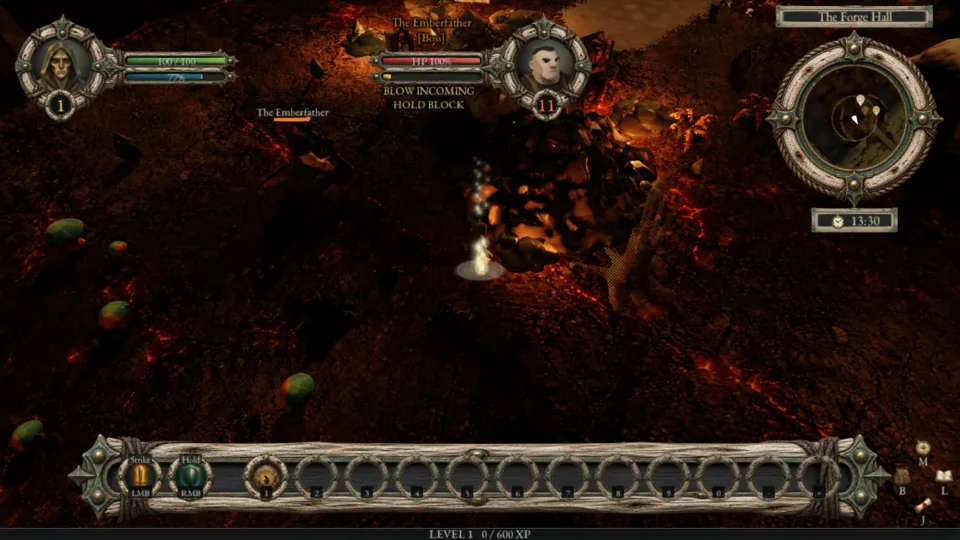

Drelthdren
 The Held HearthA single covered hearth-platform at the channel-hollow's centre, never let to go dark, tended by the Adapted in rotating watches.
Up close
3 things to look at closer
- You come up onto the hearth-platform. The fire has not been let go dark, and the rotation that keeps it is written on a board in a hand that changes every week.
- Everything about the platform is built to be rebuilt: lashed joints, thatch in courses, and a spare stack of both underneath.
- The Adapted keep one fire for the whole hold. Standing on it you understand that this is not poverty, it is a decision about where everyone has to come back to.
People here
| Name | Does |
|---|---|
 Gremnir Skorsen | quest giver |
Gathered here
- Dry Tinder
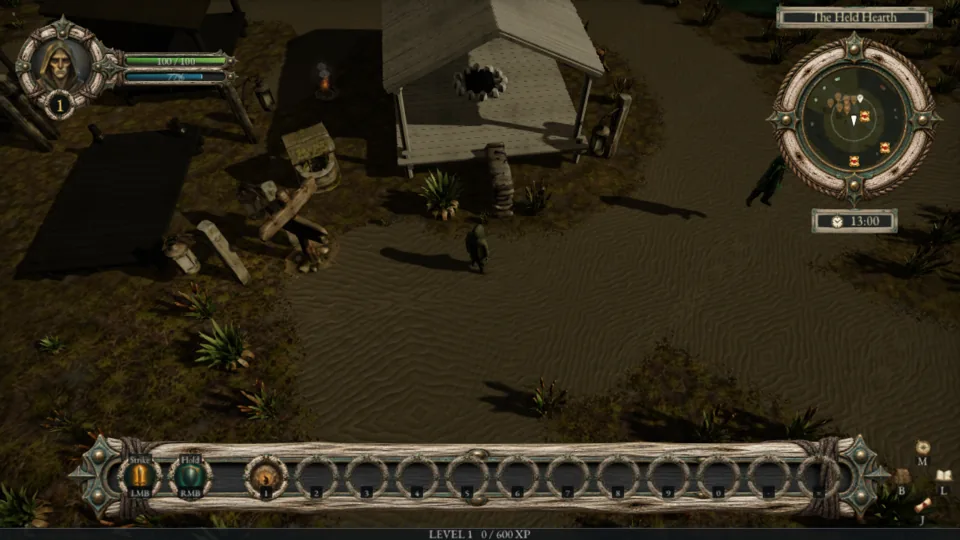

 The OutwatchDownstream of the Hearth, where the one channel Drethmark actually uses narrows to a single reed-choked throat — a modest, rotating-watch checkpoint deciding who's worth waking Gremnir Skorsen for.
Up close
3 things to look at closer
- You go down to the throat. One channel, reed-choked, narrow enough that a single pole-boat blocks it — which is why Drethmark uses this one and not the wider ones.
- The reeds have been cut back in a pattern that looks like neglect from the water and is a sightline from the bank.
- The throat is what it is: a door the hold can shut with one boat. There is nothing else here to find.
Gathered here
- Bog Iron
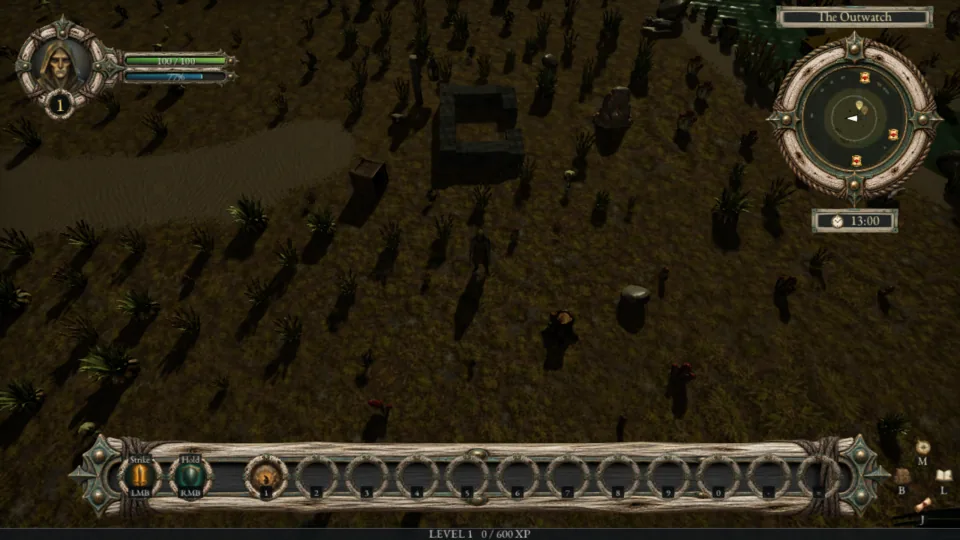
 The Mend StakeA second staked platform downstream of the Held Hearth, thatched low the same way, where Drethmark sets aside what the hold doesn't need — mended cordage, patched hide, reed-ware nobody's using — for whoever the Outwatch has already let this far in.
A second staked platform downstream of the Held Hearth, thatched low the same way, where Drethmark sets aside what the hold doesn't need — mended cordage, patched hide, reed-ware nobody's using — for whoever the Outwatch has already let this far in. Kelnora Reedmend tends it and the board nailed to its rail, the hold's second word to a stranger already worth a hearing. Coin still changes hands here, same as anywhere, but only because the crossing already cost more trust than the price ever will.
Up close
3 things to look at closer
- You go through what the hearth sets aside. Broken hafts, split baskets, a torn hide — everything is here to be mended rather than replaced.
- The mends are done in the same style across four different kinds of thing, which means one pair of hands does all of it.
- Nothing on this platform is finished and nothing is abandoned. It is a hold's whole margin, stacked.
People here
| Name | Does |
|---|---|
 Kelnora Reedmend | quest giver, vendor |
Gathered here
- Marsh Cordage
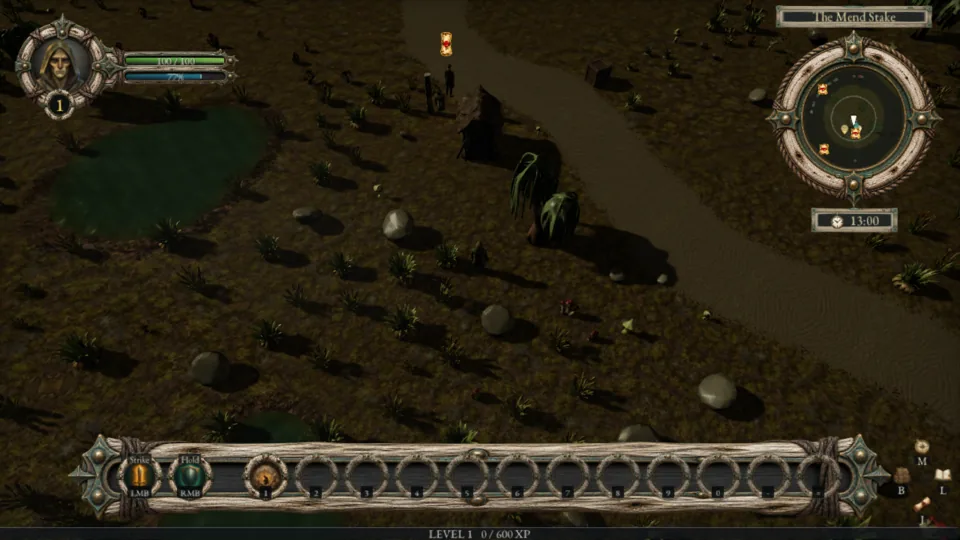
 The Sunken BendA dead bend in one of the fens' 'worse' side-channels, poled by no one anymore, where a half-sunk dugout canoe sits wedged in reeds and silt — older than anything at the hold, and nobody at the Hearth built it.
A dead bend in one of the fens' 'worse' side-channels, poled by no one anymore, where a half-sunk dugout canoe sits wedged in reeds and silt — older than anything at the hold, and nobody at the Hearth built it. Whoever dragged it this far never made the last stretch to the platforms; what's left in its hull is theirs, unclaimed. Drethmark leaves it exactly where the channel put it, the same restraint they'd show anything the marsh has already decided to keep.
Up close
3 things to look at closer
- You get to the half-sunk dugout. It is wedged in the bend nose-first and its stern is stove in from the inside.
- Nobody poles this bend anymore, and the reason is not the canoe: the channel above it has silted to nothing, and the silt is recent.
- The dugout is older than the silt. Two different things went wrong at this bend, years apart.
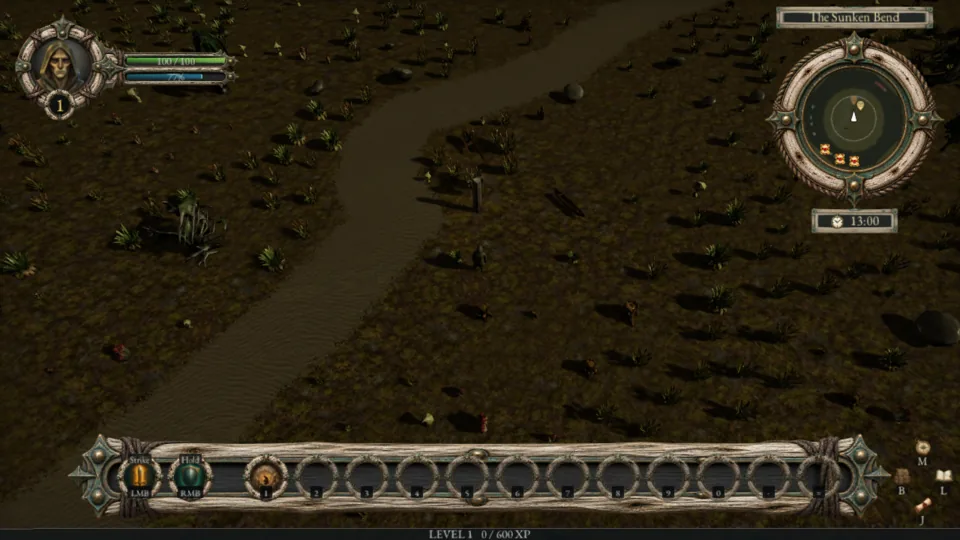
 The Trapline PerchA single staked platform on the road out from the Hearth, where whoever's due to check the hold's own vole-lines rests between rounds rather than pole all the way back.
A single staked platform on the road out from the Hearth, where whoever's due to check the hold's own vole-lines rests between rounds rather than pole all the way back. No hearth of its own — a lean-to, a coil of spare cordage, dry footing — but far enough out that it has become the second place word travels from when the hold has something to say past its own dooryard. The same rotating watch that holds the Outwatch keeps it.
Up close
3 things to look at closer
- You rest where the vole-line checkers rest. The platform is one person wide and the pole rack holds two, which is the hold saying nobody checks a line alone.
- There is a tally scratched into the rail: lines run, in fives, going back further than the platform looks old.
- It is a perch on a road. Everything it holds is somebody's turn.
Gathered here
- Mud-Vole Hide
- Reed Cordage
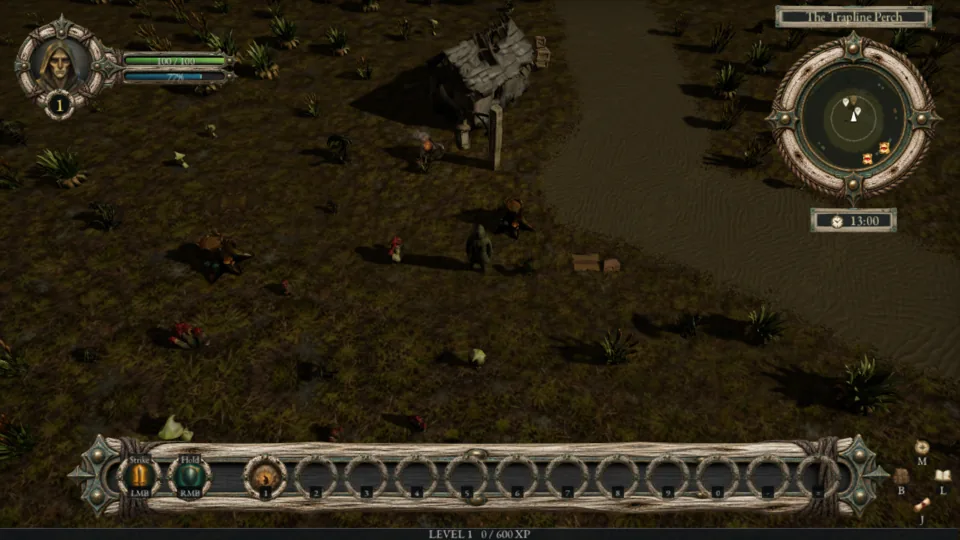
 The Vole WarrensThe soft margin where the channel-bank breaks into burrows — mud-voles thick in the reed-root tangle, worked by whoever's watch it is to check the lines rather than left to breed wild.
The soft margin where the channel-bank breaks into burrows — mud-voles thick in the reed-root tangle, worked by whoever's watch it is to check the lines rather than left to breed wild. The ground carries every trapper's boot-print, old and new, and nothing taken here goes to waste, down to the last skin.
Up close
3 things to look at closer
- You work the reed-root tangle. The voles are thick in it and easy, and the margin is soft enough that you go in to the ankle with every step.
- The warrens run under the bank in a mat. Taking too many from one stretch collapses it, and the trapping lines are spaced to prevent exactly that.
- You have taken what this stretch gives without breaking it. The next stretch is a walk along the bank.
Gathered here
- Mud-Vole Hide
- Reed Cordage
 The Margin BanksThe channel-bank stretch the hold's own trapping lines actually run, where mud-vole hide and meat come off the snares and whatever's left on the margin after — torn cordage, scraps of hide, a dropped net — gets gathered rather than left to the current.
The channel-bank stretch the hold's own trapping lines actually run, where mud-vole hide and meat come off the snares and whatever's left on the margin after — torn cordage, scraps of hide, a dropped net — gets gathered rather than left to the current. Drethmark works it exactly as carefully as everything else the hold touches: sparingly, and never past what the season needs.
Up close
3 things to look at closer
- You run the snares along the bank. Hide and meat both, and the lines are set at intervals somebody worked out a long time ago.
- Every fifth snare is deliberately left unset. Ask why and the Adapted will tell you: a line that takes everything stops taking anything.
- The set snares are cleared and the unset ones stay unset. That is the whole discipline of this bank.
Gathered here
- Marsh Cordage
- Mud-Vole Hide
- Worn Hide
 The Deep HollowThe channel-hollow the whole hold is named for — the deep water at Drelthdren's center, where the current slows enough to silt, and the silt has carried a rust-red bog-iron stain for as long as anyone at the Hearth can say.
The channel-hollow the whole hold is named for — the deep water at Drelthdren's center, where the current slows enough to silt, and the silt has carried a rust-red bog-iron stain for as long as anyone at the Hearth can say. Drethmark has known the ore was there for generations and never once dug it: no keep, no forge, no crew left to work it, and iron nobody's going to smelt isn't worth a stranger's channel to reach. It waits for the first hand Drethmark trusts enough to point at it.
Up close
3 things to look at closer
- You look into the deep water at the hold's centre. The current slows here almost to nothing and the channel-hollow the whole place is named for opens out under you.
- The water has run rust-red since before anybody's grandmother, and up close the colour is IN the silt rather than on it.
- You scrape the bottom where you can reach it. Iron, and enough of it that the hold has been drinking the taste of it for generations.
Gathered here
- Bog Iron
- Marsh Herbs
 The Outer FringeWhere the poled channels give out and the fens' own 'worse' stretches actually begin — reed and standing water past the last platform, harder going the further out it's read.
Where the poled channels give out and the fens' own 'worse' stretches actually begin — reed and standing water past the last platform, harder going the further out it's read. A lone drifter has squatted here for months, tolerated rather than welcomed, the same restraint Drethmark shows anything it doesn't judge worth a fight. What they carried in from further upstream still turns up wedged in the reeds nearby, for whoever reads the marks and not just the water.
Up close
3 things to look at closer
- You pole out to where the channels give out. Past this the reed and the standing water are nobody's route, and the maps say worse rather than unknown.
- The last stake anybody planted out here has a rag on it, sun-rotted to threads. Somebody marked a way and then stopped coming.
- There is nothing further this way that anybody has told you about, which is not the same as nothing further.
Foes here
| Who | Levels |
|---|---|
 The Uninvited | 4–6 |
Gathered here
- Bitter Salt
 The Drowned CampA flooded stretch east of the Sunken Bend where the current runs sluggish enough to squat on — lean-tos lashed to half-drowned stakes, nothing Drethmark built or claims.
A flooded stretch east of the Sunken Bend where the current runs sluggish enough to squat on — lean-tos lashed to half-drowned stakes, nothing Drethmark built or claims. Whoever's made camp here isn't tolerated the way the Outwatch tolerates a lone drifter; they work the worse channels for whatever a stranger drops or leaves behind, and Drethmark is content to let the marsh handle them rather than spend a watch on it.
Up close
3 things to look at closer
- You go through the lean-tos lashed to half-drowned stakes. Whoever squats here squats above the current and moves when it rises.
- The gear is all Roost-pattern and none of it is Roost-marked. Somebody left the Roost with their kit and did not go far.
- The camp is wet, temporary and defended. Everything about it says short stay and no plans.
Foes here
| Who | Levels |
|---|---|
| Throsselds in the Outwatch Throat | 4–6 |
| Squatters on the Drowned Camp | 5–6 |
| The Drowned Camp's Outer Watch | 5–6 |
| Slingers off the Drowned Camp | 5–6 |
 The Fen GateThe staked marker where Drethmark's own channels give back onto the wider Gullbone Fens — the last dry footing before a crossing, and the first after one.
The staked marker where Drethmark's own channels give back onto the wider Gullbone Fens — the last dry footing before a crossing, and the first after one. Holvren Channelwarden keeps it, checking every hand-off leaving the hold or arriving at it, the one post in Drelthdren that answers to the Fens as much as to the Hearth.
Up close
3 things to look at closer
- You stand at the marker where Drethmark's channels give onto the wider fens. Last dry footing, and the stake is cut with the hold's own mark rather than the Trade's.
- The dry ground here is made ground: brushwood and silt, laid in courses, kept up every season by somebody.
- It is a gate in the sense that everybody agrees it is one. There is nothing here to close.
People here
| Name | Does |
|---|---|
 Holvren Channelwarden | quest giver, guard |
 The Poleway ShelterA dry lean-to on the pole-boat route back out toward the wider fens, downstream of the Mend Stake — no warden, just a bench, a coil of spare pole-rope, and a fire kept the way every Drethmark fire is kept: never quite out.
A dry lean-to on the pole-boat route back out toward the wider fens, downstream of the Mend Stake — no warden, just a bench, a coil of spare pole-rope, and a fire kept the way every Drethmark fire is kept: never quite out. Runners carrying word between the Hearth and the Roost break their crossing here rather than push it in one go.
Up close
3 things to look at closer
- You duck into the lean-to. No warden, a bench, and a pole rack with one pole left in it that has been there a while.
- The route out to the wider fens starts here and the shelter is dry, which on this water is the entire luxury on offer.
- There is nothing kept here worth keeping. That is why it is still dry and still standing.
Gathered here
- Worn Hide