Act II has a main road, and it is not the only thing out here. The ground it passes through is full of notes, rosters, hens, goats, rope and rubbings, left by people who are gone or about to go, and most of the side quests are the hero picking those notes up. Almost all of them are written in the same voice: a dry hand on a stone or a door saying what needs doing before the weather or a scavenger gets to it. The main story is told on its own page; this page follows what runs beside it, zone by zone.
Tornkeld
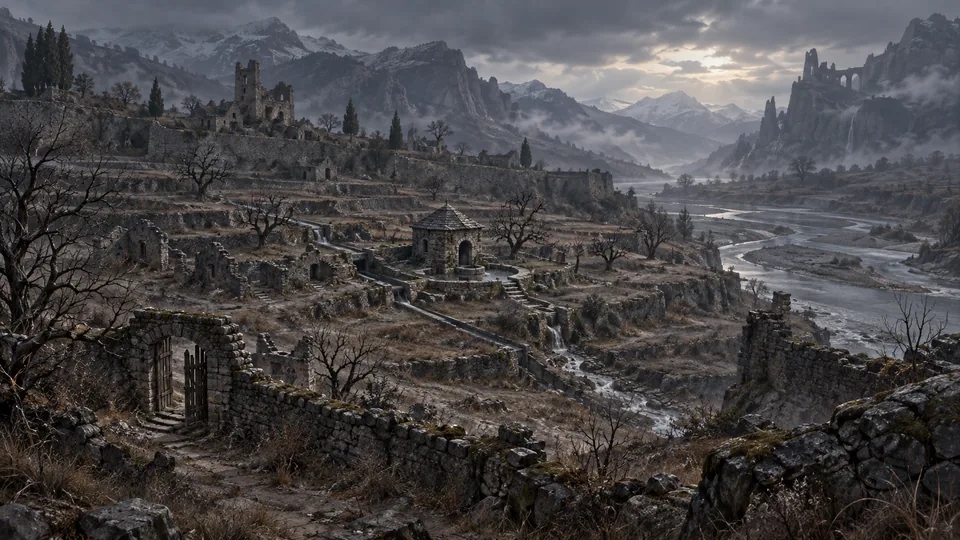
Tornkeld is a settlement that emptied itself four years ago. The main path through it, Skennor Gatewarden's chain about the name on the lintel and Vetra Ironmend's chain about the channel and the cut, is told on the main story page. Everything below happens in the same ruin, among the same terraces, and nearly all of it asks one question: what do you do with a place that is somebody's and has no owner?
Picked Clean
The first answer is the ugliest. In Before Trade Gets Organized, Skennor, at the Well-Road Waymark, sends the hero to survey the Salvage Hollow and kill eight Strand-Scavvers. They have no leader and no banner. They are simply people who found an empty settlement first and mean to pick it clean. Skennor expects them back, and with more of them: the only question was ever whether the Trade organises this ground before they finish stripping it.
The chain's second quest makes it personal. In The Well-House Door the scavvers have torn the fittings off the door of the Well-House, and are still prying. The hero searches the Salvage Hollow for four of them and carries them to Vetra, who re-hangs the door on its own iron. They tore these off our door,
Skennor says. Ours. Listen to me, I said ours.
She does not take it back.
The scavvers do not stay beaten. Scratched notes around the ruin tell the same story again and again. In Back Again at the Well a third crew has written the same complaint, and for once the answer is a hero who kills three of them; nobody leaves a note afterwards, which is how the next hand through knows it was dealt with. The Band Returns Again follows: newer ink beneath the old warning, the band back on the path down to the ford, and three more to kill. The reveal states what the whole thread amounts to: a settlement with nobody in it is a thing that has to be defended by whoever is passing.
The same ironwork has an honest use. Loose Fittings for the Bench sends scrap from the Salvage Hollow to Vendrelm, who asks, once, whether anybody is left to ask. Told no, he lays it on the bench with everything else: Then it is salvage. The word is doing a lot of work today.
The Ground That Gives Too Easily
The terraces have not starved. Their hens are tame, their grain reseeds itself, and a clean spring runs through all of it, with nobody to eat any of it. Vetra's quests are the long answer to why the crews find this unsettling.
He begins with the birds. In Hens in the Terrace Walls the hero crouches by the Sown Terrace wall and the hens come to them, four years after their owners vanished. The hero takes six Terrace-Fowl, only what the thin flock can spare. Whatever happened here was not something the animals learned to be afraid of,
Vetra says. What the Flock Sheds answers a note in the wall that asks whether the thin flock can still feed a crew; the answer is that it is thin because nobody has culled it in four years, not because the ground is poor.
Generous, in an Unsettling Way has the hero gather eight of the fowl at the Feral Steading, and Vetra finds the word for it: The ground is doing exactly what it was set up to do and there is nobody it is doing it for.
The Safest Ground in Tornkeld is the grain version, eight bundles of volunteer grain reseeded every year since the settlers left. Volunteer grain, tame birds, clean water, and not one person. That is the safest ground in Tornkeld and it is also the part that unsettles the crews most.
A note on the steading door, A Second Cutting, asks for another cutting off the far terrace before the birds have it, and observes that the wild grain is doing better than the settlers did.
Two of these end in somebody's kitchen. Proof of the Flock asks the hero to dress one bird and carry it down to the Tally House at Threnvast, because nobody in the port will touch feral meat off an abandoned settlement until somebody has put one on a table; it is the quest that opens cooking. What the Settlers Left Running is Vetra's own: walk the old holding, gather marsh herbs from the hedge at the Hollow Gate, and bring back what can still be used. The Trade will decide that means it is the Trade's. I would rather it was written down first that it was theirs.
It makes Vetra a vendor. The Hedgerow Harvest is the same hedge from the other side, a stake-note saying the herbs have gone uncut for a year, and the observation that somebody planted the row expecting to stay.
One animal is not tame. The Boar in the Rows is a notice pinned to a post, badly, in a hurry: something has been through the rows and is not afraid of a lamp. The hero hunts the Rootbreaker Boar. Afterwards the note comes off the post and nobody replaces it.
What Was Left in the Ground
The most affecting threads in Tornkeld are about preparations. The people who left meant to come back, and the evidence is everywhere.
Under the Collapsed Wall follows a hand-drawn mark on fallen stone to a root-cellar under the terraces. The hero levers the capstone clear: the cellar is dry, sealed, and still full of four-year winter stores. A Word on the Seed Store, a follow-on, has the hero tell Brekva Tollwright that the cellar holds a full year's seed. She stops writing. Nobody abandons a full seed store; they meant to be back before sowing.
The water tells the same story. The Well-Cap Checked has the hero check that the cap seats true at the Well-House, and it does, because it was laid by people who meant to lift it again and laid it well. The Spring Still Gives runs the other way: take six Spring-Cut Catch from the outlet of the capped spring and survey the Terraces along the way. The water is clean, the fish are good, and the people who capped it never came back for either; it unlocks fishing. A Fresh Catch for Brekva follows: one catch carried to Brekva, who tastes it and places a standing order. The survey said clean. This says food.
What the Rows Say
Aluvi Threlveld and Brendorn Vrenveld want numbers rather than impressions, and several quests are errands for them. A note left in the terraces sets Reading the Rows, which counts the rows still sown against those gone to scrub on the Terraces: a third still sown, two thirds gone over. The last season was worked short-handed before it was abandoned. Terraces Hold Steady takes Vrenveld an all-clear he has no way to ask for: A settlement whose terraces are still steady four years on tells me more about how it emptied than any of them.
The Roof-Timbers Noted gives Aluvi the observation about the one roof still standing in the hollow: That is not what fire does or what weather does. That is what people do when they leave in an order.
Word for the Tally House tells her the lintel's name-cut is holding, because a place with its name still cut in the stone is a place that can be found again on a chart.
Keeping the Marks Legible
A smaller cluster is about the waymark and the writing on it, the kind of upkeep nobody is paid for. Clearing the Cut Face scrapes lichen and grit from the waymark's lettering so it reads for another decade. Re-Reading the Waymark checks the stone's sightline up to the Terrace Crown and finds that four years of weather have moved nothing. Re-Sighting the Well-Road follows a standing order cut into the waymark and re-sights the Well-House for the port's survey chain; it unlocks surveying. The Lintel Rubbing takes a charcoal rubbing of the lintel and sets it with the waymark so that, if the weather takes the stone, the name survives on paper. A Line Kept Clear cuts back the reeds on the Channel Bank, and Skennor adds the bank to the roster as safe working ground.
Vronveld
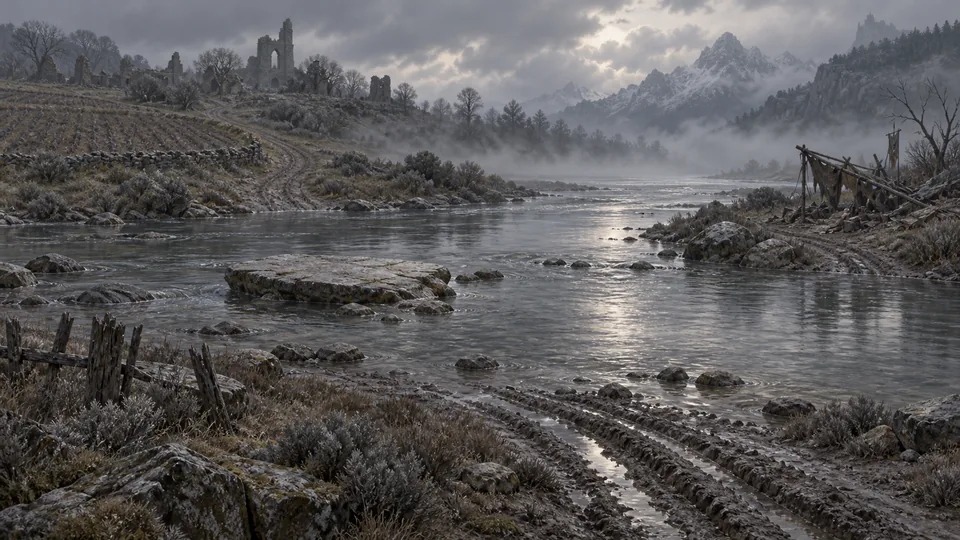
Vronveld is the ford country downstream of Tornkeld, and it has no main-story quest of its own. It is a ford, a ruined farm, a herd that was nobody's and a camp of people who claim what they find. Its stories are about who a place belonged to first, and how thin the paper is that says so.
The Ford Already Known
Skeva Fordwarden keeps the roster at the Vronveld Waymark, and her chain begins with a stone. In Older Than the Cobbles the hero surveys and inspects the Fording Stone, worn smooth before Tornkeld laid a cobble. So this crossing was a crossing before the farm, and the farm was built beside it rather than the other way round. That changes who this ground belonged to first.
In Quietly Restocked the field cart beside the stone has been stripped, and then filled again, with fresh cordage over stripped settlement fittings. Skeva reads it quickly: Not the salvage crews, they take. Somebody is leaving things there, and leaving things is a plan.
Who that is is left open.
Two nearby quests are about the cart itself. What the Cart Still Holds finds a bundle of medicines packed deep in the cart bed, where the restocker never dug, and carries it to Kreskava Fenmend. A family packed this. Nobody packs this and then leaves the cart. They meant to come back for it within the week.
Word From the Buried Cart reports the load to Brekva: the settlement-era load is still lashed in place, the shafts pointing away from Tornkeld, which is one more thing pointing the same way as the capped well.
Set, Not Stacked
A second line of quests asks who built the ford. What the Smith Makes of It puts a stray observation to Threkmir Skrenward: the stonework is set, not stacked. By somebody who expected carts. That crossing is older than the farm it served.
Silt-Worked Metal gives him a fitting pulled from the cobble-set, and he turns it twice. Not our pattern, not Tornkeld's, and not new. Somebody built this crossing to a standard and then somebody else farmed beside it for a generation without asking who.
A Fitting Off the Ford brings a second fitting, worked loose from the same set, to Vendrelm, and two from the same hand is the end of anybody calling it coincidence.
Trelsava Skevnorn adds a stranger thread. In A Mark on the Cobbles the hero describes a half-worn ward-mark on a ford cobble, and she reads it twice. You ward a threshold, not a road, which means whoever cut it thought crossing here was the dangerous part.
A Rubbing Off the Ford takes the rubbing she asked for, since she wants marks rubbed and not described, and she files it beside three others. Four places now carry related marks, and she has stopped calling that coincidence.
Without Leave
The fight that defines Vronveld is a story about claiming. No Brand, No Writ sends the hero to survey the Fallow Rows, where a fresh warning is cut across the old common-row marks: the herd belongs to the Drover, and the next hand who takes a goat will be put in the silt. The hero kills the Drover. The Drover chose violence to make an unowned herd private.
Skeva's chain picks it up from there. Who Drives Them asks who moved that herd for months, and the Drove Rise answers: the tracks of one person working alone, moving them somewhere rather than away from something, with the cropping worn into a circle where the herd was held, and an old boot-line leading toward the Drover's ground. Without Leave finishes it at the Cart-Road Camp, where the lean-tos are built from the settlement's own fence-rails and the claim is the same as the Drover's: found empty first, no writ, no brand, and nobody living who could have granted leave. Skeva closes the Drover's roster line. That is why a marked stake became a claim until somebody finally read it.
One thread attaches. A Look at the Crook has the hero tell Vendrelm about a well-worn herding crook left beside the rows. He prices it and puts it aside. That is a tool somebody used every day and did not take with them.
Drenna's Camp on the Cobbles
Drenna Cartwright works from the Crossing Camp and has the only fight she thinks is worth having. Lifted Off the Strayed kills eight Strand-Scavvers at the Cart-Road Camp. Everything they have came off a crew that wandered past the marked crossing. That is why the crossing is marked.
Crates in the Open then searches the camp crates and finds the port's own burn-marks on them, unplaned: That is not carelessness. It is a statement that nobody out here is coming to take it back.
Squatters on the Bank deals with three who have started working the crossing itself, and the scratched note comes off the ford stone.
Drenna also has the quiet errands. The Nearest Rows is the first walk out from the cobbles for hides from the untended goats, and makes her a vendor: Everybody's first day here is that walk, and everybody comes back saying the same thing about how quiet it is.
What the Fowl Work collects feral barn-fowl from the drier rows, the same settlement stock as Tornkeld's hens; Crows Behind the Plough surveys the fallow rows and gathers field cuttings, among a thin flock of crows still working furrows no plough has turned in four years.
The Soft Ground
The good fields are the dangerous ones. The Soft Bank marks the upstream shallows, which read like ground and swallow a boot to the shin; the open furrows show the same soft ground following the deepest ploughing exactly. Solid From a Distance is Drenna's survey of the same: three soft patches, all in line, all on the deepest ploughing. The ground that fed them best is the ground that will not hold you.
Marking the Soft Ground sets the written report at the waymark, where Skeva logs every crew, so the warning does not live in one head. Sound the Crossing is the standing instruction behind all of it: survey the ford and the reed flats, because a crossing that stops being sounded stops being a crossing.
The Herd That Outlived Its Farm
The settlers' goats went wild and thrived. The Herd in the Reeds counts them at the Reed Flats, thick enough to hide a person in the growth; Reed for Kreskava's Stock collects Kreskava's reed from the same flats, wading carefully because of that herd. She will not come out here. Not because of the walk.
Hide Off the Herd gathers the thick-coated hides, and Hide and Catch to Market delivers the surplus to Thalva Packwright's stall. The ford still gives.
Aluvi reads the herd as evidence. The Goats and the Grain lays the herd marks over a grain sketch and reads them as one account: an abandoned farm feeding an abandoned herd. The Count, Reconsidered goes one step further: with the goats in her count of worked rows, the number moves more than she expected. The herd is eating the evidence.
Paper on Time
Several quests are really about who is allowed to cross. Authorization, Renewed has the hero renew the crossing's seasonal authorization with Vrenveld before it lapses; Paper on time. That is the whole trick, and nobody ever believes me.
Numbers Off the Banks gives him a tally of how many crews work the bank, so he can argue with a number rather than an impression. Tolls Off the Ford carries the ford's chit and small goods to the port, with nobody watching whether they arrive. A toll everyone agrees to pay is a toll until somebody writes it down, and then it is a claim.
The Tally Before the Silt is the one real answer to a real question. Brekva checks her own dates: the ford's silt entries start the season after Tornkeld's last harvest, not before. So the ford did not empty Tornkeld. Tornkeld emptying silted the ford.
A last quest closes the thread upstream: Word Left at the Waymark carries an unposted field-check to Tornkeld's waymark, so that the season's work is known to more than one person.
Smaller errands. A Question for Kreskava asks Kreskava about the wrongness in the ground, and she will not soften it: the ford's herbs read clean, the ground does not, and she will not call the difference nothing. Cordage for the Crossing cuts ford reeds for cordage, the one thing in Vronveld being produced rather than taken. A Line Worth Working and What the Shallows Give fish the Shallow Bend, slack water and silt together; the second notes the silt winning at a rate anybody standing in it can measure with their own boots.
Vrelskarr
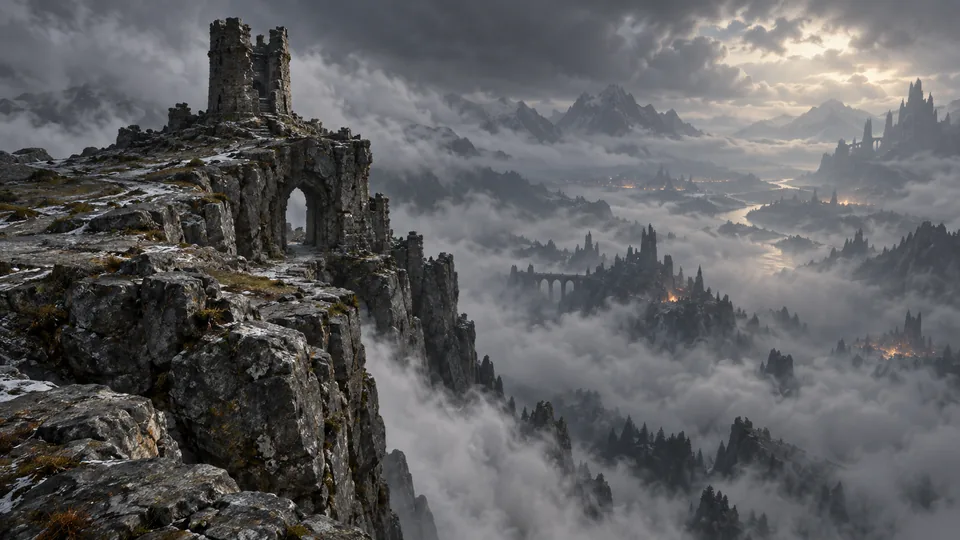
Vrelskarr is the act's high ground and, with Fenneth Farwarden's four-part chain, its main story, which ends below the Hollow Stair; see the main page. Around it grows the most crowded set of side stories in the act: a glow that holds steady, stonework older than Tornkeld's, a seam of iron better than anything off the Skarnmar Shelf, and a camp that keeps books on who came back.
Glass and Iron on the Crust
A note scratched on the Old Footing starts it. The Cracked Crust asks for three pieces of Windglass from crust that comes away in sheets and takes an edge like glass. Whatever fused it did so fast and under heat, and the footing the note was scratched on is no natural formation either. The Fuller Crust follows in the same hand: the first batch was worth it, so take five pieces of Forge-Country Iron from the Ironcrust Shelf, and mind your hands. Under the note, in a different hand, there is a third line.
A Glass Worth Naming asks that a shard go to Fenneth and not to Threnna Stockhand: One of them wants to sell it and one wants to know what it is.
Fenneth holds it against the red glow below for a long time and does not say what she thinks. Windglass in Cold Cracks is Threnna's own version: glass fused into cold rock, this far from any glow, in enough quantity that people stop pretending it is normal. Crust Without the Stair brings eight pieces of the iron from the shelf at the camp's own edge, after six seasons of crews risking the Stair for iron that was in the scree the whole time.
Watching the Same Thing
Fenneth asks whether the Old Footing was built to watch what the camp watches now. The Glow Reads Clearer takes a bearing on the red glow from the Sighting Rise: it is steady rather than flickering, and whatever makes it is not a fire. The three hollows under the footing are cut, not natural, and they line up on it. Watching the Same Thing cracks four more hollows and puts down eight Forge-Revenants camped on the rise. Every hollow lines up. They were watching the same thing. From the same place. With better masonry.
The Hands That Built It
The stone itself raises more questions. What the Footing Hides finds the courses under the moss are fitted rather than stacked, better than anything the Trade builds, and nobody has said whose stonework it is. What the Scree Hides takes tally marks copied from a sealed alcove to Threnna, whose book goes back to the camp's first rotation. It does not go back this far, and he says so himself. Tallies. Older than anything in here. I hate that.
The Footing, Cleared is the newest note on the footing, in a shaking hand: revenants hold the stone and will not leave, so the hero puts two of them down where they stand.
Two quests connect Vrelskarr to the cut in Threvdren. The Cut and the Collapse compares the Sunken Cut's stonework with the Watch's footing, and they are the same: the same courses, the same fitting, the same hand. Two ruins, one builder, and nobody in the Trade's records who could have been them. The Cut, Hand-Measured reads the tool-marks by hand and finds every stroke was cut downward with a shoulder behind it, at an angle that never varies.
The Seam and the Shelf
The Hollowstair Seam adds the hero's five pieces of iron to a running tally chalked into the fissure wall, and the tally does not move: whoever started it wanted a number that stays with the seam rather than with a crew. Three quests spread from that. Ore for the Assay carries a sample to Threnna, who weighs it twice and enters the first line ever written against the seam, with a note two words long: Not ours.
The Shelf and the Stair carries a piece to Vrensveth Dreskorn, the prospector of the Skarnmar Shelf, who does not believe it until it is in his hand. Better than anything off the shelf. And it is in a WALL. Somebody built with ore we would open a dig for.
The Standing Order turns the proved seam into a standing request for six pieces of quarried stone to shore the Stair's cut, and the tally stays on the wall.
A Relay of Marks
The Watch is the far end of a chain of benchmarks, and a handful of quests keep it honest. The Deepest Mark re-sights the deepest benchmark the relay has reached, cut to the port standard out where nothing else is; it unlocks surveying. Somebody raised it expecting the chain to go on, and nobody has raised the next one. The Mark That Reaches Back sights it back to the Scarp Cairns, closing the oldest instruction on the road across two zones. Plumb the Stair reads the mouth of the Hollow Stair and finds the seam has not moved, and from there The Triangulated Mark closes a return sight from the mouth back to the waymark ("two marks is a line, three is a position") while An Offcut for the Stack carries an offcut of the Stair's benchmark to the Saltmarsh Cairn, since rock will not hold a stack out here. True the Benchmark sets the frost-heaved waymark true again and checks the Stalled Climb against it.
Stopped Where They Stood
The camp's book is full of the people who did not come back, and Threnna keeps the book of them. Where the Climb Gave Out puts down a Forge-Revenant at the Stalled Climb so a passing crew can use the path. They were coming back UP from the Stair, and they stopped where they stood. It holds no line and it guards nothing.
Stopped Where They Stood recovers what the stopped crew were carrying: climbing irons, a snapped tally-case, and relief tokens still tied to their owners' belts. They were carrying the Watch's work home, not advancing on a line. Threnna makes a point of the word: it goes in the book as their gear, not salvage, and it stays in the book under their name.
Clear the Switchback clears soft footing before a crew goes down blind, and The Relief Rig, Reported finds a rig still seated in the switchback wall, set by someone who expected to come back. The anchors are sound. Then it was not the rock that failed,
Threnna says, and writes a name in the book that he does not say aloud.
Ptarmigan and Corbies
The ridge's only reliable food draws a small thread of quests. The Watch's Roost takes six Ridge Ptarmigan from the Forewatch roost, no more than a crew's day, and unlocks harvesting. The Far Face and Thinner-Flocked Than Below hunt the same birds on the far face, where there are fewer every season. A Feather Gone Strange takes a wrong-coloured bird to Threnna before it reaches a pot.
The corbies are the odd note. The Corbies, Noted tells Fenneth that there are more of them than there is carrion to feed them. So what else up there is feeding them?
What the Corbies Wait For thins the hunting by culling five Scarp-Raptors, and the corbies are still there. They are not waiting on birds.
The quest mentions the Glowchaser, whom the main chain puts down on the far switchback; the side quest leaves the corbies' business unspoken.
Smaller errands. Proof the Line Still Holds carries an unsigned slip all the way down to the port: a line that can carry a plain piece of paper end to end is a line.
Vensvael
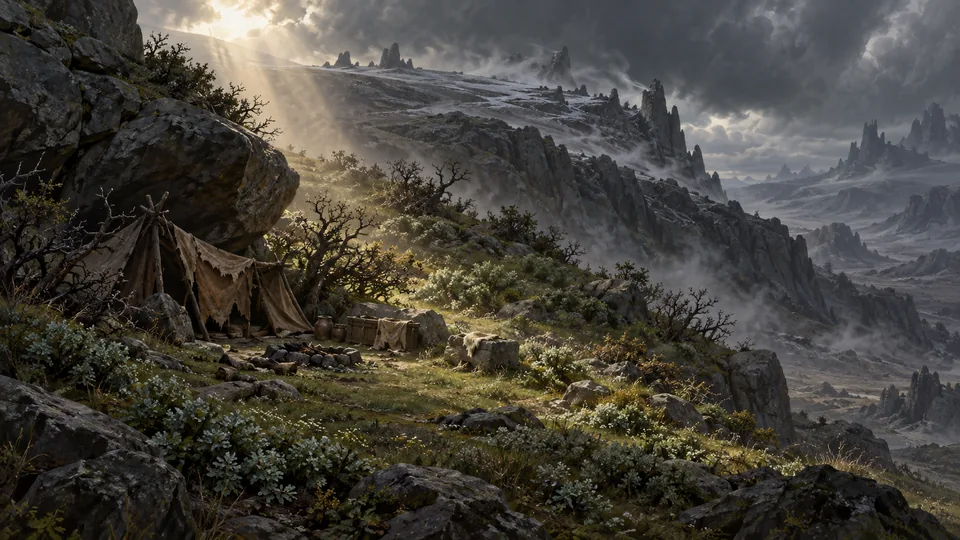
Vensvael is a ridge route, and it has no main-story quest. It has a rope line, a hearth, one green bowl of sheltered ground and the people who hold it. Its stories are about maintenance: who keeps what working, and whether anyone writes it down.
The Off-Book Climber
Torvenn Ridgewarden is the warden of the climb, at the Climb Gate. In The Last Easy Walking the hero reads the High Traverse, finds three anchor lines frayed through and the rest holding, and brings five Weathered Rope Coils from the Line Camp's spares. The gear that is going to fail up there fails at the point where turning back is already a climb.
There is also a hidden hand. Someone has been coiling what is sound and prying loose what is not, and Torvenn has been calling it a thief because it was easier than admitting he did not know. In The Off-Book Climber the hero reads what the stranger keeps at the Under-Ledge Shelter: a note-box that tallies every fitting pried loose, each marked cracked through, and lists the sound ones as left seated. That is not a thief. That is somebody maintaining a route they do not want anybody to know they use.
Still Warm finishes it. The hero follows a warm, empty camp at the First Break up to the High Traverse and finds the work for themselves: rotten line cut away, sound line recoiled beside its proper anchor, every anchor left safer than it was found. The climber stays off the books, and alive.
Marekka's Bowl
Marekka is the bird-speaker, and the Hollow is her country. What the Birds Read sends the hero to watch the thorn-wrens on the Green Shelf, who go quiet and low a good while before the first gust comes over the Lee Wall. They read it better than either of us. What I can do that they cannot is write down what they did and when. That is the whole of my usefulness and it took me four seasons to be at peace with it.
The Last Patch of Green surveys the Last Green and gathers eight Hollow Berries where the cover thins to bare rock. The edge of the only living ground on this side of the ridge, she says, has moved four paces in since she came. The Valley She Left is the quiet one: she asks for groundcover from the Warren Edge, pressed flat, to check whether it grows as it did in her own valley. The same. I came up here for the birds. I stayed for a plant from my valley growing in a bowl a quarter-mile wide.
Heavier Than Expected takes the hero through four places at the Last Green for hare hides. Nobody sends a crew that far on purpose, which is exactly why the ones who go come back with more than they were asked for.
Something for Bird-Speaker carries the crews' offerings to her; she never asks, always takes them, and writes down who left what and when, in the same book as the birds.
A Hearth at the Far Corner
Fenna Cragmend keeps the Coil Camp, and her questions are about the wall past the hearth. Where the Wind Gives Out sends the hero to stand on the far side of the Lee Wall's line, where the wind stops: one side scoured, the other holding a hand's depth of soil, with a line between you can feel on your face. Never Logged as a Stop follows the signs of occupation there. Crews who miss the hearth settle at the wall instead. Nobody had logged it, and it has been a stop for years. Now it is on paper.
The Unlogged Rest Stop does the same for the Hollow's gear stack and the Lee Wall shelter, which have never been on any roster and which every crew uses; it unlocks surveying. A logged shelter has a keeper, and a keeper has a list. The Shelter Held tells Vrenveld at the customs shed that the shelter held through a hard blow, because somebody down there has been waiting to hear it.
Fenna's last quest is the warm one. A Hearth at the Far Corner carries hearth supplies to the Last Green and gathers five measures of Coarse Salt: If they are going, they can find a fire when they arrive. That is not encouragement. That is arithmetic about how far a cold person can walk back.
It makes her a vendor.
Notes for Aluvi
Two seasonal reports run for Aluvi, who wants to be told when nothing has changed. The Season Unchanged gives her the growth line twice and she lays it against last season's sketch: Same line. Write that down before somebody decides it was dull.
A Second Season Noted delivers the written second season, careful enough to be read by somebody who was not there. That is the difference between notes and a record.
The Slide
After the Slide is a shaky note that the ledge has let go. The hero surveys the Hollow and the Fallen Cairn: the Hollow is changed but standing, and the cairn's stones lie downhill in one direction, which is not how a cairn falls. Clear of the Drop Line restacks the Hollow's gear clear of the drop line, the underline in the note belonging to somebody who has seen a stack lost to it. Stone for the Open Bench carries spare stone found beside the cairn's loose slab to Vendrelm, who can use it when nobody up here can.
Smaller errands. The rest of the ridge is hides, berries and paper. Coats Before the Climb and Hides for the Bench both want Scrub-Hare Hides, for patching coats and for Vendrelm's straps. Groundcover for the Packs gathers Hollow Groundcover to pad loads, and Pressed and Carried takes a specimen flat to the Saltmarsh Cairn's reference table, the only one there from ground the Trade does not chart. Stock Before the Turn, A Second Jar and How the Forage Held are about winter stores, berries, salt and a kitchen that plans a season ahead. A Bundle Worth Carrying takes cured hide to Brekva before the rotation turns. The Sign-In Board carries the crews' own rotation board to Vrenveld: the ridge has been running a roster nobody authorised, correctly, for two seasons. Word Down to the Port carries an unsigned chit to the customs shed so somebody knows there are still crews working the ridge.