Act I is a story about paperwork that does not add up. It begins with a ledger line and a survey sheet that never reached the loft where it was due, and it follows that small wrongness inland, from the quays of a harbour-camp to a cliff where nobody has come down. Along the way it asks the hero to do very little that sounds heroic: walk a route, count the sounds, read the stones, hand a bearing to the right clerk. Only at the end does something with wings answer back.
The Landing Shore

Off the boat
The hero arrives at Threnvast, the port of The Hush Trade, off a boat. The first thing anyone landing here sees is The Tideline Wreck, a grounded hulk on the tide-line.
Brekva Tollwright keeps the book. In The First Ledger she explains the arithmetic plainly: Every soul off a boat owes my ledger's first page.
The price is a walk out to The Saltmarsh Cairn and five pieces of pale amber from the shore. The hero brings them back, and Brekva writes one line and turns the book round so they can read it. You're a name in the ledger now, not a hull number.
It is the first kindness the coast offers, and it comes as an entry in an account book.
In The First Crossing Arranged, Halvreth Olvmark gives the hero a package to carry down the coast path to Brenvast Cove, unopened and with no questions at either end. Once, well. There will be a second.
It is a side story, and it opens onto Brenvast, which lies off the main road.
The first mornings
The port teaches its newcomers in a particular order. Brendorn Vrenveld wants the wreck cleared of the Strand-Scavver pair who have moved in with their own fire inside the hull, in The Wreck on the Tideline. It can go on being a wreck,
he says. It was starting to be a message.
Skarva Roadwarden sends new arrivals along the dunes in The First Place They Send You, a walk across The Saltgrass Flats for dune-hare hides, which he describes as a test nobody tells you is a test. It is not long before the scavvers have the gall to post watchers on that very ground, which is the business of Pickets in the Gorse. Brekva, meanwhile, lets a hand work the wreck under a toll-mark in Scavenger's Toll, because the Trade would rather tax you than chase you.
None of this is the main story, but it introduces the people the main story runs through: Brekva, who keeps the book; Brendorn, who clears scarp traffic case by case; Skarva, who sends newcomers out along the dunes; and Aluvi Threlveld, whose loft is the Survey Station.
One more errand shapes the web of people. In Word Reaches the Roost, Brekva hands the hero a sealed parcel for Vrenna Delnmark at The Gullbone Roost, out past the drowned channels. She will not say what is in it and will not ask what comes back. Vrenna's reply is that not asking was the test. It is a side road into the fens, and Vrenna is known by the ledger nobody else touches.
The Missing Report
The main story proper starts with a complaint. In A Word at the Tally House, Brekva has a sweep of the Saltmarsh Cairn marked complete in her ledger, and the survey loft never received the sheet. She sends the hero to ask Aluvi. Aluvi answers plainly: the sheet never reached her either, and she does not recognise the hand that marked the sweep complete. Brekva, hearing it, shuts the book. Paperwork is hers; being lied to in writing is mine.
Neither of them yet knows what a false line in the book might mean.
Aluvi's first instinct is to go and read the stones. In A Sheet That Isn't There, the hero goes out to the cairn and reads its own marks. A crew that has finished a sweep says so in the way it leaves its stones: a date, a crew count, and a closing stroke that means the work was done and the stones re-set. These marks show four hands, closed clean. The sweep was finished, and whatever went missing went missing after the crew walked away.
So the hero follows them out. Thirty Paces sends them along The Causeway Cut and across Reedmouth Ford, counting what they hear. What they hear is water, birds and their own boots. There is no detour and no reason to stop. The crew left whole and unhurried, and the sheet went missing somewhere between the ford and a loft.
In What Brekva Can Shelve, the hero carries all of it back to the port. Brekva hears the cairn out without interrupting once, takes the ledger down, and writes two things: A closed cairn and no sheet.
One finished sweep, one closed cairn and no sheet is now a fact the port has heard, rather than a thing only two people remember.
Side stories hang off the same cairn. Three Seasons Short shows Aluvi counting hen tallies along the same causeway. The main road, though, goes on.
Saltmarsh Reach
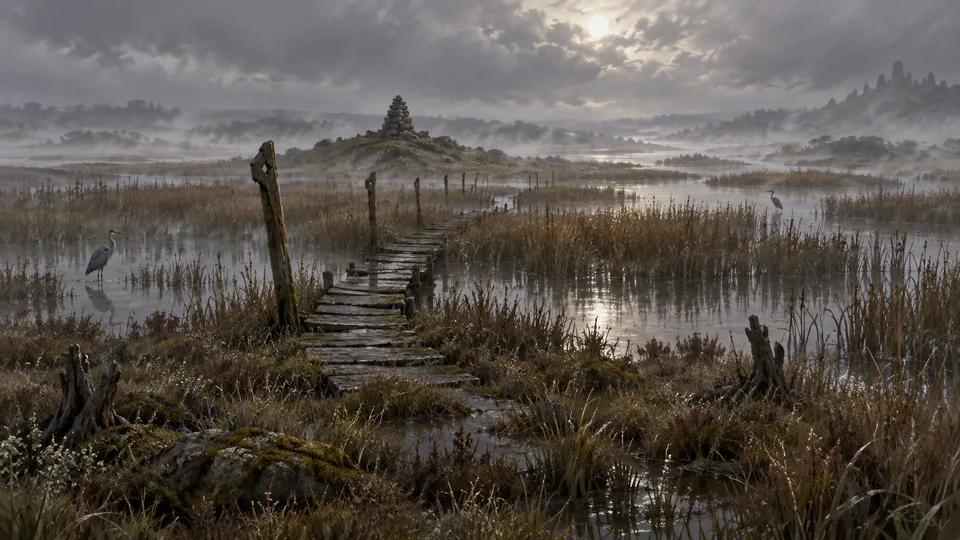
The Relay Route
One closed cairn is a curiosity Brekva can shelve. Aluvi wants the next waypoint in the crew's paperwork walked. Saltmarsh Reach is where the hero is asked to find out, and The Relay Route is how.
The crew's paperwork names a next waypoint, and Aluvi's rule is that ink is cheap. She wants to know whether the line ever stood on the ground. So the hero goes into Krelthnael, the next zone along the coast, to survey The Fallen Waymark. The route turns out to be where the sheet says it is. The missing report got that one thing right, and the hero leaves the reading at the cairn, where the relay can carry it back.
What the Ledger Can't Shelve gives Aluvi her moment of reckoning at The Eel Weir. Two cairns,
Aluvi says, and stops writing. One I shelve. Two is a pattern and a pattern goes to Vrenveld with a name on it — and the name on it is yours, because you are the one who walked both.
The hero carries the news to Brendorn, who hears both cairns without a word. His questions are small and exact: which cairn did the hero reach first, and how long did they wait at the second?
The reach holds plenty of other work. The Pattern in the Tally and Past the Quota follow Aluvi's short hen tallies to a trapline and the person working it. They are a side story.
Krelthnael

The Fading Marks
In Krelthnael the crews chalk the rock faces, because rock will not hold a stack. Fenkathr Voskresketh runs the guiding at The Scarp Cairns, and he is the next person to be bothered by a line that is not as it should be.
In Three Marks, One Hand, he asks the hero to look at the inland marks along The Chalk Relay and the Fallen Waymark. They are cut in three grades of chalk and in two hands. The first two are Fenkathr's own: neat and shallow. The third is deeper and faster, and it is cut on the waymark's own face, over an older mark that is not chalk at all. Somebody has been marking my line for me and has not mentioned it.
Following the third mark means going through The Scarp Narrows, where two Strand-Scavvers have taken to charging a toll from anyone who did not hire a guide. The Toll Before the Third Mark is the hero clearing them out. Fenkathr, with some dryness, notes that he did not have to ask twice.
The marks stop being Fenkathr's problem at the third. My contract ends at the third mark. Yours doesn't.
In Past the Third Mark the hero goes on alone to The Greatcleft, and there is a fourth. It is cut past the end of anybody's contract, on the Greatcleft's own lip, in the deeper hand. Fenkathr hears it without surprise, which is worse than surprise
, and says that whoever cut it was working past a boundary they had no paper for, like Aldorn Ornsen, the scout who never came back down off the scarp.
The Scarp Cairns themselves are a place where people have counted wrongly before. A crewman of Skarva's swears he saw a fourth mark on the scarp-face and will not go back; the hero's reading, in A Nervous Count, is three, and Skarva does not call him a liar for being afraid. The real fourth is on the Greatcleft, not the scarp.
The last step of the chain, A Bearing Nobody Filed, and it is the step that gets the bearing on record. The hero takes the bearing up to The Farwatch and gives it to Kaldrin Farwarden, who has his ledger open before the hero has finished a sentence. Bearing first,
he says. Opinions after, if the line has room for them.
He enters it. A line in a ledger is the only permission this coast respects,
he says. It is in one now. Whatever is out past the fourth mark is somebody's business officially, which is not the same as being safe.
Off the main chain, the raptors on the scarp are the subject of The Windbreak Cull and The Nest Above the Path, and Brendorn's signed roster for the crossing is the story of Papers for the Cut.
What the Greatcleft Keeps
A bearing in a ledger is not an answer, and Kaldrin knows it. A line in a ledger has never killed anything out past the fourth mark.
In What the Greatcleft Keeps, he refuses to wave another crew past The Scarp Picket until the thing that roosts there is put down. The hero goes back to the Greatcleft.
Past the fourth mark the floor of the cleft is littered with picked bones and chalk dust, and something wide-winged has been roosting on the lip above the line. This is The Cleftwing, the boss of Act I.
The Cleftwing
The Cleftwing opens with the flock's own diving, only larger and drilled sharper: a buffet of wind announces every dive, the same tell the ordinary Scarp-Raptors have been teaching all along, and the lesson is simply to remember it.
Past half its health, it drops to the cleft floor rather than give up the height. Its wingbeats kick loose scree about, and the dive becomes a ground charge.
Near death, it makes one last climb up the cleft's far wall, dragging rockfall with it, and these are the hardest tells of the fight to read. It comes down for good.
Kaldrin does what he said he would. He logs the kill under the same bearing as the sighting, and only then waves the next crew past the picket. A line in a ledger was never the dangerous part,
he says. You were.
Nothing in the Greatcleft says who cut the marks, or why a scout went up and never came down.
The road onward
With the Cleftwing down, the road out of Krelthnael is open to crews again, and the hero is the reason. Kaldrin's next request, The Fallen Line, takes the bearing past Krelthnael to the palisade at Dreskneld, which is where Act II begins. What Act I leaves behind (a closed cairn with no sheet, a third hand cutting marks, a bearing in Kaldrin's ledger) is not answered here.
The story does eventually come back to the port, though not until Act III. Once the seam at the Forgemouth has been sealed in The Sealing, The Watch Begins is the hero's account to Brendorn: the cairn over the seam goes on the watch rotation, and somebody will walk it every turn. The fog will thin. It will not lift.
Brendorn listens to the whole account without interrupting, which, the game notes, he does not do. The account begins, as it must, with the missing sheet.