This page follows everything Act I offers off the main road: the chains, errands and notices that make the Iron-Fog Coast feel lived in. The main-story path runs through A Word at the Tally House, The Relay Route, Three Marks, One Hand and the fight with the Cleftwing; wherever a side story touches it, the text says so. Zones come in the order you meet them.
The Landing Shore
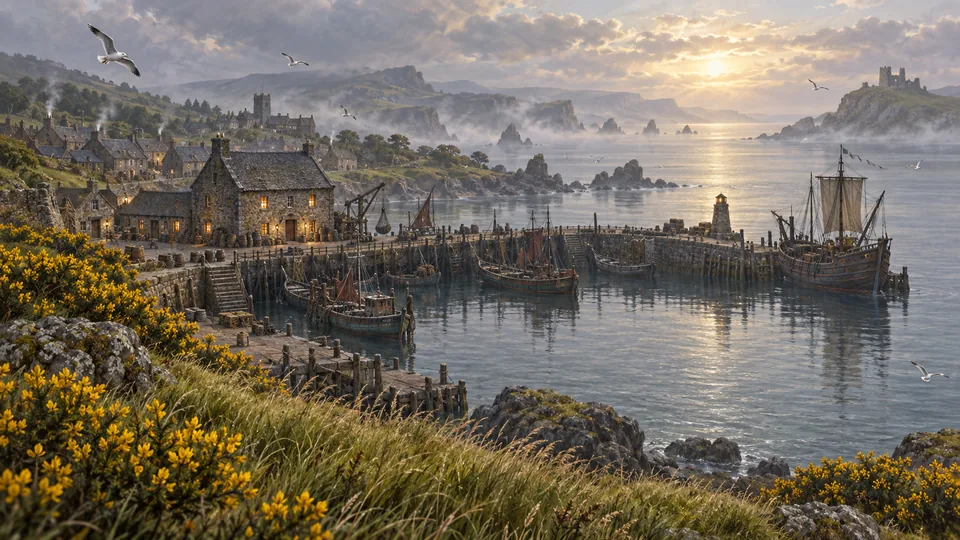
Threnvast Port is a harbour that has spent three generations moving other people's goods and making nothing of its own. Almost every side story here is about changing that: finding the people the port lacks, lighting the fires it has never lit, and writing down, in ledgers that other people will trust, what is true.
Bring Back the Healer
Brekva Tollwright, keeper of the tally house ledger, has a hole in her book. Nobody in the port sets a bone: whoever happens to be nearest does it. After The First Ledger puts your name in her book, she sends you to ask along Hollen's Racks who mends people here. In No One to Mend, Hollen holds up a finger that healed crooked, and Brekva writes down a name: Kreskava Fenmend, a fen-side healer who mends people rather than nets and has been waiting for someone to ask.
Kreskava is at the Road Hearth in Skarnmar, and she has not decided. In The Shelf Medic you watch the ebb come in on the crews: they climb off the rock with split palms and a barnacle-cut shin, and every one of them walks to her hearth unprompted. She admits she has been asked to move to the port, where there would be more people, better shelves and a queue, whereas out here she is the only one. In Marsh Stores she asks for six marsh herbs, so that if she goes she does not arrive with empty shelves and a good excuse.
She goes. A Place at the Tally House has you walk her down the fen-road to the port. She sets her bag down behind the tally house, looks at the quay as if measuring it, and observes that there is a bench and a roof and no one to mend anybody but her. Brekva writes her in as a trade, which in this port is the same as a welcome. Alchemy opens up with her, and her first batch worth the name is A Proper Batch: bring gorse-bloom and she has stock on a shelf by evening, stoppered and labelled in a small careful hand. There is a difference between a remedy and something bitter in water, and the difference is the second bloom.
Raise the Smithy
The anvil in the port has been cold for so long that the port has been buying its iron elsewhere. Threkmir Skrenward will not light it for nothing. In Iron for the Anvil you bring him five measures of hull tar from the Tideline Wreck, and he lights the forge off it without a word. First fire on this coast that was lit for work and not for warmth.
The Forge Corner finishes the job: you brace the forge frame against the tally-house wall and square the chimney so it draws, then fetch six bundles of dry tinder. That's a forge now. Two months I've been calling it one.
Threkmir takes up his trade as a vendor, and weapon and armour crafting open up with him.
The ore for that anvil is already on its way, and a hand-lettered board at the Road Picket says where it is: stacked at the scarp cairns, waiting for someone headed that way. In Ore Waiting at the Scarp you bring it down at last. It has waited so long that whoever stacked it has stopped asking, and the board has kept asking for them.
Raise the Waystone
Aluvi Threlveld, the surveyor at the Survey Station, wants one stone on this coast to be exactly where the chart says it is. In A Stone Worth Trusting she sends you to cut a block from the hard face of the Skarnmar shelf, not its deceptively soft edge: stone cut from the easy face reads true for one season and then lies to everyone who trusts it.
In True and Level you dig the footing in the port, plumb it twice, tamp it, and then climb Gannet Head to confirm that the line reads true from there. It does. Aluvi marks it on the chart in ink rather than chalk: the first thing on this coast that is where the chart says it is.
Reopening the Market
Brekva has a sealed parcel for Vrenna at the Roost. In Word Reaches the Roost she will not say what is in it and will not ask what comes back. Vrenna takes it without opening it. She told me you would not ask. That was the test and you have just passed it without being told there was one.
That clears the way for The Roost Run. Thalva Packwright runs the market stall, and Brendorn Vrenveld, the harbour-warden, has agreed that the Roost may deal with the port. You carry the word up to the Roost and come back with a lot that has papers. Thalva checks the papers against the goods twice, which is once more than she checks anything. First honest lot to come down off the Roost.
Thalva becomes a vendor. The same thread runs on in the fens, where A Buyer's Safe Crossing takes Thalva to see the Roost herself.
The False Ward
A forged ward-mark has turned up. Trelsava Skevnorn, who reads wards, has traced it back to the beachhead. In Closing the Ledger you ask Brendorn about it, and he does not pretend. Beachhead mark. I've seen it before, twice, and both times I let it go because chasing it costs more than the goods it moved.
At the old beachhead, cut into the sunken foredeck locker below the sand line, you find the mark: the Trade's own ward, drawn by somebody who had seen one but never had to sign one. The second stroke goes the wrong way.
Trelsava reads your account twice and folds it away. The mark is older than Brendorn let on and older than the port's move west. That is not a forgery any more. That is somebody keeping a ledger of their own.
The thread picks up again in Brenvast, where an unsigned note turns up with a ward-mark in its corner.
The First Green Meal
Hollen Netmend wants the port to eat something it grew. In The First Green Meal you bring five shore gorse blooms, tart and green, the first taste here that isn't salt.
Hollen tries one raw and makes a face: Tart as a toll clerk. But they're green, and the last green thing anybody ate on this coast came off a boat.
In Camp Fare the blooms go into the pot at the tally-side hearth, with three hare hides for the camp's stores, and half the quay drifts over without being asked. They cook. That's the first meal this port has grown instead of landed.
Hollen becomes a vendor, and cooking opens up.
The Open Bench
Vendrelm wants the port to make things. Scrap and Shine sends you to the Tideline Wreck for fittings and glass, anything that held a shape before the sea got it
; you come back with two hull fittings and a lens-glass rim. In The Open Bench you clear a bench and bring four pieces of pale amber to lay on it. Now this port makes something. It has been moving other people's things for three generations and making nothing at all.
Enchanting opens up. The Rarer Glass follows: Vendrelm crushes a gorse bloom, sniffs it, and explains that gorse in the melt makes glass green rather than grey. Nobody on this coast can get this.
Vendrelm reappears at the end of an odd little trail in Brenvast, where a corroded fitting nobody can place ends up in his hands and then Threkmir's.
The Strand
The scavvers have a beach east of the old beachhead, and Skarva, who keeps the roster at the Road Picket, wants to know exactly how it sits. In A Walk From Where the Work Is you count fourteen lean-tos, one fire, and boot-prints that all come up from the water rather than down from the road. Exactly one walk. That is not scavenging, that is a posting. Somebody chose that distance.
The Slinger's Stand takes the scavvers' stand on the dune, and two slingers with it, and Skarva explains what the crates were really suffering from: They were taking them from the one place that could see the whole path.
The Uncounted Lines
Hen tallies off the reach have run short three seasons running. In Three Seasons Short you walk the causeway and count: the traps are set right, baited right and sprung, and the take is a third short. Weather does not do thirds.
In The Pattern in the Tally Aluvi lays three seasons side by side and sends you to the grove to prove her wrong. You cannot: the gorse is thick, the tinder dry, the herb ground untouched. Whatever takes the shortfall does not take it from the ground. The answer comes in Past the Quota. Someone is running the trapline ahead of the crews, and you stop them by hunting down the Snarekeeper. It was a person. Better a person than a bad reach. A person can be stopped.
The Trapline Rise comes up again in the Saltmarsh Reach.
The Unwatched Fork
Tesk Covehand, at the Cove-Path Shelter, wants to know for certain that a quiet place is quiet. After Brendorn stamps a survey pass in The Open Fork, Tesk sends you in Nothing Waiting to walk the Bressdren Shallows end to end and report that nothing is there. He writes the word down like a result. Half the trouble on this coast is somebody assuming a quiet place is quiet.
In The Quiet Crossing he hands you a package to take over: don't stop, don't wave. The loud ones are the ones people remember, and remembering is the expensive part.
Silt for the Ledger adds a sack of the Shallows' dry, salt-free silt, which somebody up the coast pays for without caring why anyone has it.
Skarva's Rosters and Walks
Skarva will not let anyone out past the picket without a name on his roster and a word from Brendorn, and most of his errands are a way of making sure someone has looked at a place before the crews go. Roster for the Dell has you take Brendorn's word and then look at the beachhead: stakes rotted to the same height, hearth-ring cold, locker sanded over, nothing changed. Roster for the Ash puts your name down for ash country and has you walk the Strand to find what colour blows in: grey. Clearance for the Cut clears you with Brendorn and has you walk the fogbank grove, which reads wrong in one specific way, the tinder bone-dry an arm's length up and soaked below it. Beyond the Well petitions Brendorn for a crew going up the well-road and reads Reedmouth Ford: one crossing, one place to lose a crew.
Past the Fallen Line takes a sighting from Gannet Head so Skarva knows exactly where his charts run off the edge. Papers for the Cut, from Brendorn, carries his signed roster to the Scarp Cairns, where the sweep lead inks your name beside the crossing. A Nervous Count is gentler: one of the crew swears he counted a fourth mark on the scarp-face, you find three, and Skarva will not send the man back up or call him a liar.
Further out, The Threshold Tally puts a number on the Drethold threshold at last, in a line of Skarva's sheet that has been blank since the port was a beachhead. The Last Camp Before carries ward-charms and anti-blight draughts to the hand holding the fire there, who counts them into two piles without a word of thanks. Not Looted recovers a quarry pick and a grain basket from the Sunken Cut, which someone carried there and set down. Not loot. We remember that much.
Salvage opens up for you. Aluvi supplies two more kit runs for the same roads: Ash and Ward, eight marsh herbs for a ward and an antidote, because cut air makes you certain you are fine, which is worse
; and Past the Emberline, six measures of tar to seal cask seams from the ash.
Scavvers Near the Port
Scavvers are never far. The Wreck on the Tideline puts them off the hulk Brendorn calls the first thing anyone landing here sees, because it was starting to be a message.
Pickets in the Gorse clears five from the gorse bank where the port sends new arrivals on their first morning: it has been cut back from the inside to make a sitting place with a view of the path. Ballast and Bone thins five from the hulls, and Skarva expects them back in a season but wants the next crew off a boat to walk past, not into it.
What Brekva Logs
Brekva is not interested in guesses. In Scorch Without Fire you cut a sample of timber from the Dreskneld palisade that has been scorched clean through, with no soot and no ash-fall. In The Threshold Ground you cut a sample of packed, smooth-worn earth from Dreskvath Turn, worn smooth by years of passage with no name on any of it.
In Two Entries, One Ledger she lays the two beside each other and sends you to pin the pair beneath the roster at the Scarp Cairns: heat with no fire behind it, traffic with no one to own it. Nothing Left to Carry is the odd one out: you comb the old beachhead for any name of a builder or a crew and find nothing, and she logs the nothing anyway, so that no crew wastes a day combing ground you have already walked.
Smaller Errands
The First Place They Send You is the first walk anybody off a boat takes, along the dune line for hare hides. Combing the Dune Line has you comb the amber properly for Hollen, who notes that most people only work the easy turn of the tide. Two postings on the board pay whoever shows up: Stock for the Row (ten hare hides, paid through Thalva's row) and The Hollow Batch (a full batch of berries for the galley stores). Scavenger's Toll lets you take what the Wreck gives up under Brekva's toll, where Brekva takes a third, so that the goods are yours legally. Her advice is to remember, when someone offers you the other arrangement, that the Trade would rather tax you than chase you. No Manifest is a parcel Brendorn sends back to the Wreck with no manifest, and he does not ask whether you opened it.
Brenvast

Brenvast is a cove the port's own harbour chart does not account for: a ferry camp, a sorting yard, hauled skiffs and a great many unsigned notes left in driftwood and under lean-to planks. It has no main-story quest, only the slow business of learning who runs it and what it carries.
A Boat That Never Came
Halvreth Olvmark, who runs the boat at the crossing, asks you to look at flat stones south of the crossing, every one scratched or wedged with a coin, and nobody will say who started it. In The Waiting Stones you count the marks at the waiting stones and Halvreth goes quiet: More marks than stones. So people waited there more than once, for boats that were late more than once, and somebody kept coming back.
Whose Habit Started It finds the beginning. Under the fallen decking of the old slipway, packed in where a hurried crossing would hide it, is the oldest thing anyone has left at the cove: not a mark but a coin, wedged so deep the stone has closed on it. Somebody paid for a crossing they never took, and everyone since has been copying a man they never met.
The stones, in other words, copy a habit, and the coin is where it came from.
What Halvreth Still Owes
Halvreth is a man who pays what a thing is worth and likes you to hear the number from him. After The First Crossing Arranged, a small package carried a short walk with no questions asked at either end, he says there will be a second, and the second is the one that pays, because the first was me finding out about you.
In What Halvreth Still Owes you carry the second to the port; he does the sum aloud, twice, and pays the higher. In Owed Again it is the same amount for the same man, and he says a steady rate is a compliment and also a sign that nobody up the line has changed their mind.
The third run, The Line Runs Both Ways, ends the pattern. A return parcel waits under the fire-scarred stone at the tideward watch, marked for Halvreth in a hand that is not his. He weighs it without opening it. The line has never run this way before. Somebody up the coast now owes ME a crossing, and you are the reason there is a somebody.
It raises your standing with the Frontier Folk. A Name She Knows is the other test of his name: you say it to Vrenna at the Roost, who answers that the Roost still remembers the year he did not. He has you say it twice, the second time slower. Then my name still means something up there.
The Cliffwarden's Cove
Fenvara, the cliffwarden at the Northwatch Stone, is writing the cove down before it changes. Nothing Here Fights Back has you survey the inlet shallows (seals that do not move for you, crabs that do not run, not one animal here that has learned what a person is
) and gather five tide-crabs. The day official traffic finds this inlet those rocks will be bare inside a season, and I would rather have written the before down.
Past Where the Pickers Stop marks how far the mud is safe on the day, once only. In The Long Way Up and The View That Folds Away you climb Foldback Head to see whether the port shows from there. It does not: the land folds the quays away just short of showing them, and every climber has thought he was the first to notice. A cove nobody can see from home is a cove that keeps working.
Two errands set Fenvara's dry crossing against Halvreth's boat. The Tide Marks It for Us has you walk the low crossing while it is dry; Dry-Shod or Wait has you carry a message across on foot and tell Halvreth what it saved. He takes it better than expected: On the day the water is high, that same walk drowns you. My boat is not selling you the crossing, it is selling you the hour.
The Ferry Camp
Dresva, the ferrywright, puts newcomers to work on easy water. The Shallows Are for Learning sends you to fish the warm inlet where nothing fights back: It's where we put people before we trust them with worse.
What the Flats Give Up takes you for deeper-mud crab at low tide. Her other interest is the old slipway. In What the Slipway Still Holds you survey it and find pilings jointed rather than lashed and set into cut stone below the waterline, yard work from a yard nobody remembers. Somebody was landing something bigger than a skiff, and stopped.
A Ramp That Still Remembers levers three sound lengths out of it for her hull bench. The sorting yard raises sharper questions: The Yard's Own Manifest counts the flat against the note and finds two crates fewer, and Timber Nobody Logged has you help sort what a crossing carried. Nobody asks whose manifest it left off of. That is not the same as nobody knowing.
The Unsigned Notes
Most of Brenvast's errands arrive as scrawled notes with no giver. Some link into longer threads.
The fitting. A Fitting in the Wrack describes a corroded fitting nobody can place to Vendrelm, whose face does what the note said it would. What the Open Bench Wants carries the piece down to his bench, and he says nothing for a long time: That is not off any hull that ever landed here.
The last note, The Fitting Goes to the Forge, takes it to Threkmir, who holds it to the fire. This is not the coast's iron and it is not the Crown's. Leave it with me and do not mention it in the port.
The mark. The Mark on the Note notices that an unsigned note carries a ward-mark in its corner, and Trelsava reads it without touching it: a ward drawn by somebody who has seen one signed and never had to sign one. She does not say whose, and that is not the same as not knowing.
A Rubbing for the Record brings her a rubbing of the mark itself, and she files it with two others, the first you have heard of the others.
The skiffs and the count. A Second Skiff hauls a loose skiff off the rocks, and nobody says who did it. A Second Opinion on the Hull gets Threkmir's honest verdict on its planking: She will hold this season and not the next.
The Skiffs, Accounted For completes a half-written count for Brendorn: three skiffs, not two, a fact somebody chose not to write down.
A Count She Keeps corrects Brekva's own count of the cove by one boat and two names, and A Toll Paid Anyway pays her toll, because it costs less than being the one who did not. What Brendorn Asks gets his questions over with: Where you cross, when, and who knows you do.
The tide. Reading the Cold Ring reads the tide timings for an anonymous requester. The cove's water turns an hour later than the port's table says, and the shallows turn another twenty minutes after that, so the cove has three tides. In the morning the paper is gone and a coin sits in its place. The Tide Notes, Delivered then gets the written timings to Aluvi: A crossing with hours can be planned around, and a crossing that can be planned around stops being a favour.
Worth a Line on the Chart asks Aluvi to chart the cove at all; she hesitates, because charting a place is either a kindness or a betrayal.
The rest: A Parcel for Vrenna (not paper, and Vrenna says you will be asked again because you did not ask), The Roost Hears of It (a note sent up to the Roost by skiff, so it hears before the port does), A Catch for the Market (Thalva writes the cove down as a source for the first time), What the Market Pays (the port pays a third under what the cove assumes, and Thalva pays a third under that), The Shallows Run Clear (the yard's count and the note's differ by two crates, in the same handwriting) and What the Tide Leaves (five crabs, and the sixth stays in the mud).
Saltmarsh Reach
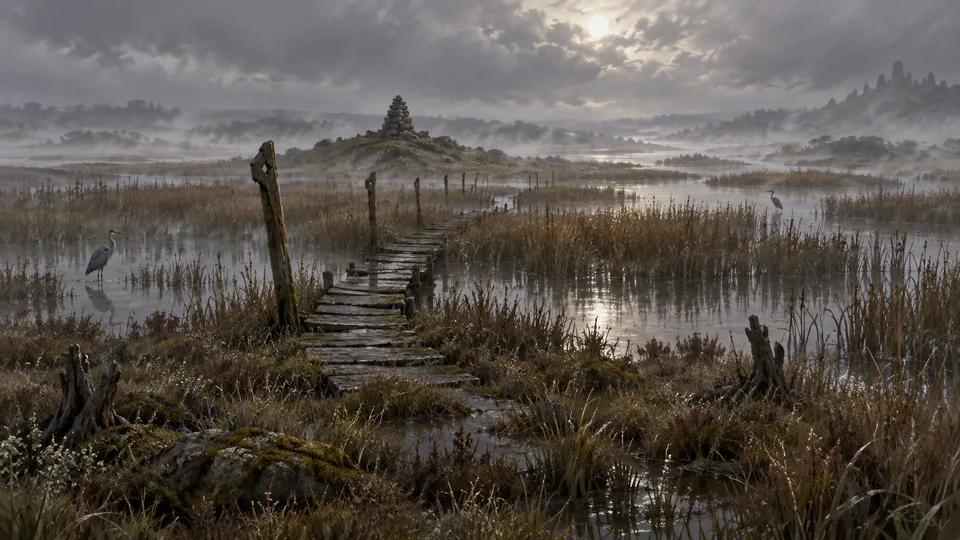
The main road through the marsh is The Relay Route: Aluvi sends you to walk the next waypoint named in the missing crew's paperwork, and then, in What the Ledger Can't Shelve, takes two cairns to Brendorn Vrenveld with your name on them. The side stories here are mostly Aluvi's quiet campaign to turn rumour into measurement, plus a long fight with whoever is robbing the reach.
More Than the Permit Allows
The Trade caps what any one hand may take from the hens that nest on the flats. Fenna Reedwright, at the eel weir, sets the standard in What the Permit Allows: six marsh hens, no more. Every hand that takes more takes it out of next season, and next season is the only thing out here that is ours.
Then the tally comes up short and the birds vanish from the north clumps. In Somebody Is Taking More you climb the trapline rise, a hummock from which the whole reach is visible, and find the snares nearer the camp are the Trade's own pattern while those further out are newer and set across the game trails rather than along them. They are not poaching the flats; they are watching the crews and taking what the crews walk past.
In The Snarekeeper you follow the lines down off the rise, into ground that gets meaner the further you go, and kill the elite Snarekeeper who strung them. Fenna's verdict is practical: cut the lines and the flats come back inside two seasons. Aluvi's Past the Quota also ends with a hunt for a Snarekeeper at the Trapline Rise.
The people behind it are not finished. Vosrenn Scarpward, at the scarp waymark, wants the second camp counted. In Past the Charted Road you count it from the lip of the Wreckers' Cut: eleven lean-tos, a fire-pit screened to face away from the coast, and crates stacked in the open with the port's own burn-marks on them. They did not drift out there. Somebody walked them out and told them where to build, and that somebody has seen our charts.
Anyone Following This Far retrieves the stacked poached hides from the camp, since anyone who followed a line that far out was fair game. What They Worked the Trails With takes a watching slinger's gear so that the camp has nothing to run the trails with, and The Road Bends Around It deals with a scavver at the one place on the long road where every traveller must slow. Loud Before You See Them is gentler, on the boars at the nesting flats, and Cut for the Ropewalks and Thatch and Cordage are Fenna's ordinary work of cutting sedge for the port's ropewalks without letting the bank go wild.
Who Takes the Toll Now
A drowned tollhouse stands out on the marsh, and Vosrenn wants to know who has been taking the toll there. In Older Charters you read the building: the threshold stone is worn in a curve that takes years of feet, and the footing carries a toll-scale notched for weights the Hush Trade has never used. The Trade did not open this crossing. It bought one that was already running.
In The Cellar, Half Flooded you go carefully through a cellar packed with whatever later takers would not carry, and kill a throsseld lurking in the reeds. The chain ends with Who Takes the Toll Now, in which you kill the elite Toll-Taker. People who cross here alone sometimes do not report what took the toll. I asked you to make that sentence stop being true, and it has stopped being true. That is the whole of the thanks you are getting.
The Empty Hearths and the Older Hand
Aluvi's other chains pile up evidence that this coast was worked, named and left long before the Trade arrived. The Empty Hearths sends you to count the deserted village of Tornkeld: nine hearths, eleven doors, one well-house. Call it sixty people, and every one of them left with the door shut behind them. Nobody shuts a door on their way out of somewhere they are fleeing.
The Furrow Count compares the furrows at Vronveld Ford against that hearth count, and her face changes. Twice the rows those hearths could ever eat. They were not feeding themselves. They were growing for somebody else, for years, and whoever that was never came to eat it.
Older Than Tornkeld measures a watch-post footing laid in fitted courses to a standard the Trade has never used on this coast, by people the Trade has no record of.
The marks themselves are the next link. The Emberline Rubbing has you take an exact charcoal rubbing of carving on a fallen marker, without interpreting it, because Aluvi wants to be the second person to see this, not the person who is told what it says.
The Rubbing, Confirmed checks the lettering on the marker at the Forgemouth: tall, narrow strokes with no Vorensh letterform among them. Aluvi goes quiet. It is not Vorensh. The name on that marker is older than Vorensh and it is cut by the same hand as the scarp. Somebody was naming this coast before we were told it was empty.
Then more turns up. Ash-Drift Search uncovers a second carved fragment below the broken waypost: same work-runes, a separate break, a separate place in the old line. Two Fragments Compared confirms two hands, and a stretch of ash between them nobody has walked in living memory.
A Standing Note is carried to Brendorn: one sighting is not a finding, so it goes in as a note, and if a second sighting comes in it stops being a note the same hour.
The Stone That Was Kept looks at what the vanished people left at the Threshold, tools, grain and a whole hearth, with only a pale place on the sill where one stone was lifted out. People do not carry a stone that far for nothing.
Still at Its Post sends you to see the warden of the cinder rise stopped, and notes that it had worn a path ankle-deep in the ash, doing a job.
A third strand compares hands. What the Channel Cut measures the worked stone in the Sunken Cut: four dressed courses and then bare rock. They stopped, they were not interrupted. There is a difference and it is the whole question.
The Same Hand, Twice sets the cut's marks beside the scarp rubbings, and they match in slope and depth. I asked to be wrong and I am not, and now this is two places instead of one curiosity.
Chalk, in Triplicate takes three readings at the scarp-face, since one reading is a story and three is a measurement.
Waymarks Past Krelthnael
Aluvi also wants to turn guesses into a road. Measuring the Fallen Line asks for numbers on the fallen palisade, after the last person came back with the word terrible
. The First Mark Past Krelthnael sets a stake on the fixed point her notes give, the first anyone has set beyond Krelthnael. The Turn, Recorded reads the angle at Dreskvath: eleven degrees, at the joint of two collapsed lines, not at any feature of the ground. In A Second Mark you set a stake on the turn, and Aluvi joins both to the scarp chalk. Two zones, two stakes, one line. That is a charted road, near enough.
The Old Waterline
In The Old Waterline you measure a waterline in the Bressdren Shallows that sits well above the sea. Either the sea was higher or the ground has come up, and neither happens quietly. Then someone has been digging at it. In What the Digger Found you read the deliberate tool-cuts, which end at the Digger's pitch, and hunt down the waterline Digger. The spoil beside the pitch holds a corroded fitting, the thing the Digger was cutting toward, and Aluvi turns it over: The sea does not choose where to dig.
The cut is left open for the next survey crew.
Smaller Errands
The Stakes the Tide Took and The Surveyor's Debt re-read the boundary stakes the tide moved and chart the cairn and the drowned tollhouse, ordinary work done before anything out there stops being ordinary. Green in the Grey catalogues what still grows in the Hollow: things stop at its lip and start again inside it, in a circle, and a circle has a centre.
Ground Marked Twice carries Aluvi's sheet to Gremnir, who marks his ground the old way; he lays his marks beside hers and signs both. How Far the Water Runs walks the long water's edge, which has not moved in a season.
The Gullbone Fens
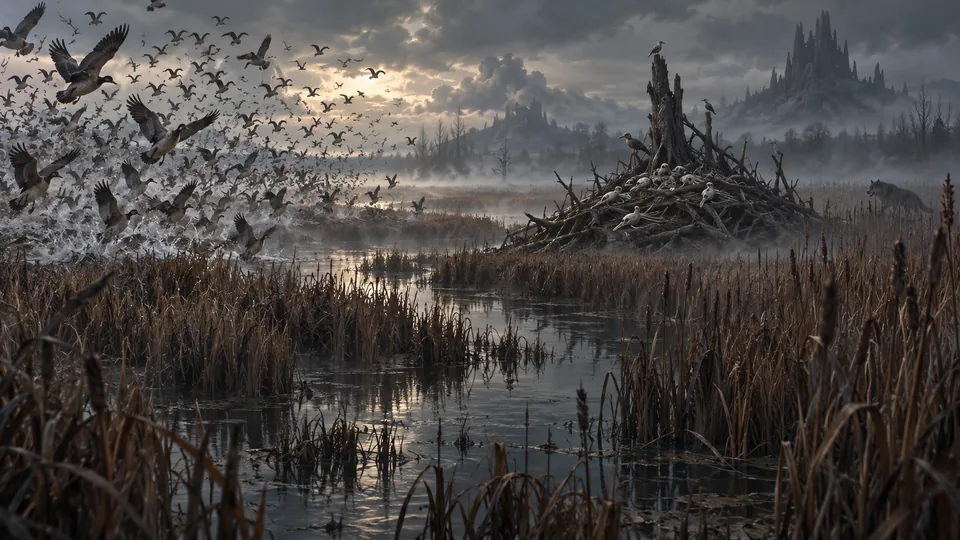
The fens belong to the Roost, a settlement that lives off what the water leaves behind and what the Hush Trade does not write down. Vrenna Delnmark runs it, Fenna Hidewright keeps its hide-ledger and Kessin Fenwarden watches the channels. Nearly everything here is a side story, and nearly all of it is about one skill: knowing where not to be.
The Birds Read First
Kessin, at the channel watch, teaches the fen in three lessons. In What the Gulls Say you read the bleaching bank: Bone bleached white means a throsseld fed there and left. Bone that is not bleached means it fed there recently.
Turning the scatter over, you find the fresh pieces all lie at the water end, where the resident keeps its own station.
Stay Small, Stay Quiet is about leaving no trace. You gather rough hide and kill six strand scavvers, working the ground so it looks as if the gulls have been at it and nothing else. Somebody out there counts what we take. As long as what they count looks like weather, we are weather.
The last lesson, The Station It Keeps, shows you the one stretch of water the whole method exists to steer around, the thross-water. The channel is silent, with no warblers, no frogs and the reeds along one bank flattened in a long arc. You read the resident's turn without entering it. Everything else I teach is a way of not being here. This is here.
The Water We Steer Around follows on: you mark the deep channel properly, thirty paces before the danger starts, for the next hand who cannot read birds. That is not a kindness. A hand who drowns out there teaches the whole Roost's route to whoever comes looking for them.
The Eel Run
Vrenna's first job for newcomers is fishing. In The Eel Run you bring back four eels from the charted cut and survey the eel channel. The eels are better one channel over. So is everything else out there, which is why the charted cut is where I send people I intend to see again.
It teaches you harvesting. Past the Safer Channels takes you closer to a marked station for three fen catch, and it only works if you have done the bird-read first. Read first, fish second. Anybody who does it the other way gets one good haul and a story about how quiet it was.
The same fishing runs through several smaller jobs. Reading the Reeds is the lesson itself, given once: reed-warblers quiet in a band means thross-water within a pole's throw. At the drowned stakes the birds are loud the whole way, and the stake-line is a closed pen, so whoever worked this bank was holding things alive. The Slow Stretch sends you to the slack water well back from the stations, the only place Vrenna would fish without watching the reeds, and A Pole and a Basket is the camp's posted offer of eels by the basket from the one cut that always pays.
Thross-Water
In Thross-Water two of Vrenna's people are stranded on the wrong side of the quiet water on the Tinder Flats, and neither is steady. One is shaking too hard to set a pole. You take the lead, call each footing back to them and bring them across behind your pole line. A steady hand is the rarest thing out here and the second rarest is somebody willing to stand in for one.
The sequel, The Narrow Season, comes in breeding time, when the routes narrow to almost nothing. You mark a narrower return through the eel channel and bring a full crew home one person at a time. That is the season, and this is the year it did not cost us anybody.
The Overreach
A posted note at the trapline camp advertises a salvager's lookout of wreck-timber, and the view is worth the climb exactly once. In The View Is Worth the Climb you go up the driftwood stand and see the channels clear to the far bank, with the poled ones darker than the rest, and a notch cut in the rail that puts you on one gap in the far bank. Then a second note, in a different hand, warns that a squatter has taken the stand. The Company at the Top ends with you killing the elite Overreach, a lone human, and finding the hoard behind the rail: sorted fittings, tally scraps and a salvager's glass fixed on the far bank. The Read-and-Left Glass comes out of it.
Vrenna wants to know what the Overreach took. In Past What Toleration Covers you walk the stand and the bleaching bank and count what is left: the sorting marks on the rail tally far more kill-sites than any hand's margin, and the bank is picked down to the stakes. The arrangement covers scavenging, not taking every kill-site before my crews reach it. Now the Roost stays small until it grows back.
Fenna's Ledger
Fenna gives the Roost its trade. What the Gulls Left asks for four hides off sites the gulls have already stripped, and she becomes a vendor. Nothing goes to waste in a fen. Not because anybody is thrifty. Because if you leave it, something else eats it and then that something is nearer.
Margin Remedies brings five marsh herbs and opens alchemy. Everything out here that cuts you also grows the thing that stops it. The fen is not hostile. It is indifferent, which is better and worse.
Dry Stores wants four bundles of sun-bleached reed, since every fire on the Roost was carried in on somebody's back, and Bone and Scrap sends you to the drowned stakes, where one piece of jaw has bleached all the way through and is not a bird's.
The ledger runs in both directions. The Packwright's Order takes goods to Thalva, who asks nothing about where they came off. A Second Tally hands the Roost's count to Halvreth, so that the Roost's count and Brekva's now disagree in writing. A Word for Vrenveld is a spoken check-in with Brendorn Vrenveld, who asks two things no sheet would have prompted, both about people rather than counts. A Quiet Word for Aluvi answers three straight questions from Aluvi, which Fenna says is rare enough to be worth doing.
The longest of these is the pair with Brekva. In Word Back to Brekva you return the Roost's reply to a message Brekva would not explain. She turns the fold over, reads the mark on it, and for the only time you have watched her writes nothing down. Then it held. Tell Fenna the debt sits on my side of the ledger now.
A Return Tally then carries the written half: numbers, which agree with the words. Words are how you find out whether somebody will deal with you. Numbers are how you find out whether they can.
What the Roost Owes
In What the Roost Owes you sit and hear Vrenna out, and she tells it once: the crossing owed to Halvreth, the silence owed to Vrenveld, and the bird-read, taught to her by a woman who died on thross-water eleven years ago. Fenna closes the hide-ledger afterwards and marks the debt heard, not retold.
The silence is the subject of No Manifest, No Questions: you carry a parcel to Vrenveld at the customs shed with no manifest and no name on it. Vrenveld and I have never met. We have had a working relationship for four years. Both of those are true and I would like them to stay true.
The Quiet Drop-Off is the same shape from the other side, an unsigned bundle left on a post for the docks, and nothing comes back but the absence of a problem.
Then Vrenna reaches towards the Hollow. In Roost to Hollow you carry a written word to Gremnir, who keeps the Hearth and has never traded a word in writing with the Roost. He reads it standing, twice, and tucks it inside his coat. First written word between that Roost and this hearth in my lifetime. Tell her the Hollow will answer in kind.
His answer, in Gremnir's Second Word, is that Vrenna must come herself and ask at the Outwatch. A welcome that belongs to a person stops being one the moment anybody can carry it.
The Roost's own buyer asks to see it in A Buyer's Safe Crossing. Thalva wants to see the hidebank and the guarded margins behind the goods she sells, and you walk her in and out again, the harder half. A buyer who has stood on the ground pays differently. One who stood there too long would ask differently as well, so I am glad you brought me home.
Smaller Errands
The Marker Keeps Itself has you re-lash the shelter at the reach stone with four lengths of reed cordage before the wet season, and The Hand-Off Nobody Keeps uses that same stone for goods the Roost would rather the Trade found on its own doorstep. Left at the Stone leaves Bent Scrap and Rough Hide under it, and by the next crossing it is gone and nothing is left in its place. What Doesn't Go in the Ledger salvages a kill-site on the slack water that the throsseld is finished with, and opens salvage as a trade. That is the entire margin this Roost lives on: the gap between what the water leaves and what anybody writes down.
Half the Scavenger's Work gathers the scrap a gull-picked strip leaves along the cut, and Tinder Before the Wet cuts dry reed for every hearth in the Roost. Who Camps in the Cut Reed clears out a slinger sleeping in the drying stands and burning the Roost's cut, which is theft of a season rather than of a thing.
Krelthnael
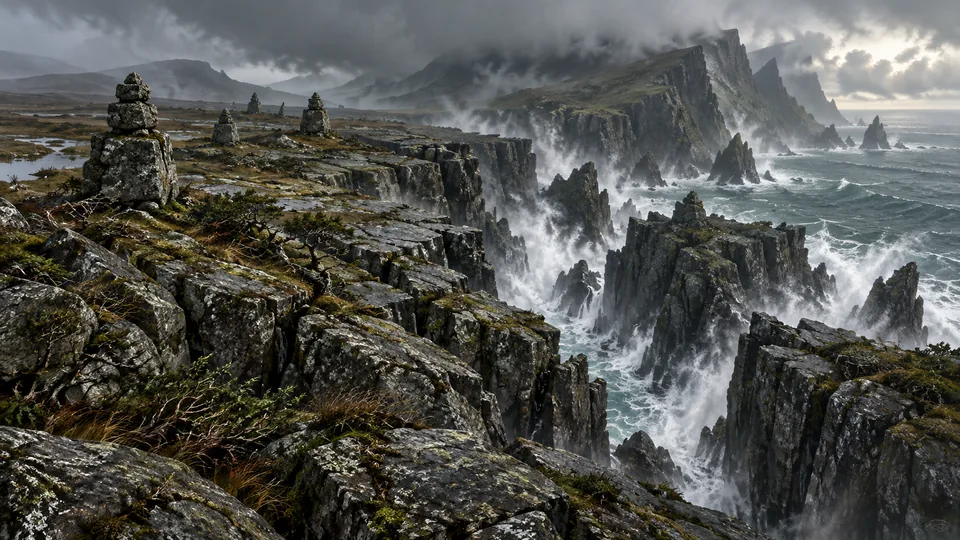
Krelthnael is a fogbound scarp where rock will not hold a stack, so the crews chalk the faces instead. The main path here runs through Fenkathr Voskresketh's three chalk marks, the fourth mark cut past the end of anyone's contract, the bearing given to Kaldrin at the Farwatch, and the Cleftwing on the lip of the Greatcleft. The side stories fill in the crossing and the people who work it.
The Far Crossing
Fenkathr is a guide who walks crews across the boundary. In The Scarp Line he walks a pack across the boundary to a crew that is waiting and tells you to watch the fallen waymark, not him. At the far end he checks the mark before he checks you. You watched the stone. Most people watch me, and then neither of us knows where we were.
The Ledger Holds repeats the crossing in thicker fog. The road does not change, and what it takes out of you does, and only one of those gets written down.
Once you have walked it, he trusts you with more. The Scarp Tally carries his own count to Brekva, who sets it beside hers and finds they differ by four crossings. Two counts that agree are one count written twice. Now I know which four to ask about.
The Shelf Exchange carries a packet between him and Vrensveth, who holds the shelf, so neither has to leave his ground. Feathers for the Crossing wants doves from the ledges, feather and meat, since a crossing is paid for in what a crew eats. The Nest Above the Path kills a scarred hen, the Wind-Rider, who has begun diving the path itself. A bird that has been hit once and comes back is doing arithmetic.
The chain's quiet end comes in two parts. A Precise Kind of Quiet sends you to stand at the fallen waymark until the surf shuts off like a door thirty paces past the stub, and then to ask why he is here. He answers once: I am on this scarp because I asked to be. Down there a man with my ledger gets a desk and a queue.
The Season Closes comes after the fourth mark is found. You carry his written count down to Brendorn Vrenveld, who signs the closure. He stayed on the scarp until the account closed, which the account will not say anywhere.
The Nesting Cracks
Kaldrin runs the scarp picket and keeps a roster of who is out there. In A Territory Held Longer he marks the faces where a flock has held its ground longer than any sweep crew has held anything on this coast. There is no beating that. There is only working around it, and now the working-around is written down.
In Near the Nesting Cracks he wants wing-feathers whole, which means lingering by the cracks until the startle becomes a fight, and lingering anyway. That is the difference between a feather worth having and a feather.
Past the Return Window
One name on Kaldrin's roster is a scout who never came back down. In Past the Return Window you hunt the Unmandated, who holds a lean-to below the Farwatch against every crew that approaches. Kaldrin strikes the name afterwards. Aldorn Ornsen. Whatever kept him up there past his window, he was barring our crews from their own road. You ended the standoff he chose.
On the main path Fenkathr had already compared whoever cut the fourth mark to Aldorn Ornsen, the scout who never came back down. The quest raises your standing with the Hush Trade.
The Waypost and the Chalk Relay
Torvek Stockward runs the waypost and wants no more lost loads. In The Shelf, Sighted you walk the path to the shelf before he risks a consignment, and he becomes a vendor. I have lost one load to somebody's opinion that a path was fine. Never twice.
Past the Tame Gathering sends you into the tide gullies for meat and feathers, where the tide still climbs at the high mark, and What the Tide Wedges finds that rope-carrying slingers without a permit have been emptying the easy cracks before anyone. A Plain Account gives Vrenveld the scarp crossings in words, step by step, instead of on a sheet. Paper is slower, and it never answers.
The chalk relay and the picket carry unsigned notes from crews who never meet. They set the relay's own sums in order. Tide Windows, Charted reads the tide off the wet line on the rock and finds the pools drain in a fixed order, outer first and the deep one last. The Bearing Back sights the second cairn from the marsh cairn, to the pace. Fixed Against the Port carries the scarp benchmark all the way to the quay, so the chain of trust becomes one measurement. Stones for the Stack takes dressed stone down to the marsh cairn, where mud will hold a stack and rock will not. The Cairn Kept puts the slumping stack back up straight and The Cairn-Fire Catch fills a pot on a lit fire for the next crew. Warm Before the Push lights a laid fire so the next crew comes off the crossing into warmth.
The rest go to Krelthnael's listeners. Thinning on the Wing tells Aluvi, not the Trade, that the birds are fewer than last season. What the Wind Carries takes her half a set of wind and spray readings from exposed rock, and Word Ahead of the Ledger tells Brekva a shipment is running light a week before the paper will. The Windbreak Cull thins the raptors at the windbreak, and A Mark for the Port pins a requisition on the customs board, the only way a scarp run ever gets more crates.
Skarnmar
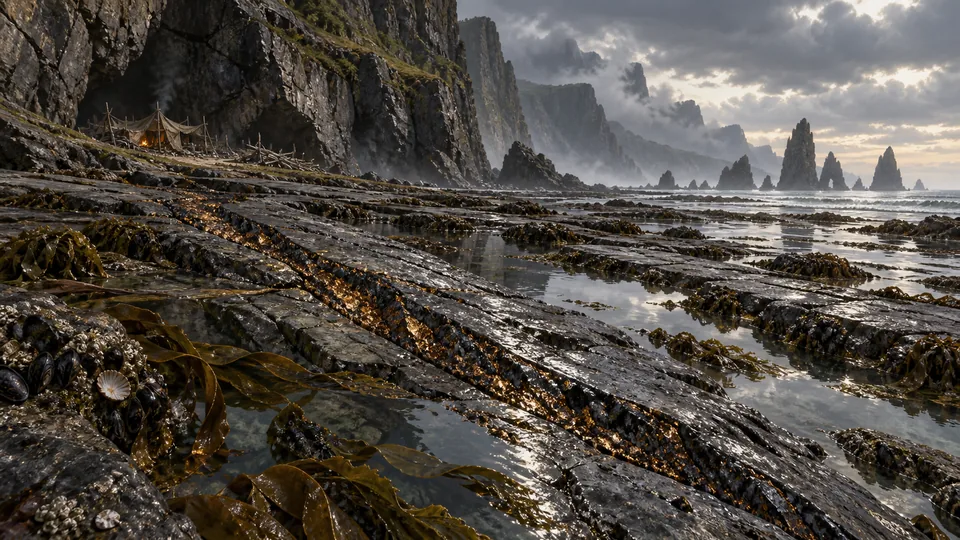
Skarnmar is a working shelf under a cliff: ore seam, tide pools and a lot of people with schedules. Skarn for the cliff, mar for the edge,
says Gremveth, who keeps the stair. Vrensveth Dreskorn holds the shelf, Fenkorva Chalkwright the landward camp, and Kreskava Fenmend the Road Hearth. Nearly every errand turns on the tide. The healer's story that begins with Kreskava is told under The Landing Shore, and her middle steps here, The Shelf Medic and Marsh Stores, only deepen it: at the ebb the crews come up with split palms and barnacle-cut shins and walk to her without being told, and the six herbs go on her shelf as part of her weighing whether to move to the port or stay.
The Crab Flats and the Lower Low
Vrensveth's first jobs show you what the shelf gives. In The Crab Flats you bring back crabs twice the cove's size. The seam warms the rock and the rock warms the mud. Everything on this shelf is downstream of the ore, including the crabs.
The Far Flats takes three from a bed uncovered for barely an hour. Three is plenty and three is all you will get.
Low-Water Haul is the ore equivalent: eight pieces, stopping when the water starts back. At the ebb line the pools fill from the seaward edge well before the open water looks higher, and that first creep is the only warning the shelf gives. The Lower Low goes deeper, to the deep notch on an unusually low tide, and you take only four. A crew that takes eight on a tide like that is a crew that loses somebody on the next one.
The back wall tells you more than the tallies do: the seam runs on past the claim-jumper's cuts, and the surge-throat behind it floods on a count of its own.
The Last Claim
Gremveth sends you to count the shelf pools from the scarp eye in The Tally Taken From Above. Counting pools from inside the pools is how a crew convinces itself the shelf is richer than it is.
He warns you that when the notch floods, something comes up out of it. The Last Claim puts you on that: you kill the claim-jumper that came up as far as the perch, and Gremveth writes the patrol timing into the stair's log. That was the only warning a climber got, and now it is written down instead of being learned.
What It Costs Instead
The shelf has jumpers, crews with no window and no shed to ask. In A Wide Berth Costs Less you count their camp and do not touch it. Going round costs less than the fight would. I still want the number, because the day the number changes, so does the arithmetic.
Shelf-Jumpers kills four who came at low water for the same reason the shelf crews do, and Between Raids searches their lean-tos while they are out: half of what is stacked came off this crew's own hauls and half off somebody else's, so the shelf is not the only place worked this way. What It Costs Instead ends it with a harder choice. The jumpers are back within a season, on word of mouth. So somebody has decided we are paying the other price. I have decided the same thing. That does not mean either of us likes the sum.
The Shelf's Books
Vrensveth has a standing worry about what the shed thinks it is owed. A Word for the Tide-Window carries his petition so the shed renews the window before the deadline, not after. A clerk with a rule is the easiest thing on this coast to satisfy.
In An Honest Tally you walk loads off the seam yourself and find the shed's book two loads over the shelf's, and he writes the difference down rather than arguing it; it raises your standing with the Hush Trade. The Honest Copy brings Brekva the fair copy and A Report for Vrenveld tells Brendorn the whole thing from your own mouth after two papers said the same. A petition can be filed. A set of numbers can be doubted. Somebody standing in front of me is harder to put in a drawer.
A Fair Word for Borrek tells Borrek his crew's share was weighed fairly. A share is one haul. A weigher who is fair is every haul after it.
The Far Crew
The ore dig on the other side of the shelf is run by Dreneth Thralkorn. In The Far Crew you carry a note from the shelf and he answers it in his own hand. We share a passage and nothing else. That is exactly enough to be worth being polite about.
A Word with the Dig brings Fenkorva's introduction back, and Dreneth gives you two things he would not have put in writing: what the dig really clears at the pit-head and what it would take for shelf ore to undercut it. Selkorn Across the Shelf sees a traveller across the tideline with the window and not against it.
Smaller Errands
Fenkorva sets the camp's own jobs. Drevarn Supplies takes a run to Kreskava and reads the deep notch on the way: a sea-cave somebody made deeper, its dig-marks old and its back under water even at the low. Slinger Watch thins three slingers, The Dense Cut Below brings three of the dense ore and The Deepest Pools, Left Alone sends you fishing only the edges. The deep pools are what puts fish back in the edges.
Where the Tide Turns Fast re-chalks the shallows. Chalk to the Shelf puts the first chalked faces on the shelf, above the wet line, and The Relay, Checked re-cuts the relay marks. Spare Chalk, North carries chalk to Fenkathr, who calls it a debt paid early.
Gremveth keeps the stair. Raptors on the Face clears enough of them, not all, clearing all of them is a story,
and Skarn for the Cliff has you stand under the cliff once and bring back what the tide stripped. Kreskava's errands are for the Road Hearth: Never Just One Thing (crabs and ore in the same window), Pot Before the Turn (the pot filled so the wet crew stops huddling round empty cups), and The Band That Breaks Surface (a wide band two crews could work at once, so somebody will fight over it). The remaining jobs for Vrensveth are Hauling the Common Cut, The Seam, Worked Back, Tide-Pool Tally, and Loose Stone Toll, which is paid in coin under the same rock the note was.
Stolkeld

Stolkeld is a headland dig that answers to nobody. Dreneth Thralkorn runs the mine, Borrek the shoring camp, Fenneth Scalewright the scale camp and Torvenn Ridgehand the ridgewatch. Every story here concerns the same question: what keeps a dig without a charter alive.
No Charter, No Muscle
Torvenn begins with a count. In Where the Fights Are you survey the Switchback and find three groups, mixed hands and lookouts, sharing one toll-ground. No charter watching this dig means no muscle riding its ore off the headland, and they worked that out before we did.
No Charter, No Muscle takes the toll apart: the rope gate, the lookout perch and three levy stakes come down together. Dreneth's crew, Selkorn, Borrek, all three were paying that corner in distance. The hands may come back. The toll they built does not.
The Deep Gallery
Selkorn crawls the seams alone. In The Deep Gallery he calls stress marks from the narrow cut and you chalk each exactly where he says it, copying his last three measurements against the squared timber without reconciling them. Read back, three of the calls contradict each other, and he nods. Rock does. A read that agrees with itself everywhere is a read somebody smoothed.
In Driving the Gallery Dreneth risks it: you drive the hard vein, take twelve loads and are out before the shift ends. That is two things I now know about Selkorn and only one of them is about rock.
The gallery sets other errands going. Bracing the New Face sets the first braces on the new face before anyone works under it, and The Deepened Face lays the face-read beside the scree-read: both moved a hand's width in the same season. Everything on this headland is one slope with a hole in it.
The Crawler's Own Account gets Selkorn's explanation in nine words, Alone is quieter. Quiet is how you hear rock,
and The Scarp's Own Word sets his read beside the scarp's drier, harder rock. Seeing the Crawler Off walks him as far as the ridge, which nobody has done before.
The Steadier Channel
In No Ledger to Answer To a stranger turns up at the Scale Camp with hide and salvage laid out beside the weights and a fair count of each. Nothing is hidden, but none of it says where he will sleep tomorrow. Dreneth lets him take a surface shift. A man who answers to no ledger is either the best hand you will ever hire or the reason your ore stops arriving.
The Formal Word takes the dig's manifest to Brendorn Vrenveld, who files it as an overflow and not a claim. Out through a manifest instead of out through nobody. Which is the difference between a dig and a rumour.
It raises your standing with the Hush Trade.
Trust is the price. Trusted at Stolkeld has Dreneth tell you plainly that a Skenveld crew crossed the passage two seasons back, asked to buy the dig and was told no by a man with no charter to protect him. They will come again. I would rather you heard why from me than from them.
He becomes a vendor.
The Two Camps
Stolkeld shares its passage with the shelf at Skarnmar. The Word Goes Over crosses to Vrensveth and back inside a day, a relationship and not a courtesy. A Second Opinion for Skarnmar sets the dig's read against his wet rock, and he agrees with three parts in four. The fourth is where their seam goes under and ours comes up.
A Second Set of Hands is a notice carried across by somebody crossing anyway, and Neither Crew Answers restocks the shared low camp. The Fire Never Quite Out finds the ash there layered without a break and a tally of nights in more hands than either dig has crew. Somebody else is using the camp too.
Borrek's errands are the quiet ones. Another Pair of Hands sets six props in one shift, nobody under a loose roof tonight,
A Hand Not Wasted asks about the crew, not the ore, and A Name for Kreskava brings a racked wrist to Kreskava. Props for the Face and Stone for the Forge are supply runs. Dreneth sets the ore work: Hauling Common Ore, The Dense Seam Cut at twice the price and weight, The Harder Vein, Shore the Adit (That is how a dig kills people
) and The Forgotten Pocket's Echo. Spare Oil for the Lamps is six hides for lamp oil.
The Squatter in the Old Seam
Fenneth's The Squatter in the Old Seam finds fresh spoil and boot-cuts running from the Broken Crest into the sealed workings, a Holdfast squatter, and you put him down. Whoever it was, the seam is quiet now.
Her other errands are Ore for the Ledger, which gets a sample onto Brekva's own line, and Ore-Word to the Scarp, which puts the vein read into Fenkathr's ledger. Torvenn's are The One Door Out and The Roster Straight, where the roster and the traffic disagree by two names: somebody is on this headland who is not on the roster.
Drelthdren
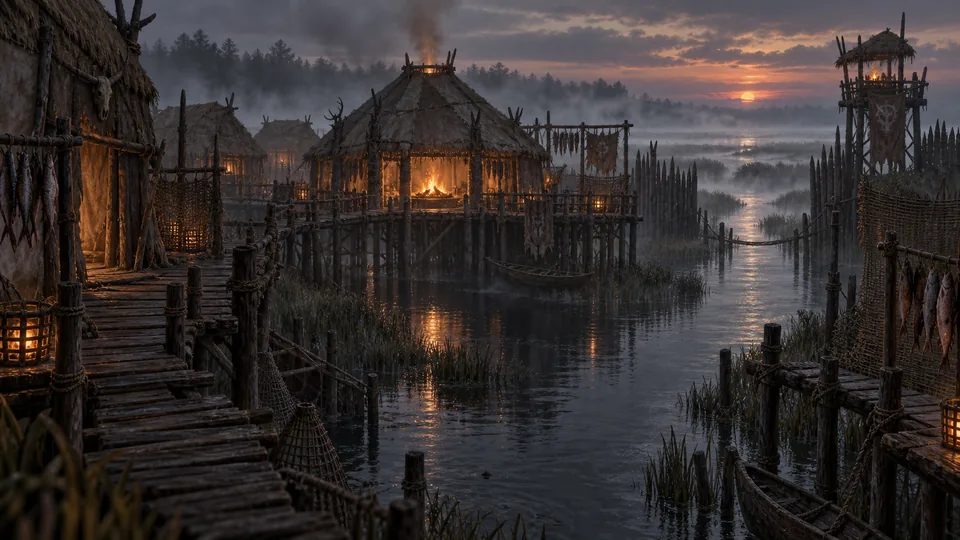
Drelthdren is a hold hidden by the shape of its own bank, home of the Adapted. Gremnir Skorsen keeps the Hearth, Kelnora Reedmend the mend stake and Holvren the channel. It has no main-story quest. Its stories are about whether a place that lives by not being seen can stay that way.
The Walk In
Brekva sends you to the fen gate in The Walk In, and everything else in the hold opens from it. Gremnir does not look back once on the way, and at the hearth he says only: You did not mark it. Good. A path anyone can follow is a path everyone follows, and then it is not a hold, it is an address.
After that, Gremnir and Kelnora give you small jobs: A Fire Not Wasted, fuel carried in from outside, since everything this hearth burns comes in on somebody's back, and the Trade calls us Drethmark. At this fire we are Drethkin.
Restaking the Platforms ties six lengths, everything you are standing on is knots,
and Line and Peg resets the far peg. Tending the Watch has you stand three turns at the Outwatch without anyone naming you lookout, and Coast-Folk Trade Goods pairs a delivery with a read of the sunken bend. Both raise your standing with the Adapted.
Iron Nobody Smelts
In The Stain in the Silt you go to the Deep Hollow and bring up a handful: iron, dense and cold, in water the hold has watched run rust-red since before Gremnir's grandmother. In Iron Nobody Smelts he sends you back to take only a little. A crew would have taken all of it and then we would have had to explain to somebody why our water changed.
The iron lies just under the silt, untouched, where generations have chosen to leave it. What the Hearth Keeps explains the rest: the hold keeps one fire because a hold with two fires is two holds, and the water under that fire is a shared thing nobody owns and nobody has dug.
The Narrowing Channel
Kelnora has noticed that what hides the hold is changing. In The Bank That Hides It you survey the hearth bank, which is high, soft and undercut and losing a hand's width a season, and then the Deep Hollow, where the same shape has already gone. What hides us is the shape of the ground, and the shape of the ground is changing.
The Narrowing Throat measures the pinch: If it narrows another hand's width the hold is a place you carry things into, not one you pole into.
Does the Arrangement Hold asks Vrenna whether the Roost's arrangement survives that, and she names the sinking channel herself before you can, so the Roost had already seen it. An arrangement that cannot survive the ground moving was never an arrangement, it was a season.
The Watch That Vouches
In The Uninvited Approaches you watch from the Outwatch as a lone figure drifts up the throat without turning towards the Hearth, which the hold calls the Uninvited. Not invited, then. That is the whole of what the Outwatch is for: not to stop anything, only to be the reason nothing arrives unannounced.
In A Second Set of Eyes Gremnir sends you to walk Brekva in. She arrives rather than merely setting out, and is surprised. The Adapted sent somebody to walk me in. They have never done that.
Three more errands grow from that: News Off the Circuit finds the road-note she left under the Outwatch rail, half of it not for the ledger; The Tally Off the Throat brings her the hold's count at last; and What the Throat Keeps Fed supplies whoever stands the watch.
Brendorn Vrenveld is handled with care. A Notice for the Cell tells him, as a courtesy and not an arrangement. In The Cell-Master's Answer he replies in one sentence: The Hearth may hold its channel, provided the Outwatch keeps reporting through my roster.
Kelnora hears it twice. He put the condition last. A man who means a condition puts it first.
What the Channel Keeps
Holvren has found things that were here first. In The Half-Sunk Dugout you find a boat wedged in the sunken bend, older than the hold, with its fittings still on the thwarts and the stern stove in from the inside. Somebody sank their own boat rather than leave it afloat for whoever came next. Who Poles the Worse Channels finds a drowned camp with six sleeping places: three carry scraped-off Roost marks, three belong to hired muscle. Drifters have nothing. That camp has gear, and the gear is Roost-pattern with the marks off it.
The Marks in the Reeds follows pressed marks, a body's width at intervals and always in one direction, and traces the route and the stride to the Uninvited. We tolerate what keeps its distance.
The Drowned Stakes clears squatters' lean-tos off old stakes set before the Roost existed, and What the Drifter Carried In lays out what a squatter dropped in the silt, none of it coast work.
Smaller Errands
The hold and the Roost now speak. Roost to Hollow began it, and Word Back to the Roost returns Kelnora's answer the same day. They spoke to us first. Making them speak twice would have been an answer of its own.
A Line to the Fixer carries the one line that does not run through the Trade.
The hold also talks to Aluvi. The Cairn's Own Account gets her to say her account of the cairn aloud, and the spoken version carries a clause the written one does not: the hand that signed the sweep complete is not one she recognises. A Fragment Carried Back brings her a piece of reed-work. They do not pay for a kindness,
you say. No. They answer one.
The Hearth Answers in Kind invites her in: you walk the route to the Hearth once more and fix it for her, channel by channel.
Dailies of the hold: A Crossing Broken in Two (nobody poles Hearth-to-Roost in one go), A Fire Never Quite Out (the shelter fire is never out and nobody admits to tending it), Salt Against the Damp, The Perch Between Rounds, The Second Place Word Travels (all word goes through the perch first), and the trapline set: The Tended Lines, What the Warrens Owe, The Margin After and What the Marsh Wears Down. A warren nobody works swells and then collapses and then there is no warren.