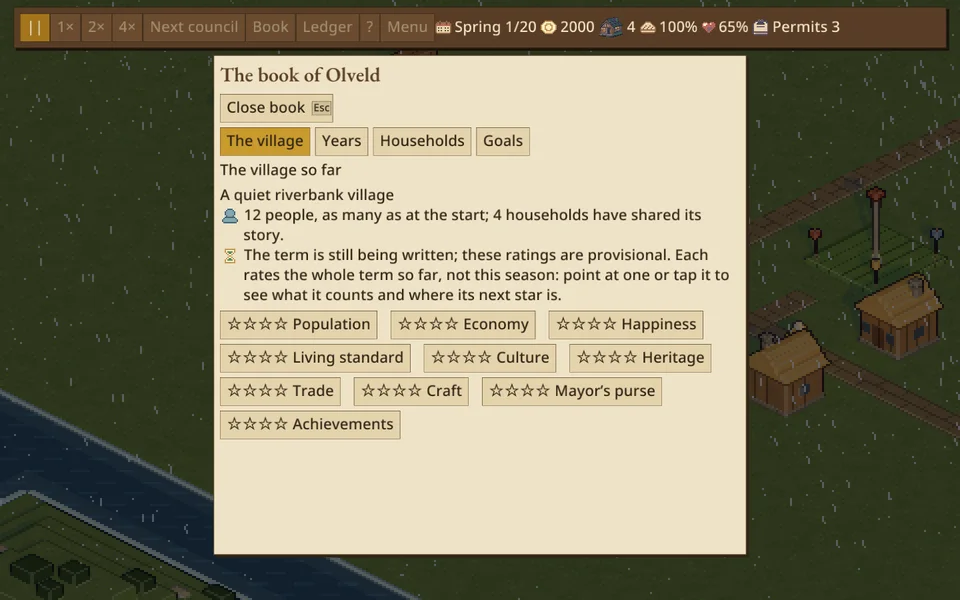
A term is twenty years of four seasons. Time runs on its own at the speed you set (one season takes 90 seconds at 1×) and stops at every council. Everything below is what the game itself shows; the codex lists every building, plan, event and goal with its numbers.
The council
At the start of each season the council offers a hand of plans: four, plus one for each cultural building that adds to the hand. Each card is a family or guild asking to build one trade. It shows who asks and pays, what the trade provides and how many jobs it opens, and its site rules. A green ✓ means a rule is met now; a red ✗ means it is not yet, with the count so far. Choose one with a click or its number key. A plan whose rules cannot be met yet asks again before you take it (Y takes it anyway).
The plan you take waits in Build › Plans. It lapses unbuilt after 4 seasons; the chapel lengthens that. Plans cost the treasury nothing: their patrons pay. Plans for stronger trades are dealt from later years of the term, one new set every five years.
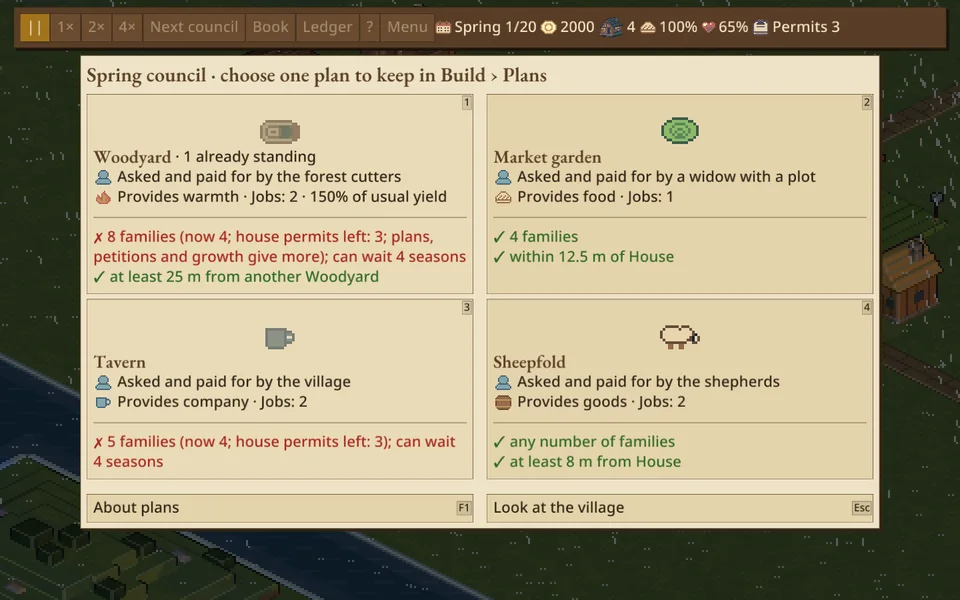
The line above the cards says how this season's needs stand without the plans on offer, and which of them would raise a need that is short. From autumn it also warns how the coming winter will go.
Building
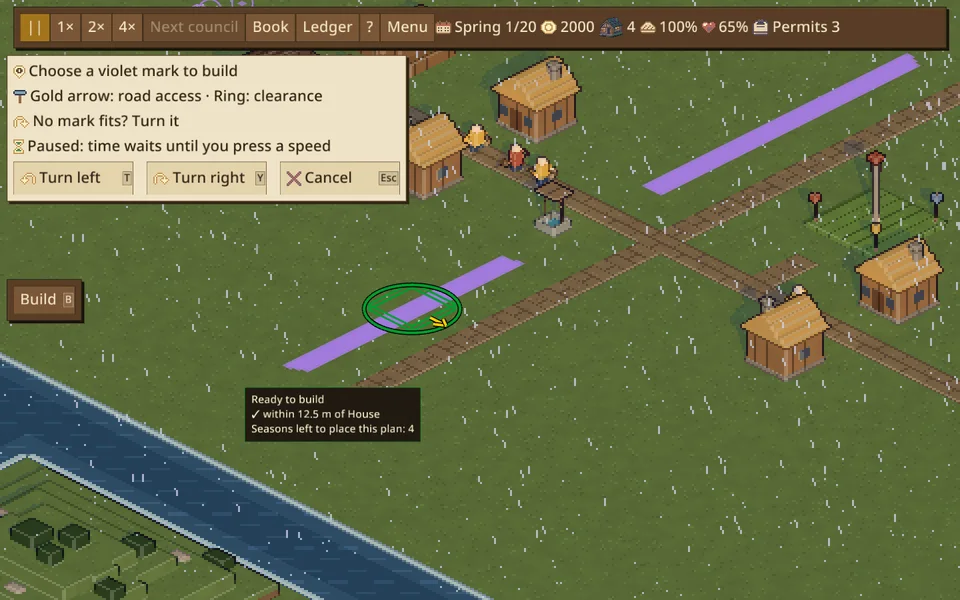
Houses use a house permit instead of pennies. Roads cost 20 pennies a piece and channels 60. Public buildings are paid from the treasury when you place them and then cost upkeep every season. A site no builder has started yet, a house too, can be dragged to another spot for free. Clicking a building lets you move it (300 pennies) or pull it down; a ringed building is one whose removal would open land.
Needs and the needs ladder
Each family needs food and warmth, then goods, company and meaning. Trades sell these to the homes within their reach; the well adds company and the shrine, chapel, bell tower, festival ground and guild hall add meaning. In winter each person needs twice as much warmth, and many food trades make less. The top bar shows this season's food and warmth cover.
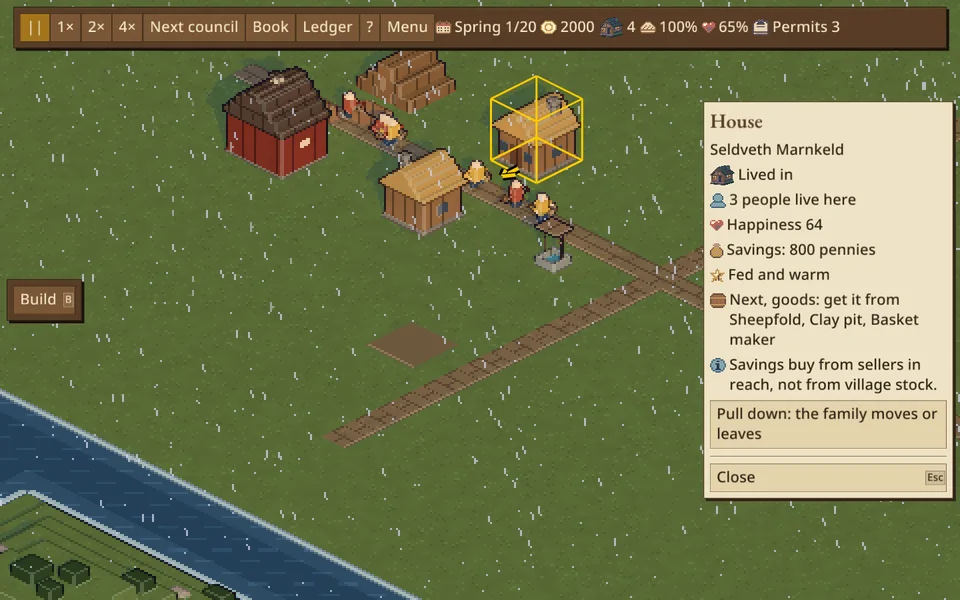
A family's place on the needs ladder is how many of these it has: Basic needs unmet, Fed and warm, Has goods, Has company, Has meaning. Click a house to see its rung, where it buys each need and what it is missing.
People, jobs and permits
Every house brings a family, and families grow up to five. People work in the trades; the council says when jobs stand empty or when every worker is busy. House permits come from plans, met petitions and a happy village: cultural buildings that draw settlers add one every few seasons.
Money
The treasury pays for roads, channels and public buildings. Taxes come in from families and trades each season, and public buildings take their upkeep. The Ledger (L) forecasts the season: sales, taxes, treasury, wages, workers and jobs, caravans, and how each need is covered.
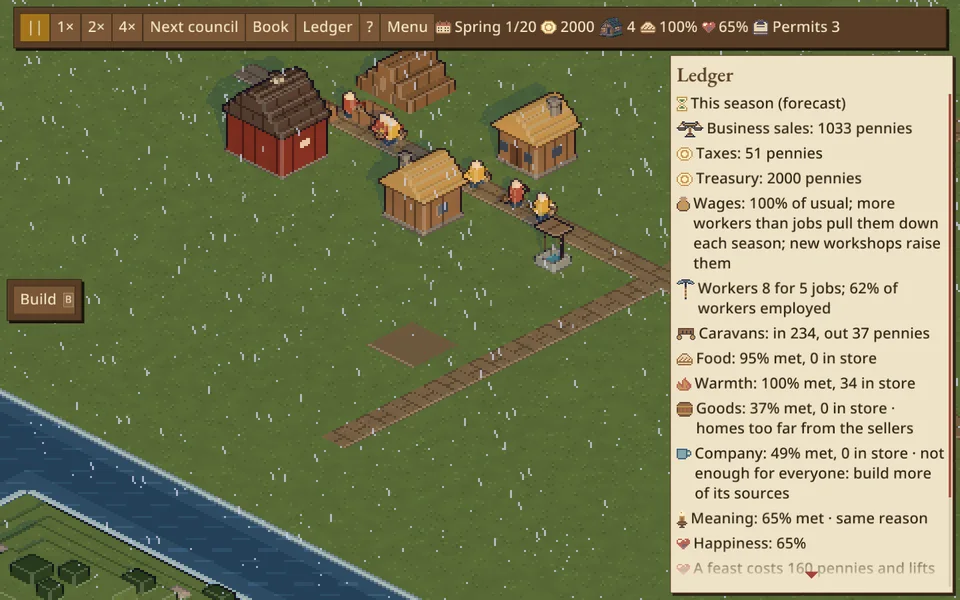
A feast costs 40 pennies per household and lifts every home's happiness by 7 until the end of the season; the village waits 8 seasons before the next.
Petitions
From time to time the village asks for one need to reach a share of homes by a date. Meeting it gives 600 pennies and a house permit. Only newly built sources count toward it; when you place a building, the game says whether it will stand in time and how far it moves the petition.
Events
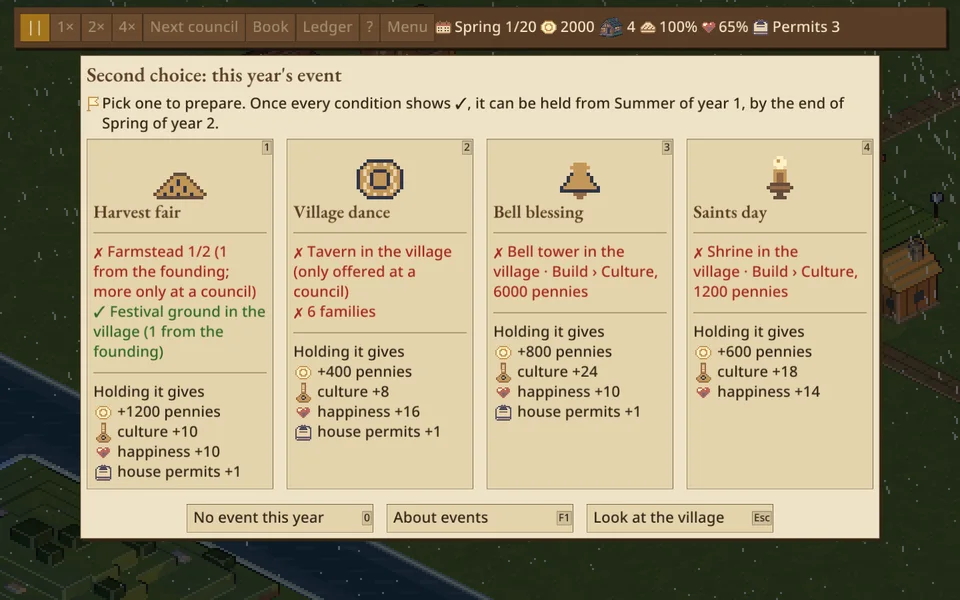
After the spring plan, the council offers a second choice: this year's event. One event is prepared at a time. Each needs certain buildings; crossed conditions can be met later. Once every condition shows ✓ and its window is open, press Hold the event (H) in Tasks. The events page lists all eight.
The year's review and the book
After each winter the review pauses play: how the winter went, happiness over the year, people, treasury, permits, culture, what was finished, the open petition and the stories of households that moved up or slipped down the ladder. Continue to spring (Enter) goes on.
The Book (K) keeps the village page with its ten rating boards, yearly pages, household stories and the goals. The ratings are provisional until the twentieth winter.